What Is a Roadster? Open Cabin, Roof and Cargo Explained
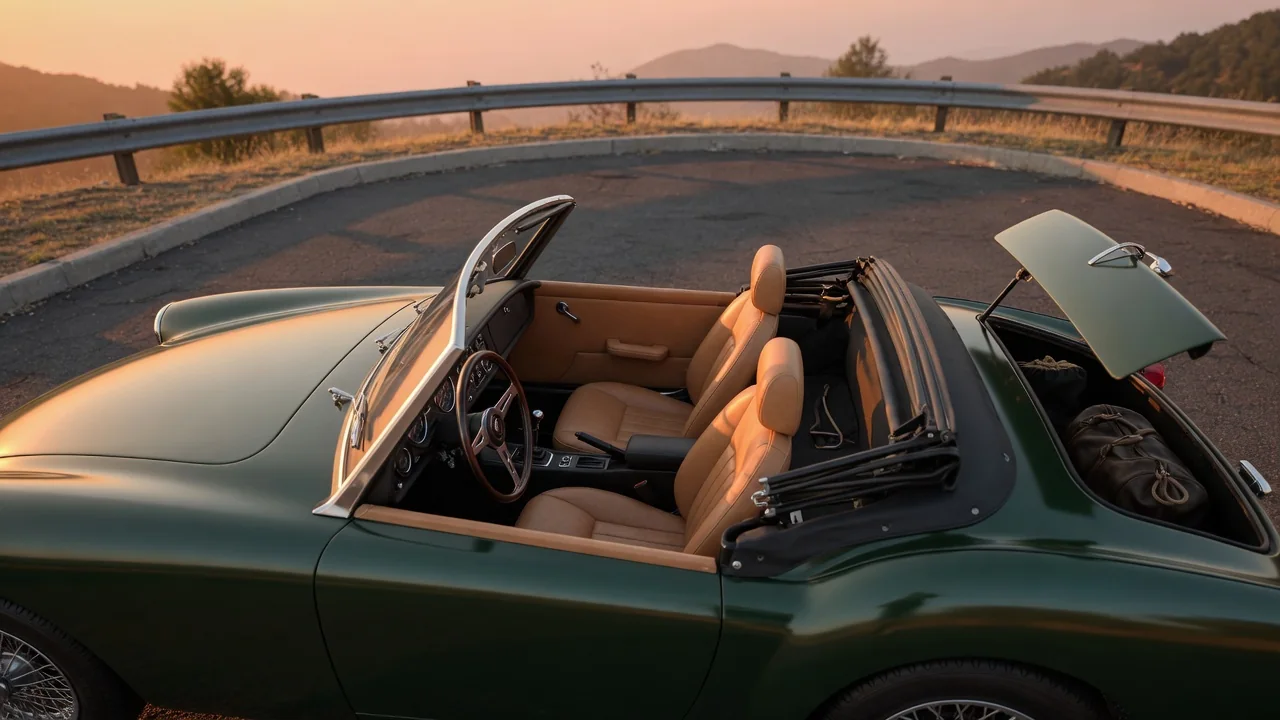
A roadster is a two-seat open car built for the experience of driving rather than for carrying people or luggage. In practical terms, it has a compact cabin for a driver and one passenger, a roof that folds away or comes off, and modest cargo space. Marketing uses the label loosely, so the roadster car type is best understood through these three traits rather than through a strict legal definition.
Open Cabin: Two Seats and the Open Air
The defining feature of a roadster is an open cockpit with two seats, usually side by side, and no rear seating. Classic roadsters seat the occupants low and close to the center of the car. The windshield and doors frame a cabin that feels more like an exposed cockpit than a room. This layout keeps the body short and the cabin small, which helps hold down weight and overall size. The two-seat format is a large part of what separates a roadster from a broader convertible, which may have a rear bench or small rear seats.
Because the cabin is meant to be driven open, its design priorities differ from those of a closed car. Seats, controls and gauges have to work in wind, sun and occasional rain, and interior materials are often chosen to tolerate more exposure than those of a sedan. A fixed roof normally helps hold the body rigid. Without one, engineers typically reinforce the floor, sills and windshield frame to restore stiffness, and many open cars add roll hoops or reinforced pillars for occupant protection. How this is done varies by vehicle, so the structure of any given car is described in its own documentation.
The meaning of the term has shifted over time. Early roadsters often had very basic weather protection, sometimes only side curtains instead of wind-up windows. Modern cars sold as roadsters generally have glass side windows, heating and other comforts, but they keep the two-seat open-cabin concept. Manufacturers use the words roadster, spider or spyder, and convertible with some overlap, so the name on a badge is not a precise technical category.
Roof: Soft Tops, Hardtops and How They Stow
A roadster's roof is designed to be lowered or removed. There are two broad approaches: soft tops and hard tops. A soft top is fabric or vinyl stretched over a folding frame of hinged bows. It can be operated by hand, which keeps weight and complexity low. It can also be raised and lowered at the press of a button by an electric or hydraulic mechanism. The rear window may be flexible plastic or glass, and the folding geometry determines where the stacked material sits when the roof is down.
Hard tops come in two forms. A removable hardtop is a rigid panel or shell that bolts or latches onto the body. It is typically fitted seasonally and stored off the car the rest of the time. A retractable hardtop is a set of rigid panels that a powered mechanism folds into a compartment behind the seats. Rigid roofs generally insulate better against noise and weather and resist tampering better. Soft tops are usually lighter and simpler to stow. Depending on the vehicle, a roadster may offer only a soft top, only a folding hardtop, or a choice of either.
Whatever the type, every roof relies on seals, latches and drainage paths to keep water out when it is closed. Powered roofs add motors, switches, sensors and sometimes hydraulic lines. Many will only operate under certain conditions, such as when the vehicle is stopped or moving slowly. Those conditions and the correct operating sequence vary by model and are listed in the owner's manual.
Cargo: What Fits in a Roadster
Limited cargo space is a direct consequence of the roadster formula. Two seats and a short body leave little room for luggage, and the roof itself needs somewhere to go when it is lowered. In a front-engine roadster the trunk sits behind the cabin, and the stowed roof frame or folding hardtop often occupies space directly above or in front of it. Retractable hardtops in particular tend to take up part of the trunk when stowed. Some cars use a divider or cargo cover that must be in place before the roof can be lowered.
Mid-engine and rear-engine designs divide storage differently, sometimes with one compartment at the front and a smaller one at the rear, each shaped around the mechanical layout. Inside the cabin, storage is usually limited to small bins, a glovebox if fitted, and perhaps a shelf or recess behind the seats. In an open cabin, loose items can blow around or get rained on. Packing for a roadster therefore favors soft bags that fit irregular spaces, and valuables belong in a lockable compartment rather than on a seat.
Practical Implications and Limits
Together, the open cabin, folding roof and small cargo areas shape how a roadster fits into everyday life. It cannot carry more than one passenger. Whether a child seat can go in the passenger position depends on whether the vehicle allows it and how its passenger airbag is managed, and only the owner's manual can confirm this. Shopping trips, airport runs and longer vacations require planning around trunk volume. If the roof stows into the trunk, the available space can also change depending on whether the top is up or down.
Weather and security call for realistic expectations. With the roof up, a soft top usually lets in more road and wind noise than a fixed steel roof and may insulate less well in cold or hot conditions. Fabric can be cut, so leaving items visible in a parked soft-top car is riskier than in a closed vehicle. Driving with the top down increases sun and wind exposure. With the top raised, rear visibility can be narrower than in a sedan because of the roof shape and window size.
Owning an open car also adds a few maintenance tasks. Fabric tops benefit from cleaning products made for the material, and plastic rear windows can scratch if wiped carelessly. Weatherstrips and drain channels need to stay clean so that water is guided away instead of into the cabin or trunk. Powered roofs depend on the condition of their motors, linkages and sensors, so unusual noises or incomplete cycles are worth investigating early. None of this makes a roadster impractical for everyone. It means the car type suits owners who value open-air driving enough to accept its compromises in space and comfort.