What Is a Targa Roof?
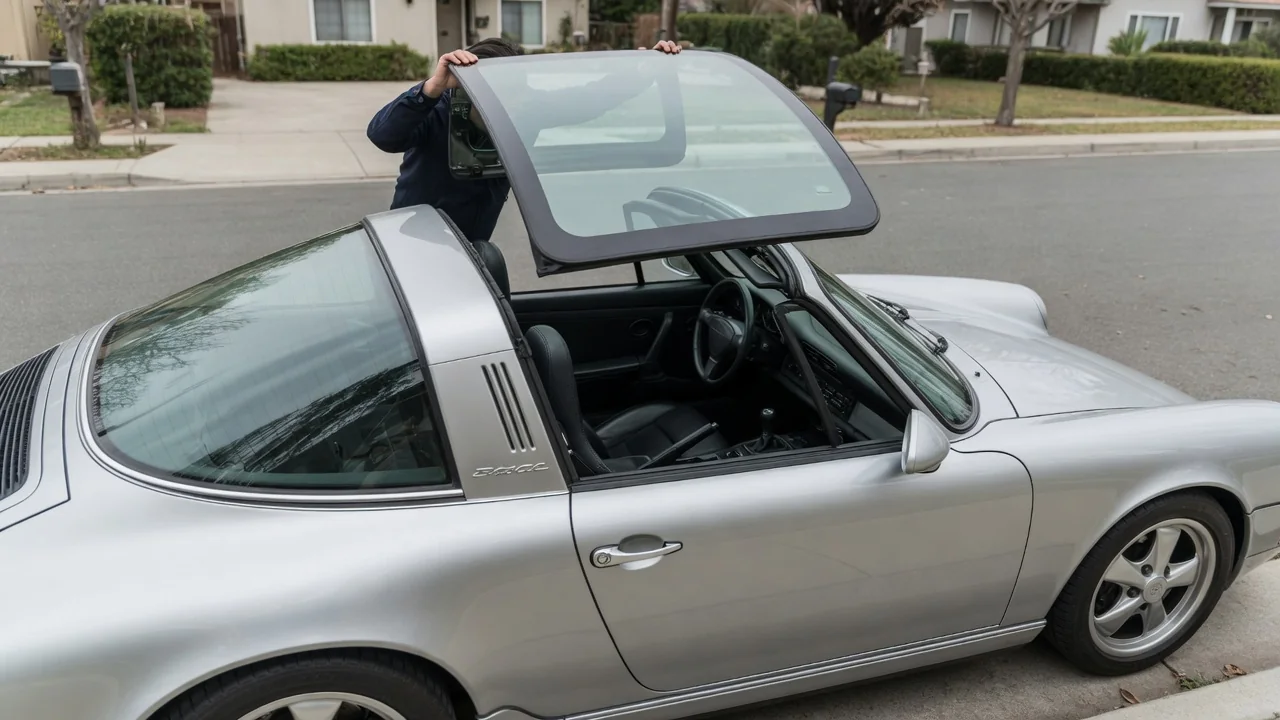
What is a targa roof? It is a semi-open body style in which a panel above the front seats lifts out or retracts, while a fixed bar or hoop behind the occupants and a rear window remain in place. The layout aims to combine open-air driving with more retained structure than a full convertible, though the details differ considerably between manufacturers and generations.
Roof sections
A targa layout usually divides the roof into three zones. The windshield header forms the front edge, a removable center panel spans the space above the driver and passenger, and a fixed roll hoop or wide rear pillar structure sits behind the seats. With the panel off, the header and hoop stay in place, so the car keeps a visible frame around the opening rather than the fully open profile of a conventional convertible.
The panel itself may be a single rigid piece made from painted metal, composite or tinted glass, or on some cars a folding fabric section stretched over a frame. Behind the hoop, the rear window can be fixed glass, a removable or zip-out plastic screen, or part of a powered mechanism that moves the whole rear section to stow the panel automatically. A related design, the T-top, keeps a central spine between two smaller panels, which is a different arrangement.
Storage and sealing
Once removed, a manual panel needs somewhere secure to travel. Many cars provide a dedicated spot in the front trunk, the rear cargo area or behind the seats, often with brackets, straps or a padded bag to stop the panel from sliding and scratching. Stowing it typically takes up luggage space, so a weekend trip with the roof off calls for some planning. Powered designs hide the panel under a rear deck instead, trading simplicity for motors, linkages and added weight.
Sealing depends on rubber weatherstrips where the panel meets the windshield header, the hoop and the tops of the frameless door glass. Latches or locating pins pull the panel down to compress those seals evenly. Because several surfaces meet at the upper corners of the side windows, that junction is a common place for wind noise or water to appear when seals harden, shrink or shift. Drain channels, where fitted, route water away and need to stay clear of leaves and dirt.
Ownership checks
Anyone assessing a targa-roofed car can learn a lot from a slow look at the panel and its surroundings. Check that the panel sits flush with the header and hoop, that gaps look even from side to side, and that latches engage firmly without excessive force. Seals should feel supple rather than cracked, flattened or torn. Damp carpet, water stains on the headliner or seat bolsters, and a musty smell point toward leaks that deserve further investigation.
It is worth removing and refitting the panel during an inspection, since worn latches, bent locating pins or a warped panel often show up only then. Confirm that any storage bag, tools or brackets supplied with the car are present, because missing pieces can make stowing the roof awkward. On powered systems, watch a complete open and close cycle and listen for straining or uneven movement. Warning lights or stored fault codes related to the roof are clues to interpret with vehicle-specific diagnosis, not proof that a particular component has failed.
Everyday Use and Observations
With the panel off, a targa tends to feel calmer than a full convertible at speed, because the hoop and rear glass limit how much air swirls into the cabin from behind. Some buffeting can still occur, and it changes with side window position and road speed, so drivers often experiment to find a comfortable setup. Certain cars include a small pop-up deflector on the header for the same reason. With the panel on, the cabin behaves much like a coupe.
Daily life with a manual panel involves a few habits. Removal is easier on some cars with two people, since a rigid panel can be bulky and easy to knock against paintwork. A sudden shower means stopping to refit it, so many owners keep the panel aboard rather than leaving it in the garage. Glass panels brighten the interior but can add heat in strong sun. Occasional creaks over rough roads often come from dry seals or latches needing adjustment rather than anything serious.
Limits and Next Steps
A targa roof does not deliver the fully open experience of a soft-top, because the hoop and rear window remain overhead and behind. It also should not be assumed to match a fixed-roof coupe for stiffness; the opening removes part of the structure, and engineers compensate in different ways with reinforcement that varies by model. The retained hoop may contribute to body rigidity and occupant protection, but how much is specific to each design and not something to judge by appearance.
The practical next step is to consult the owner's manual for the specific vehicle, which explains the correct removal sequence, storage location and any advice on seal care or washing. Persistent leaks, wind noise that adjustment does not cure, or a powered roof that hesitates are best taken to a workshop familiar with the model, since alignment and mechanism work call for the right procedures. Buyers comparing body styles should drive each with the roof both on and off before deciding.