Choosing a Water Filtration System for a Motorhome
The short answer
For most motorhome owners in the US, a sensible starting point is two stages. The first is a sediment and carbon filter on the incoming supply, either at the campground hookup or before the fresh tank. It protects the plumbing and improves taste and odor. The second is a separate drinking-water filter at the galley tap, chosen and certified for the specific contaminants you want reduced. That combination covers everyday use on treated municipal or campground water without filtering the whole system to drinking-water standard.
Your water sources change this answer most. If you regularly fill from wells, springs or other untreated sources, filtration alone may not be enough. You may need a purification stage that addresses bacteria, viruses and cysts, such as ultraviolet treatment or a filter certified for microbiological reduction. Off-grid use also changes the choice, because some technologies need electrical power or discharge wastewater. If you only drink bottled water, a basic sediment and carbon filter on the inlet may be all you need.
Filter or purifier: why the term matters
Products sold as water filters, water cleaners or water cleaning systems do very different jobs. A sediment filter traps particles such as sand, rust and scale. Its rating in microns describes the particle size it is designed to capture, and a smaller number means finer filtration. Activated carbon mainly reduces chlorine, taste and odor, and some carbon block designs are also certified for certain health-related contaminants. A purifier is a stage intended to deal with microorganisms. Read what a product is certified to reduce rather than relying on its marketing name.
Common system layouts in motorhomes
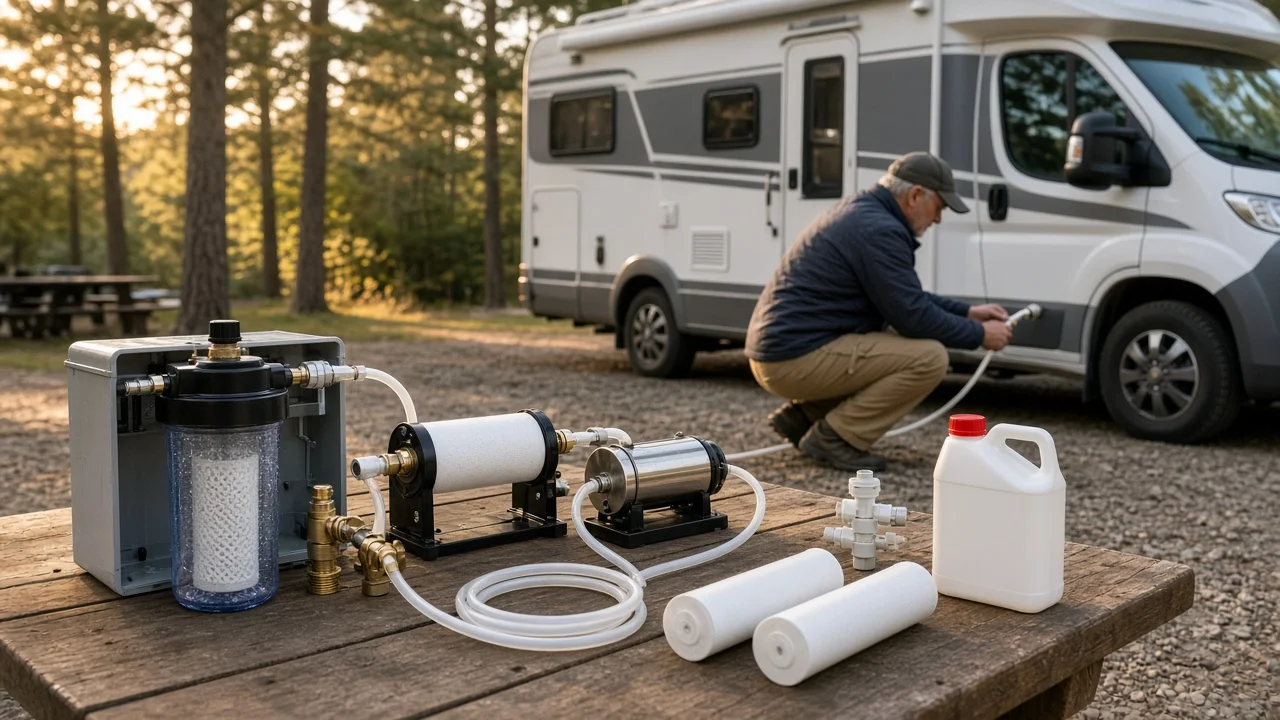
Inline hose filter: a disposable cartridge that connects between the campground spigot and the fill hose. It is simple and cheap to start with, but filtration is usually limited to sediment and basic carbon, and it only treats water drawn from a hookup. External canister system: one or more housings with replaceable cartridges, often in sediment-then-carbon order, used at the hookup or when filling the tank. It offers more capacity and choice of cartridges, but it is bulkier and needs storage space. Onboard whole-system filter: a housing plumbed in after the water pump, so tank water is also filtered. It treats water from both the tank and the hookup, but it must suit the pump's flow and the available mounting space. Point-of-use drinking filter: an under-sink cartridge feeding the galley tap or a dedicated drinking faucet. It targets the water you actually drink, but it adds plumbing work and another cartridge to replace. Reverse osmosis: a membrane system that removes a broad range of dissolved contaminants. It needs adequate water pressure, takes space and sends reject water to waste, which fills the grey tank faster when you are not connected to a sewer hookup. Ultraviolet treatment: a lamp that inactivates microorganisms. It needs a power supply and clear, pre-filtered water to work properly, so it is normally installed after sediment and carbon stages.
What to check before you buy
Match the system to how you travel
Start by listing where your water comes from: mostly full-hookup campgrounds on municipal supplies, a mix that includes rural or private wells, or frequent off-grid fills. Then decide what you want the system to achieve: protecting plumbing and appliances, better taste, safer drinking water, or all three. A setup that suits weekend trips between serviced sites can be inadequate for extended boondocking, meaning camping without hookups.
Verify certifications for the exact model
In the US, drinking-water treatment products are commonly certified against NSF/ANSI standards. NSF/ANSI 42 covers aesthetic effects such as chlorine, taste and odor. NSF/ANSI 53 covers health-related contaminants such as lead. NSF/ANSI 58 covers reverse osmosis systems, NSF/ANSI 55 covers ultraviolet systems, and NSF/ANSI 401 covers certain emerging contaminants. A general claim that a product is tested or meets a standard is not the same as certification. Check the certifier's own listing for the specific model and cartridge, and note which contaminants it is actually certified to reduce.
Confirm fit with your motorhome's plumbing
Hookup filters in the US typically use standard garden hose threads, but onboard and under-sink units must match your motorhome's pipe type, fitting sizes and layout. These vary by manufacturer, model year and floorplan. Check the owner's manual or plumbing diagram for your specific coach before ordering. Also note whether your coach already has a factory filter housing and which cartridge it takes. For filters installed after the water pump, check that the filter's rated flow is compatible with the pump's output, because a restrictive filter can reduce pressure at the taps and shower.
Account for space, weight, power and waste water
Measure the mounting space, including clearance to unscrew housings and change cartridges. Consider where wet external canisters will be stored while you travel. Every gallon carried and every component adds payload, which matters if your motorhome is close to its weight limits. Ultraviolet units draw power from the house battery system. Reverse osmosis reject water reduces your fresh water supply and fills the grey tank faster. Both trade-offs weigh more heavily when you camp without hookups.
Plan for winterizing and sanitizing
Water left in filter housings can freeze and crack them. Check how easily the system can be drained, bypassed or removed. Carbon cartridges should generally be removed or bypassed when RV antifreeze or chlorine sanitizing solution is run through the lines, so follow the filter maker's instructions. A filter does not replace periodic sanitizing of the fresh tank and lines, or the use of a hose rated for drinking water.
Work out the total cost of ownership
The purchase price of the housing is usually only part of the cost. Compare the price and stated replacement interval of each cartridge, and whether cartridges use common standard sizes or a proprietary design. Check whether replacements are easy to find while traveling. Then add fittings, mounting hardware, any power wiring, and professional installation if you will not fit the system yourself. When comparing quoted prices, note the retailer, the date, that the currency is US dollars, and what is included. A listed or advertised price is not necessarily what buyers actually pay. No verified prices were available for this guide, so treat any figure you find as a starting point to confirm.
Check the seller and warranty
Many readers search by water filter brand or company. Rather than relying on reputation alone, check the warranty terms for housings and cartridges, whether installation affects the warranty, and whether the manufacturer publishes performance data and certification details for each cartridge. Filters marketed for home use can sometimes work in a motorhome. Even so, confirm that the fittings, mounting method and vibration tolerance suit a moving vehicle before choosing one.
Gaps in this guidance
This guide was prepared without confirmed product evidence. It does not include specific prices, flow rates, cartridge lifespans, test results or brand comparisons, and it does not rank individual products. Before you buy, confirm those details for the exact model from the manufacturer's documentation and the certifier's listing. Check vehicle compatibility against your motorhome's model year and plumbing layout.
Next step
Write down your usual water sources, how you will use the water, the space available and your power budget. Use that list to choose a system layout first. Then shortlist products whose certifications match the contaminants you care about, whose fittings match your plumbing, and whose ongoing cartridge costs you are prepared to pay.