Portable Water Filter for Motorhome Travel: What to Check Before You Buy
The short answer
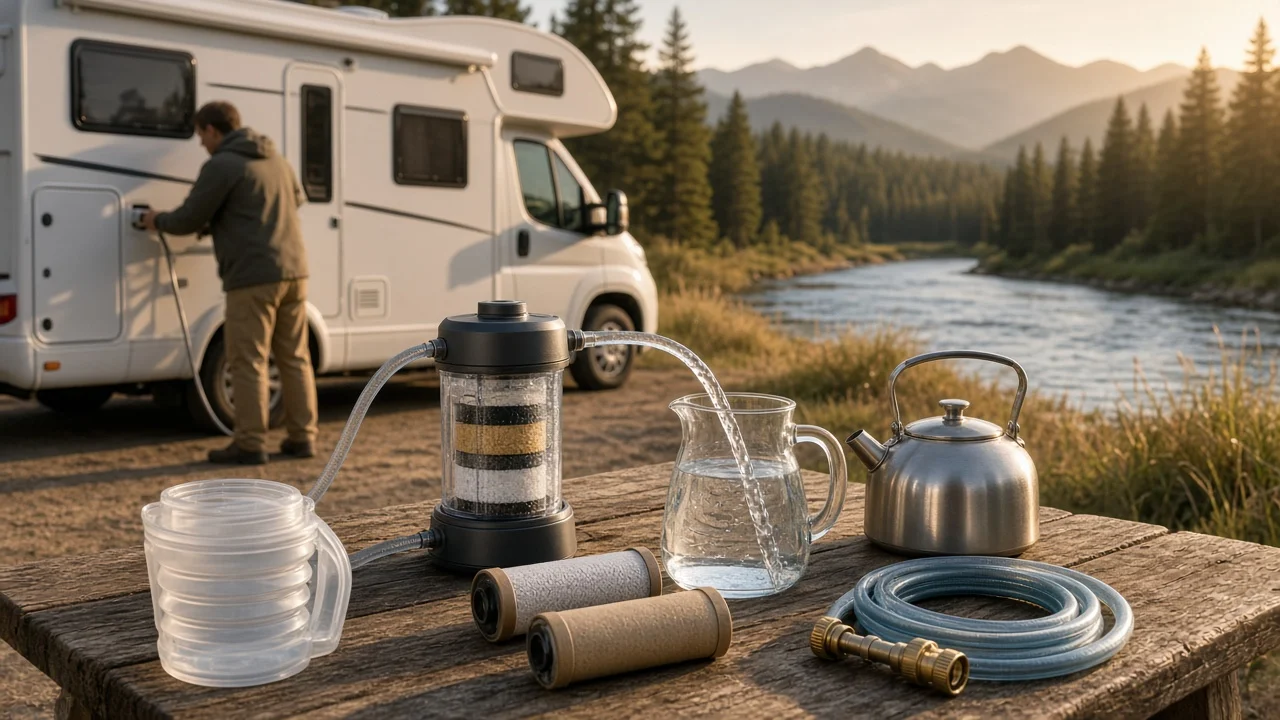
For most motorhome trips that draw from treated campground or municipal taps, an inline hose filter that connects between the water source and your rig's fresh-water inlet is the practical choice. It is meant to improve taste and odor and reduce sediment before water reaches your tank and plumbing. This changes if you expect to fill from wells, untreated springs, lakes or any source of unknown safety. In that case a basic sediment or carbon filter is not enough. You need a unit specifically rated to reduce microbiological contaminants, or a second treatment step for drinking water.
Because no specific product data, prices or test results were available for this guide, it does not recommend particular models. It covers what to check so you can compare products on their own documentation.
Filter or purifier: the distinction that matters most
Filter and purifier are often used loosely, but they describe different levels of protection. A filter generally reduces sediment, chlorine taste and odor, and depending on its design, some chemical contaminants. A purifier is intended to address disease-causing microorganisms, which can include bacteria, protozoa and viruses. Many membrane-type portable filters capture bacteria and protozoa but are not designed to remove viruses. If the product does not clearly state which organisms it addresses and under what standard, assume it does not make them safe.
Decide this first, based on where you actually fill up. A reader who stays at serviced campgrounds and one who dry-camps and refills from rural sources need different equipment.
Common portable formats for motorhome use
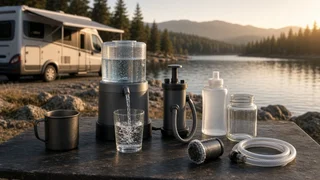
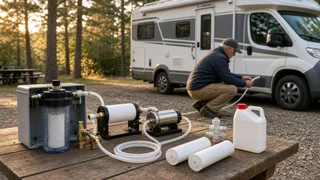
Format | Where it sits | Typical role | Main trade-off; Inline hose filter | Between the spigot and the rig's city-water or fill inlet | Treats water entering the tank or plumbing | Usually aimed at taste, odor and sediment rather than microorganisms; Canister or multi-stage portable system | Freestanding housing connected by hoses | Allows staged filtration, such as sediment followed by carbon | Bulkier to store; more cartridges to replace; Point-of-use pitcher or countertop unit | Inside the coach for drinking and cooking water | Final treatment for water you consume | Treats only small volumes; does not protect the tank or plumbing; Handheld or bottle filter or purifier | Carried for refills away from the rig | Backup for questionable sources | Low volume; not a replacement for treating tank water
Some owners combine an inline filter for everything entering the rig with a point-of-use unit for drinking water. Whether that is worth the extra cost and space depends on your sources and how much of your drinking water comes from the tank.
What to check before buying
Independent certification: Look for certification to a named standard rather than general marketing claims. In the US, NSF/ANSI 42 covers aesthetic effects such as chlorine taste and odor, and NSF/ANSI 53 covers specified health-related contaminants. Certification applies only to the contaminants listed on the product's certificate or performance data sheet, so read that list. Microbiological claims: If you need protection from microorganisms, confirm which ones the product addresses and how that was verified. Without a specific claim, treat the filter as aesthetic only. Rated capacity and replacement interval: Check the manufacturer's stated gallon capacity or time limit for each cartridge, and whether the unit gives any sign that it is exhausted. An expired cartridge may stop reducing contaminants it was certified for. Flow rate: Compare the stated flow with how you fill. A filter that restricts flow too much makes tank filling slow and may underperform when connected directly to city-water pressure. Pressure rating: When connected directly to a campground spigot, the filter sees source pressure. Check the housing's maximum pressure rating and use a pressure regulator if your setup calls for one. Connection fit: Most US hose filters use garden-hose threads, but confirm the fittings on your own motorhome's inlet and any adapters you already carry. Inlet type and location vary by manufacturer, model year and floor plan, so check your owner's manual or the inlet itself rather than assuming a match. Drinking-water-safe components: Use hoses and fittings labeled as safe for drinking water. A good filter cannot fully compensate for a hose that is not intended for potable use. Ongoing cost and availability: Price out replacement cartridges, not just the starter unit, and check whether they are easy to find while traveling. Storage and freezing: Find out whether the housing must be drained and how the cartridge should be stored between trips. Water left in a housing can freeze and crack it, and a damp cartridge stored for a long time may need replacing before reuse.
How a portable filter fits with the rest of the fresh-water system
A portable filter treats water as it enters. It does not clean a tank, lines or water heater that already hold old or contaminated water. Routine fresh-water tank sanitizing, following your motorhome manufacturer's procedure, is still needed. If your coach already has a built-in filter housing under a sink or near the pump, check its cartridge type and condition before adding a portable unit, so you know what each stage is doing and avoid paying for overlapping filtration.
Gaps to close with the seller or manufacturer
This guide could not draw on confirmed product specifications, prices, certification listings or independent test results, so these points need to be verified for any unit you consider: the exact contaminants on its certification listing, the rated capacity per cartridge, the flow and pressure ratings, the thread type of its fittings, and the current price and availability of replacement cartridges. If a seller cannot provide a certificate or performance data sheet, weigh that heavily against the product.
Choosing your next step
Start by listing where you fill your tank. If it is almost always treated campground or municipal water, shortlist inline hose filters certified for taste, odor and sediment, then compare capacity, flow, fit and cartridge cost. If you regularly use untreated or unknown sources, shortlist only products with clearly stated and certified microbiological claims, or plan a separate treatment step for drinking water. In either case, check your rig's inlet fittings before you order.