Portable Water Purifier: What to Check Before Buying One for Motorhome Use
Short answer: if you will fill your motorhome or drinking containers from sources whose treatment you cannot confirm, such as campground spigots of unknown quality, wells, streams or lakes, choose a unit sold and certified as a purifier rather than a simple filter. A purifier is intended to deal with viruses as well as bacteria and protozoan cysts, while many portable filters only address the latter two. If you only ever refill from treated municipal supplies, a purifier may be more than you need, and a taste-and-odor filter plus good tank hygiene may be the more practical choice. One condition changes this answer significantly: microbiological purification and chemical reduction are different jobs. A device that makes water microbiologically safer does not automatically reduce lead, pesticides, industrial chemicals or dissolved salts. If chemical contamination is your concern, look for a unit with a specific, certified claim for the contaminant you are worried about.
Filter versus purifier: why the label matters
In US product marketing, the words filter and purifier are often used loosely. Technically, a filter physically strains out particles above a certain size, which typically captures protozoa and bacteria. Viruses are much smaller and generally pass through standard filter media, so a purifier adds another mechanism, such as a much finer membrane, ultraviolet (UV) light, or chemical disinfection. Treat the word purifier on the packaging as a claim to verify, not a guarantee.
The most useful check is whether the manufacturer states which organisms the unit reduces and whether that claim has been tested against a recognized standard. In the US, common reference points include the EPA guide standard for microbiological water purifiers and NSF/ANSI standards; for example, NSF/ANSI 42 covers aesthetic effects such as taste and odor, while NSF/ANSI 53 covers certain health-related contaminants. Check that the certification applies to the exact model and cartridge you are buying, not to a related product or a single component.
Where a portable purifier fits in a motorhome water system
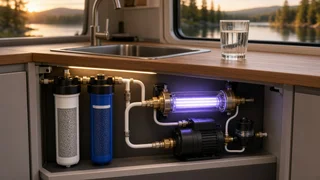
A motorhome habitation water system usually consists of a fresh water tank, a pump, distribution lines and taps, with grey and black waste tanks downstream. A portable purifier works independently of this plumbing, so it is not tied to any particular vehicle model year, trim or chassis. That independence is its main advantage: you can treat water at the point you drink it, regardless of what state the tank or lines are in.
It also defines its limit. A portable unit does not clean a contaminated fresh water tank or biofilm in the lines. If you fill the tank from questionable sources, the tank and plumbing still need regular sanitizing, and you should treat any water you drink or cook with at the tap. If you instead plan to purify water before it goes into the tank, check whether the unit's flow rate makes filling a tank realistic; a device designed to fill a bottle may be impractically slow for that job. Inline hose filters that attach at the fill point are a separate product category, and their fitting compatibility depends on your motorhome's inlet and hose connections, which vary between manufacturers and models.
Main types and their trade-offs
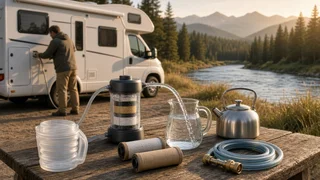
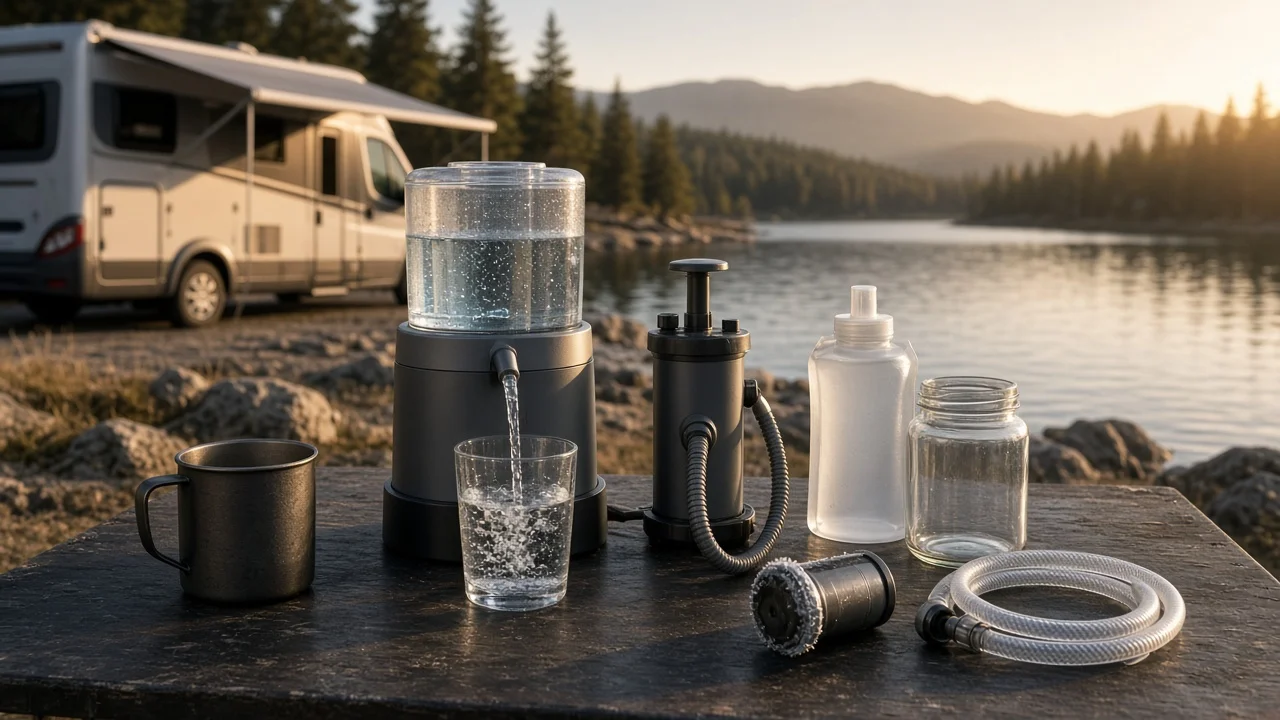
Pump units: you draw water through the element by hand. Useful when filling from open water sources, but they take effort and have moving parts and seals to maintain. Gravity units: water drains from a raised reservoir through the element. Well suited to a parked motorhome or campsite because they work unattended, but they need space to hang or stand the reservoir. Squeeze and bottle units: compact and inexpensive to carry, but best for individual drinking water rather than supplying a household-style setup. UV purifiers: use ultraviolet light to inactivate microorganisms. They need power or batteries, work best in clear water, and do not remove sediment or chemicals, so cloudy water usually needs pre-filtering first. Chemical treatment such as tablets or drops: light and compact, often used as a backup. They require contact time before drinking, can affect taste, and some are less effective against certain cysts.
What to check before buying
Stated performance claims: which organisms and contaminants the unit is claimed to reduce, and against which standard it was tested. Certification scope: that the claim covers the exact model and replacement cartridge you will use. Flow rate: the manufacturer's stated output, compared with how much water your group uses per day and whether you plan to fill containers or the tank. Cartridge life and replacement: the stated capacity, how the unit signals the end of its service life, and whether replacement elements are readily available in the US. Freezing sensitivity: many membrane and hollow-fiber elements can be damaged if water freezes inside them, which may not be visible. Check the manufacturer's storage guidance, especially if your motorhome is stored or used in cold weather. Maintenance: whether the element can be backflushed or cleaned, and how easy that is to do in a motorhome galley. Power needs: for UV or electric units, the battery type, charging method and compatibility with your 12-volt or USB supply. Pre-filtering: whether the unit includes a pre-filter for silt and sediment, which helps protect the main element when using natural sources. Storage and size: whether it fits your available locker space and can be stored dry to discourage mold or bacterial growth.
Ownership trade-offs to weigh
The purchase price is only part of the cost; replacement cartridges and elements are an ongoing expense, and running a unit past its rated capacity can reduce performance without obvious warning. Freezing during winter storage is a common way to ruin an element, so include the purifier in your winterization routine alongside draining the fresh water system. If you rarely leave serviced campgrounds, a simpler and cheaper setup with good tank sanitation may serve you better than a high-capacity purifier.
Gaps in this guide
No confirmed product data was available for this article: no specific models, prices, flow rates, cartridge capacities, test results or certification listings. Product recommendations are therefore not given. Before buying, verify any performance claim in the manufacturer's documentation and confirm it against the certifying organization's own published listing for that model.
Suggested next step
Start by listing where you realistically fill up: treated campground supplies only, or also wells and natural sources. That decides whether you need a certified purifier or a filter. Then shortlist units by certified claims, check flow rate and cartridge availability against your usage, and confirm the freezing and storage guidance fits how and where you keep your motorhome.