UV Water Purification for Motorhome Habitation Systems
The short answer
A UV water purifier can be a sound addition to a motorhome's fresh water system if your main concern is microbiological contamination, such as bacteria, viruses and cysts from campground hookups, refill points or a tank that has sat unused. It is not a complete water treatment solution on its own. Ultraviolet light does not remove sediment, chemicals, metals, chlorine, tastes or odors. It also only works properly when the water is already clear and passes the lamp at a flow rate the unit is rated for. Three conditions decide whether a particular unit suits your coach: it needs a prefilter in front of it, its power supply must match what your rig can provide, and its rated flow must match your water pump.
How UV water treatment works
Water flows through a chamber past a UV-C lamp, which is usually housed inside a clear quartz sleeve. The ultraviolet light damages the genetic material of microorganisms so they cannot reproduce or cause infection. Nothing is added to the water. The trade-off is that there is no residual effect. Treated water can be recontaminated by anything it touches further downstream, including a dirty tank, hoses or faucet.
Concern | Does UV treat it? Bacteria and viruses | Yes, when water is clear and flow is within the unit's rating; Protozoan cysts such as Giardia and Cryptosporidium | Yes, under the same conditions; Sediment, rust and cloudiness | No. These need a sediment prefilter and also reduce UV effectiveness; Chlorine, taste and odor | No. These need a carbon filter; Dissolved chemicals and heavy metals | No. These need filtration designed and certified for those contaminants; Grey or black waste water | No. UV units are for fresh water, not waste tanks
What to check before buying a UV water purification system
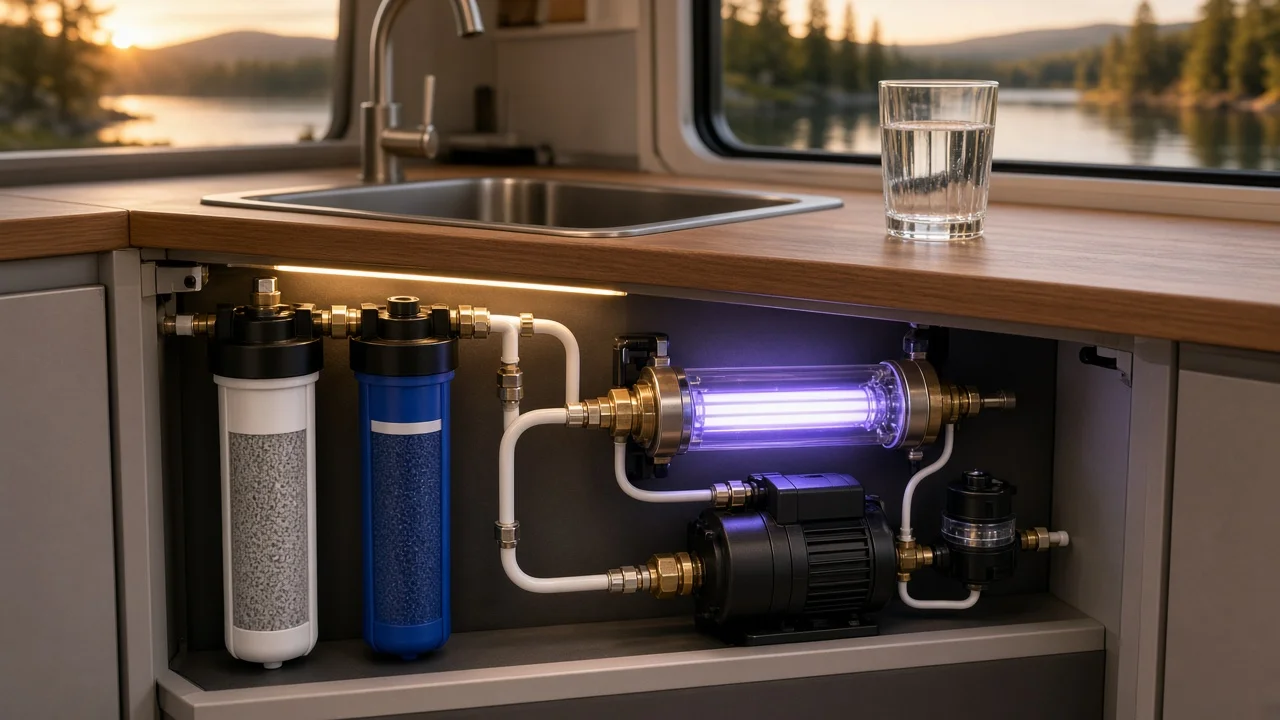
Prefiltration: Look for a unit that pairs with, or specifies, a sediment filter and ideally a carbon filter upstream. Particles can shield microorganisms from the light, and staining or scale on the quartz sleeve reduces its output. Flow rate match: Compare the unit's rated flow with your water pump's maximum output. If water passes the lamp faster than the rating allows, it gets less exposure than intended. Some coach owners add a flow restrictor to stay within the rating. Power supply: Units are sold for 12V DC, for 120V AC, or for both. A 120V-only unit needs shore power, a generator or an inverter, so it may not suit boondocking. Check the current draw against your battery and charging setup. Operating mode: Some lamps run continuously and others switch on with water flow. Continuous operation draws power the whole time. Flow-activated designs need a warm-up period, so check how the manufacturer handles the first water out of the tap. Monitoring: A UV intensity sensor or lamp failure alarm tells you when treatment has stopped. A simple power light only confirms that electricity is reaching the unit, not that the lamp is working effectively. Certification: In the US, UV systems can be certified to NSF/ANSI Standard 55. Check whether the listing covers disinfection or only supplemental treatment, and confirm it applies to the exact model you are buying. Maintenance: Find out how often the lamp must be replaced, whether the quartz sleeve can be cleaned without tools, and whether replacement lamps and sleeves are easy to obtain. Physical fit: Measure the space available, check the inlet and outlet fitting sizes against your plumbing, and confirm the unit can be mounted securely enough to cope with road vibration. Cold weather: The quartz sleeve and housing can crack if water freezes inside them. Check whether the unit can be fully drained or bypassed as part of your winterizing routine.
Where to install it in the coach
Because UV leaves no residual protection, it works best close to where you draw water. There are two common layouts. In the first, a whole-coach unit sits after the pump and treats every outlet. That needs a higher flow rating and usually more power. In the second, a smaller point-of-use unit serves only a dedicated drinking water tap. That reduces power use and lamp wear but leaves shower and other outlets untreated. In both layouts, the fresh water tank, lines and water heater still need regular sanitizing, because UV does not clean surfaces it never reaches.
Compatibility depends on your specific motorhome
Pump output, plumbing fitting sizes, available mounting space, battery capacity and inverter fitment all vary between coach builders, chassis and model years, and they can differ between trims of the same model. No vehicle-specific data was available for this guide. Before buying, confirm your pump's specification, the pipe and fitting sizes, and your electrical capacity from your owner's documentation or the coach manufacturer.
What this guide cannot tell you
No verified product specifications, prices, test results or reviews were available, so this guide does not recommend particular brands or models and does not state lamp lifespans, power draw figures or flow ratings. Treat the manufacturer's certified specifications as the deciding information, and compare them against the checklist above and the details of your own vehicle.