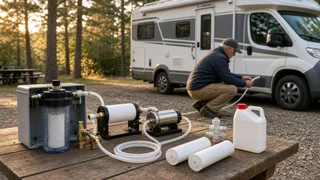
Testing Water Hardness for a Motorhome Water System

The Short Answer
A water hardness test kit measures the dissolved minerals, mainly calcium and magnesium, in the water you put into a motorhome's fresh water tank. For most owners, inexpensive test strips are enough to tell whether a fill point's water is soft or hard. A titration drop kit is the better choice if you want a more precise number, for example to set up or check a water softener. Because a motorhome takes on water from many different sources, the useful habit is to test at each new fill point rather than once.
One qualification changes the answer for some readers. A digital TDS (total dissolved solids) meter is not a hardness test. It reports all dissolved solids, including salts that do not cause scale, so it cannot tell you how much calcium and magnesium are present. If your goal is hardness specifically, use a kit labeled for total hardness.
What Hardness Means in a Motorhome
Hard water leaves mineral scale when it is heated or evaporates. In a motorhome's habitation system, the parts most exposed to this are the water heater, whether a tank type or an on-demand (tankless) unit, along with faucet aerators, shower heads and the surfaces of sinks and showers. Scale buildup can reduce heater efficiency and restrict flow through small outlets. Hardness is not a measure of whether water is safe to drink. Microbial contamination, chemical contaminants and taste are separate questions that a hardness kit does not answer.
Types of Hardness Test Kit
Kit type | How it works | Strengths | Limitations; Test strips | Dip a pad strip in the sample and compare its color to a printed chart | Fast, compact, easy to carry and use at a campsite | Results fall into color bands rather than an exact figure; color reading is subjective; Titration drop kit | Add reagent drops to a measured sample and count drops until the color changes | Gives a more specific number; useful for checking softener performance | Takes longer; needs care measuring the sample and counting drops; Digital TDS meter | Measures electrical conductivity and estimates total dissolved solids | Quick electronic reading | Does not measure hardness specifically and should not be used as a substitute
When buying hardness test strips, check that they measure total hardness. Multi-parameter strips sold for pools or aquariums may include a hardness pad, but they are designed and calibrated for those uses, so read the packaging to confirm what each pad reports and in which units.
Reading the Units
Kits in the US usually report hardness in grains per gallon (gpg) or in parts per million (ppm), which is equivalent to milligrams per liter (mg/L) expressed as calcium carbonate. One grain per gallon is about 17.1 ppm. Softener settings are often given in grains per gallon, so convert if your kit reports in ppm.
The US Geological Survey uses this general classification, in mg/L as calcium carbonate. Individual kits may print different bands on their charts, so follow the chart supplied with yours.
Soft: 0 to 60 mg/L; Moderately hard: 61 to 120 mg/L; Hard: 121 to 180 mg/L; Very hard: more than 180 mg/L
How to Test at a Fill Point
Run the source tap or your drinking-water hose briefly so the sample reflects the supply rather than water that has been standing in the line. Collect the sample in a clean container before filling the tank, so you can decide on treatment before the water goes in. Follow the kit's instructions exactly for dip time, number of drops and how long to wait before reading, because readings taken too early or too late can be wrong. Read strip colors in good natural light, and compare against the chart promptly. Check the expiry date and keep strips sealed and dry, since moisture and age can affect the reagents. Note the result and location so you can compare sources on future trips.
What to Do With the Result
If the water tests soft, no hardness treatment is needed for that fill. If it tests hard, the main options are a portable water softener connected before the inlet, or simply planning more frequent descaling of the water heater and outlets according to the manufacturer's instructions. Be aware that common inline sediment and carbon filters are designed for particles, taste and odor and generally do not remove hardness minerals; check the filter's stated purpose before relying on it. If you use a softener, testing the water after it is a straightforward way to confirm the softener is working and to tell when it needs regenerating.
Gaps in the Available Information
No specific product data was available for this guide, so it does not name brands or give prices, measured accuracy figures or shelf-life claims for particular kits. It also does not give hardness limits from specific water heater or softener manufacturers. Before choosing a kit or treatment, check the product's stated measuring range and units, and consult your motorhome's and water heater's documentation for any water quality recommendations.