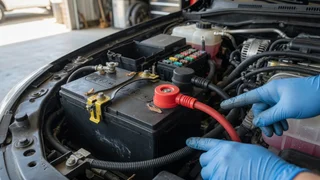
Which Side of a Car Battery Is Positive? How to Identify the Positive Terminal
There is no universal positive side on a car battery. Depending on the battery's group size and the vehicle it was designed for, the positive terminal may be on the left, on the right, toward the front or toward the rear. Reliable identification comes from the markings and physical features of the battery itself, not from its position under the hood. This guide explains how to find the positive terminal on a standard 12-volt automotive battery, why the layout varies, and what to keep in mind before connecting or disconnecting anything.
The Short Answer
The positive terminal is the one marked with a plus sign (+), the letters POS, or red coloring, usually on a red cap or cable. On common top-post batteries, the positive post is also slightly thicker than the negative post. Which physical side it sits on depends on the battery design, so always check the markings rather than assuming left or right.
How to Identify the Positive Terminal
Several clues usually point to the same answer. Checking more than one helps, especially on an older battery where labels have faded or corrosion hides the markings.
Symbol or label: a plus sign (+) or POS is molded into the case or the terminal itself. The negative terminal shows a minus sign (-) or NEG. Color: the positive cable and protective cap are typically red; the negative cable is typically black. Treat color as a supporting clue, because replacement cables and aftermarket parts do not always follow the convention. Post size: on standard SAE-style top posts, the positive post has a larger diameter than the negative post. This is meant to make reversed connections harder. Where the cable goes: the positive cable usually runs to the starter and to a fuse box or power distribution center. The negative cable usually bolts to the engine block or the vehicle body as a ground. Terminal cover: many vehicles place a hinged or snap-on plastic cover over the positive terminal only, since that is the terminal that can short against grounded metal.
Why the Positive Side Changes From Battery to Battery
In the US, automotive batteries are commonly sold by group size, a standard that defines case dimensions and terminal placement. Two batteries with identical dimensions can be built with their terminals in opposite positions so they fit different engine bays and cable lengths. Reversed-terminal versions are often indicated by a letter in the group designation, such as an R or F suffix, though conventions are not perfectly consistent across every size and brand. The practical takeaway: a replacement battery should match the original group size and terminal orientation, or the cables may not reach the correct posts.
Terminal Styles You May Encounter
Terminal style | Where it appears | How to spot positive; Top post (SAE tapered posts) | Most common style on cars and light trucks | Plus sign, red cap, thicker post; Side post (threaded bolt-in terminals) | Used on many vehicles, notably some domestic models | Plus sign molded beside the terminal, red cable; Dual terminal (top and side) | Some replacement and marine-style batteries | Same markings on both sets; each pair shares polarity; Remote jump posts | Vehicles with the battery in the trunk, under a seat or under the floor | Labeled positive stud under the hood, often with a red cover
If you cannot find the battery under the hood, the vehicle may use a relocated battery with remote jump-start points. The owner's manual identifies the battery location and any remote posts for that specific model.
Confirming Polarity With a Multimeter
When markings are missing or unreadable, a digital multimeter settles the question. Set it to measure DC voltage, touch the red probe to one terminal and the black probe to the other. If the display shows a positive reading, the red probe is on the positive terminal. If it shows a negative value, the probes are reversed. A healthy standard car battery reads somewhat above its nominal 12-volt system voltage at rest; a reading well below that suggests a discharged battery, but the polarity test works regardless of charge level.
Why Getting Polarity Right Matters
Connecting cables or a charger backward can blow fuses, damage the alternator's diodes, and harm sensitive control modules. A fuse with the correct fuse rating may protect some circuits, but it cannot be counted on to prevent all reverse-polarity damage. Jump-starting with reversed cables can also produce sparks near the battery, which may vent flammable hydrogen gas.
Disconnecting: remove the negative cable first, then the positive. This reduces the chance of a short if a tool touches the body while loosening the positive clamp. Reconnecting: attach the positive cable first and the negative cable last. Jump-starting: connect positive to positive, then attach the final negative clamp to a clean, unpainted metal ground point on the disabled vehicle rather than directly to its battery, unless the owner's manual instructs otherwise. Wear eye protection and keep metal jewelry and tools away from the terminals.
Hybrids and Electric Vehicles
Hybrid and electric vehicles still use a conventional 12-volt auxiliary battery, and it follows the same marking conventions. They also carry a separate high-voltage traction battery, typically connected with orange cables. Those components are not meant for owner service and should be left alone. The 12-volt battery may sit in the trunk or behind a panel, so the owner's manual is the best guide to its location and jump points.
When Terminal Identification Points to a Bigger Problem
If you are locating the positive terminal to troubleshoot a dead battery or a warning light, terminal condition is a common starting point. Loose or corroded battery terminals create resistance, and the resulting voltage drop can mimic a weak battery or a failing alternator. Cleaning and tightening the connections is a reasonable first step. If problems continue, the next areas to look at are the alternator's charging output with the engine running and possible parasitic draw, which is current that keeps flowing after the vehicle is shut off and slowly drains the battery. A wiring diagram for the specific vehicle helps trace where the positive cable feeds power and which fuses protect each circuit.
A Note on Household Batteries
If your question is about a cylindrical household battery such as AA or AAA rather than a car battery, the positive end is the one with the raised bump on top, and the flat end is negative. Coin cells usually have the positive side marked with a plus sign on the wider flat face. Device compartments typically show a plus symbol or a spring on the negative contact to guide orientation.
Bottom Line
Look for the plus sign or POS label, the red cable or cap, and on top-post batteries the thicker post. Ignore assumptions about left or right, since terminal placement varies with battery group size and vehicle design. When in doubt, a multimeter confirms polarity in seconds, and the owner's manual covers any model-specific battery location or jump-start procedure.