Reduced engine power after an oil change
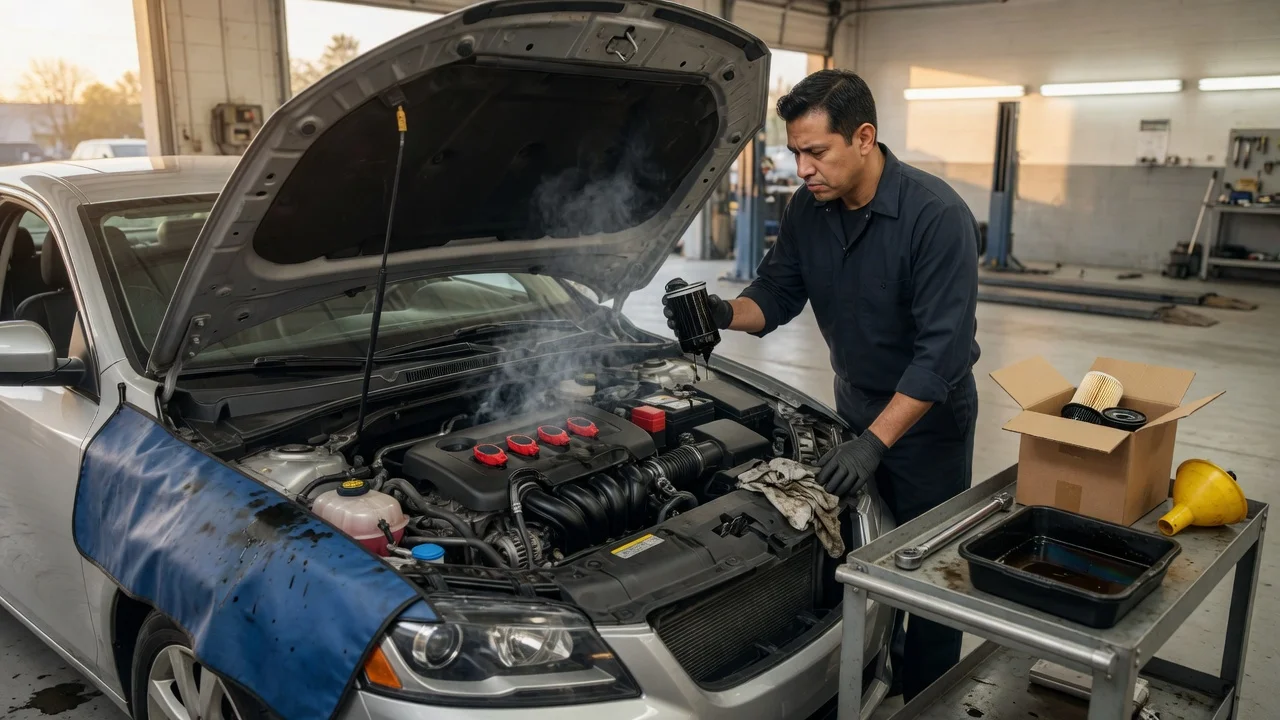
What a reduced-power warning after an oil change usually means
A correctly performed oil and filter change does not reduce engine power. If a “reduced engine power,” “engine power reduced,” limp-home, or similar warning appears right after the service, treat it as a fault that showed up during or immediately after the job, not as an expected side effect of fresh oil. The message is typically the engine control module limiting output because it has detected a problem with oil level or pressure, a related sensor or actuator, or an electrical or air-intake connection disturbed during the work.
Scope matters. The same wording can cover a mild torque limit or a severe limp mode, and the trigger set differs by make, model year, powertrain, and market calibration. Gasoline engines with variable valve timing, diesel engines with oil-fed turbochargers, and hybrids with an engine that starts and stops on demand can all show a power limit after an oil-related fault, but the exact threshold and dashboard text are vehicle-specific. This guide covers the common mechanical and service-related causes; it does not substitute for a scan of stored diagnostic trouble codes on the vehicle in front of you.
Why the timing often points to the service, not the oil itself
Fresh oil of the specified grade does not starve the engine of power. What the service can change is fill quantity, viscosity relative to the manufacturer’s specification, sealing of the lubrication system, and the position of nearby connectors, the oil filler cap, and the air-intake path. Modern engines also use oil as a hydraulic fluid for cam phasers, timing-chain tensioners, and, on some designs, turbocharger or valve-train control. If pressure, aeration, or viscosity is outside the range the control module expects, it may command reduced torque to protect the engine.
A warning that appears only after the vehicle is driven, rather than at first start, still fits this picture. Some monitors run after oil is hot and pressure is stable; others set when variable valve timing or turbo control cannot reach a commanded position. Coincidence is possible—an unrelated sensor can fail on the same day—but the first checks should still be the items the oil change can disturb.
Fill level, viscosity, and filter installation
Overfill and underfill are the most direct oil-change errors. Too little oil can drop pressure at idle or when hot, which may trigger a low-pressure warning, a cam-phaser fault, and a power limit. Too much oil can aerate in the crankcase, raise crankcase pressure, foul spark plugs or the catalytic converter on some gasoline engines, and upset level or quality sensors. Check the level on level ground with the procedure in the owner’s manual: some engines are read hot after a short wait, others cold. Do not add or drain by guesswork if the dipstick or electronic level display is ambiguous; that display itself can be the source of the warning.
Wrong specification is the next qualification. The bottle grade (for example a winter-start viscosity versus the grade listed for the climate and engine) and the performance specification (the maker’s listed standard, not only the SAE viscosity) both matter. Oil that is far thicker or thinner than specified can slow hydraulic cam timing or oil-control valves enough for the control module to set a timing or pressure-related code and cut power. Exact acceptable ranges are printed in the owner’s manual or under-hood label for that engine and market; they are not interchangeable across all cars of the same brand.
Filter and drain-plug faults belong in the same pass. A filter that is cross-threaded, missing a seal, fitted with two gaskets, or not tightened to the specified method can leak or, on some cartridge housings, fail to open the oil gallery. A loose, overtightened, or wrong-thread drain plug can leak or crack the pan. A housing drain that was never reopened, or a cap that was left off the cartridge, can leave the engine short of oil after the first miles. These are installation defects, not properties of the oil brand.
Cap, sensors, and connectors disturbed during the job
An oil filler cap left off or poorly seated can throw oil onto the intake, belts, or nearby wiring and can set a crankcase-ventilation or smoke-related complaint. Oil on a mass-air-flow sensor, intake-air temperature sensor, or an exposed connector is a documented way for a routine under-hood service to produce a sudden power limit: the control module sees implausible airflow and reduces fuel and spark. The same is true of a battery, ground, or engine-harness connector that was bumped, a camshaft or crankshaft sensor connector left unlatched, and an oil-pressure or oil-level sensor that was moved with the filter housing.
If the shop also replaced an air filter, induction hose, or engine cover, look for an unseated intake duct, a disconnected breather hose, or a pinched wiring loom. Those are not lubrication faults, but they are common companion jobs and they produce the same dashboard message. A scan tool reading pending and confirmed codes, freeze-frame data, and live oil pressure or cam-timing values is the way to separate an electrical disconnect from a true hydraulic problem. Code text alone is not a complete diagnosis; the same “reduced power” lamp can be commanded by several modules.
What to do next
Stop in a safe place if the warning is accompanied by low oil pressure, unusual knocking, a burning-oil smell, visible leakage, or rapidly rising temperature. Continued driving with those signs can damage bearings, the timing drive, or a turbocharger. Check oil level with the vehicle’s specified hot or cold method. Correct only to the marked range. Note whether the oil looks aerated, milky, or fuel-thinned; those appearances point beyond a simple fill error and need workshop diagnosis. Confirm the filler cap is on, the filter housing and drain plug are dry, and no fresh oil is on the intake, exhaust, or harnesses. Ask the servicing shop which oil grade and specification were used, what filter was fitted, and whether any other parts or connectors were disturbed. Compare the oil to the manual for that engine, model year, and market. Have stored codes and live data read before clearing them, including oil-pressure, camshaft-position, intake-air, and throttle or torque-limit codes. Clearing first erases freeze-frame evidence of whether the fault set at start-up, at temperature, or under load.
If level, cap, and visible leaks are correct and the engine runs smoothly, a short, gentle drive to a workshop may be reasonable, depending on the vehicle’s message and any accompanying lights. If power is severely limited, the engine is noisy, or oil is still leaking, arrange a tow. Returning to the shop that did the oil change is appropriate when the timing is immediate; ask them to verify fill, filter seating, and connectors before replacing unrelated parts.
What this article cannot settle for a specific car
No single pressure figure, viscosity, or mileage applies to every engine. Whether a given car uses a dipstick, an electronic level sensor, or both; whether limp mode is triggered by oil pressure, cam correlation, or a throttle fault; and whether the oil-life monitor must be reset for normal running are all model- and calibration-dependent. Published service information for that vehicle is the source for those values. There is also no reliable way, from the warning text alone, to prove the oil change caused the fault versus an unrelated failure that happened the same day. Immediate post-service checks still start with fill, leaks, specification, and disturbed connectors because those are the items the job can change and the items most often reversed without further damage.