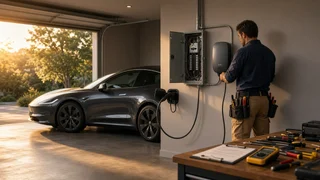
Choose the Fastest EV Charger for Home
The Short Answer
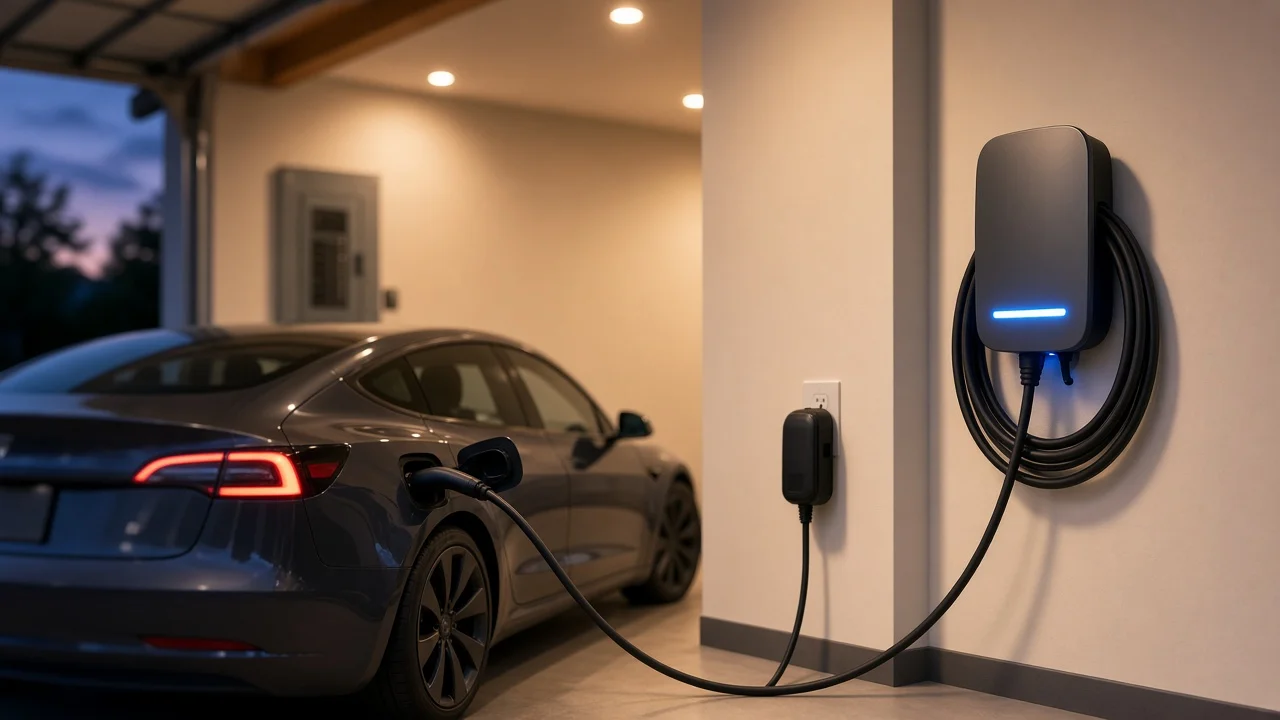
The fastest practical EV charger for most US homes is a hardwired Level 2 unit that matches your car's maximum AC charging rate and fits within your home's electrical capacity. A charger with a higher rating will not charge faster than the car allows. Your real charging speed is set by the lowest of three limits: the vehicle's onboard charger, the charger's output, and the circuit that feeds it.
This means the right choice depends on your car and your house, not on finding the highest number on a spec sheet. A charger that outpaces your car does not add speed today, though it can make sense if you expect to own a faster-charging vehicle later.
What Limits Home Charging Speed
Home chargers supply alternating current (AC). The car converts it to direct current (DC) for the battery using a component called the onboard charger. Each onboard charger has a maximum power it can accept, and that maximum can differ by model year, trim, battery size and market. Check the figure for your exact vehicle in the owner's manual or the manufacturer's specifications rather than assuming that all versions of a model are the same.
Electrical power is voltage multiplied by current. Most US homes supply about 240 volts for large appliances, so a charger's amperage largely determines its power. As an illustration, 48 amps at 240 volts works out to about 11.5 kilowatts. Some multi-unit buildings supply 208 volts, which lowers power at the same amperage.
US electrical code treats EV charging as a continuous load. Under that rule, the charger may draw no more than 80 percent of the circuit breaker's rating. A 40-amp charger therefore needs at least a 50-amp circuit, and a 48-amp charger needs at least a 60-amp circuit. Your local code and inspector have the final say on the requirements.
Comparing Home Charging Options
Level 1 (standard 120-volt outlet): This is the slowest option and needs no new installation. It suits drivers who travel short daily distances or own plug-in hybrids with small batteries. Level 2, plug-in (240-volt receptacle, often a NEMA 14-50): This option is faster than Level 1, and the unit can be unplugged and moved. Because these receptacles are typically on 50-amp circuits, output is usually capped at 40 amps. Level 2, hardwired: The charger is wired directly to the circuit. This is generally required for outputs above 40 amps, so it is the route to the highest home AC charging speeds. It is less portable, and installation can cost more. DC fast charging at home: This option bypasses the onboard charger. It typically requires electrical service, often three-phase, that most US homes do not have, so it is rarely practical for residential use.
Choose Level 1 if your daily driving is short and overnight charging covers it. Choose plug-in Level 2 if you want faster charging with flexibility, or if your car's onboard charger does not accept more than a 40-amp unit can deliver. Choose hardwired Level 2 if your car can accept more power and your panel has capacity for a 60-amp or larger circuit.
How to Pick the Right High-Power Charger
Confirm your vehicle's maximum AC charging rate for its specific model year and trim. Have a licensed electrician perform a load calculation to see whether your panel and service can support the circuit you need, or whether an upgrade is required. Size the charger to the lower of the car's limit and the circuit's capacity at 80 percent. Choose a unit with adjustable amperage if you may upgrade later. Match the connector to your car. US vehicles use either the J1772 connector or the SAE J3400 (NACS) connector, and adapters are available in some cases. Choose a charger listed by a nationally recognized testing laboratory, such as a UL listing, and obtain any required permits and inspections. Ask your utility about EV rates, time-of-use pricing and rebates, which can affect both installation cost and running cost.
What This Guide Cannot Tell You
No verified product specifications, prices, test results or model-specific charging rates were available for this guide, so it does not rank individual chargers or estimate charging times for particular vehicles. Before you buy, compare current manufacturer specifications for the chargers you are considering, and get an installation quote based on your own electrical panel.