Residential EV Charger Selection and Home Installation: What to Check Before You Buy
For most US households that drive an electric vehicle daily, the practical choice is a Level 2 residential EV charger on a dedicated 240-volt circuit, installed by a licensed electrician. The right unit depends on four things: what your vehicle can accept, what your electrical panel can supply, where you park, and whether your local utility or permitting office imposes requirements. If you drive short distances and park near an existing outlet, the standard 120-volt cord that came with many vehicles may be enough, and you may not need to buy anything at all.
Start with how much charging you actually need
Home charging equipment comes in two practical levels. Level 1 uses an ordinary 120-volt household outlet and adds range slowly, which can still cover a modest daily commute if the car sits plugged in overnight. Level 2 uses 240 volts, the same type of supply used by electric dryers and ranges, and refills a typical battery several times faster. DC fast charging is not a residential option; it requires commercial-grade equipment and electrical service.
Estimate your typical daily miles, add a margin for occasional longer days, and compare that with how many hours the car is parked at home. If Level 1 replaces what you use each day with time to spare, upgrading is a convenience rather than a necessity. If you regularly arrive home with a low battery, share one charger between two vehicles, or use time-of-use electricity rates that give you a short cheap window, Level 2 is the better fit.
Check charging compatibility with your vehicle
Connector type is the first compatibility question. In North America, most non-Tesla vehicles have historically used the J1772 connector for AC charging, while Tesla vehicles use the connector now standardized as SAE J3400, often called NACS. Many automakers are moving to J3400 ports, so the connector on your car depends on the make, model year and sometimes the build date. Adapters exist in both directions, but a charger with the native connector for your vehicle, or one sold in both versions, is simpler. If you expect to replace the car in a few years or have two vehicles with different ports, consider that when choosing.
Charging speed is the second question. The wall unit, more accurately called electric vehicle supply equipment or EVSE, does not convert power for the battery. The vehicle's onboard charger does that, and it has a maximum AC rate set by the vehicle specification for that model year, trim and market. A charger rated above what the car can accept will not charge it faster. Look up the onboard charger rating for your exact vehicle and buy equipment that meets it, with headroom only if you plan to own a vehicle that can use more.
The car's battery management system also controls how fast it accepts energy. It slows charging as the battery approaches full and adjusts the rate based on battery temperature through the vehicle's thermal management system. Real-world charging times will therefore vary with weather and state of charge, regardless of the charger's rating.
Match amperage to the circuit
Level 2 chargers are sold by output current in amps. The National Electrical Code treats EV charging as a continuous load, which means the circuit breaker must be rated at 125 percent of the charger's continuous output. In practice, a charger delivering 32 amps needs a 40-amp circuit, and one delivering 48 amps needs a 60-amp circuit. Many units let the installer set a lower output during setup, which is useful when the panel cannot support the maximum.
Higher amperage only helps if both the vehicle and the home can use it. Choosing a charger that can be configured to several current levels gives you flexibility if your panel is upgraded later or you change vehicles.
Assess your electrical panel before choosing a model
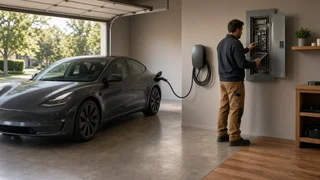
Your service capacity often decides more than the charger does. An electrician will perform a load calculation that accounts for your main service size, existing large appliances such as electric heating, air conditioning, water heaters and ranges, and whether the panel has physical space for a new two-pole breaker. The outcome usually falls into one of three paths.
Enough capacity: add a dedicated circuit at the charger's full rating. Limited capacity: install a lower-output setting, or use a charger or separate device with load management that reduces charging when the home draws more power. Insufficient capacity: a panel or service upgrade, which may involve the utility and adds cost and time.
Get this assessment before buying a high-output unit. A charger that must be turned down to suit the panel is not a problem, but paying for capacity you cannot use is avoidable.
Hardwired or plug-in installation
Level 2 chargers either connect directly to the circuit or plug into a 240-volt receptacle, commonly a NEMA 14-50. Each has trade-offs.
Factor | Hardwired | Plug-in (240-volt receptacle); Maximum output | Can support higher-current units | Typically limited to lower output on a receptacle circuit; Portability | Fixed to the wall | Can be unplugged and moved or taken when relocating; Wear points | No plug or receptacle to wear | Receptacle quality matters; repeated use or a loose fit can cause heating; GFCI considerations | Protection often built into the charger | Recent code editions may require GFCI protection at the receptacle, which can cause nuisance tripping with some chargers; Outdoor use | Simpler to weatherproof | Receptacle needs an appropriate weather-resistant cover
If you choose a plug-in unit, ask for an industrial-grade receptacle rated for repeated use, and confirm with the charger maker and your electrician how GFCI protection will be handled under the code edition adopted in your area. For permanent installations or higher output, hardwiring is usually the cleaner option.
Safety certification and build quality
Buy equipment listed by a Nationally Recognized Testing Laboratory, such as UL or ETL. Listing confirms the unit has been tested for electrical safety, including ground fault protection and isolation between the high-voltage supply and the parts you touch. Some insurers, inspectors and utility rebate programs require a listed charger, and unlisted units sold online at low prices are a common source of problems. ENERGY STAR certification is a separate mark related to standby energy use and is sometimes required for rebates.
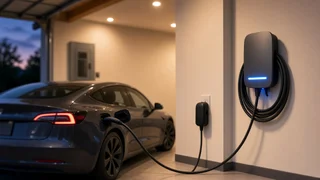
Also check the enclosure rating if the charger will be outdoors or in an unheated garage. Ratings such as NEMA 3R or NEMA 4 indicate resistance to rain and, for higher ratings, hose-directed water. The cable should be long enough to reach the charge port wherever you park, including if you sometimes park nose-in and other times back in, without stretching across walkways.
Smart features: useful, not mandatory
Connected chargers offer app control, scheduling, energy tracking and integration with utility programs. Many vehicles can already schedule charging on their own, so a basic unit may be enough if you only want to start charging at a set time. Smart features become more valuable when your utility offers rebates or lower rates that require a connected charger, when you want to track energy use for a business vehicle or reimbursement, or when two chargers need to share one circuit. Check whether core functions keep working if the manufacturer's app or cloud service is unavailable.
Permits, inspection and the installer
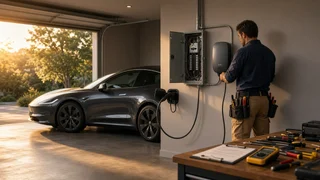
Adding a 240-volt circuit generally requires an electrical permit and inspection in the US, though rules vary by city and county. A licensed electrician normally pulls the permit, sizes the wire and breaker, and arranges inspection. Skipping this step can create insurance and resale complications and leaves you without an independent check of the work. Homeowners' associations, condominiums and rental properties may have additional approval steps for exterior or shared-space installations.
When collecting quotes, ask each installer to state the circuit size, wire run, whether a panel upgrade or load management device is included, permit fees, and who handles the inspection. The length of the wire run from the panel to the parking spot is often the biggest variable in installation cost.
Incentives and utility programs
Utilities, states and some cities offer rebates for chargers, installation or panel upgrades, and some offer special EV electricity rates. Federal tax incentives for home charging equipment have changed in recent years, so do not assume a credit is available. Check your utility and state energy office for current programs before buying, because some require a specific charger list, pre-approval or a connected charger enrolled in their program.
Pre-purchase checklist
Confirm your vehicle's connector type and maximum AC charging rate for its exact model year and trim. Estimate daily driving to decide whether Level 1 is enough or Level 2 is worth it. Have an electrician assess panel capacity and the wire run to your parking spot. Choose an output current the circuit can support, applying the 125 percent continuous-load rule. Decide between hardwired and plug-in based on output needs and portability. Buy a unit listed by a recognized testing laboratory, with an enclosure rating suited to its location. Make sure the cable reaches the charge port comfortably. Decide whether smart features matter for your utility program or usage. Check local permit requirements and any HOA or landlord approvals. Look up current utility and state incentives and their eligibility rules before purchasing.