Exhaust Gaskets: Choosing the Correct Joint Seal
The short answer
The correct exhaust gasket is the one made for that specific joint on that specific vehicle: the right outline, bolt pattern, port openings, thickness, and heat rating. An exhaust gasket is a sacrificial seal between two metal flanges in the exhaust path. It keeps hot gas inside the system so the engine can meter air and fuel correctly, the cabin stays free of fumes, and downstream parts such as the catalytic converter and oxygen sensors see the gas they were designed to see.
That answer changes with joint location and hardware. A cylinder-head-to-manifold gasket sees combustion heat and must match the head and manifold ports. A manifold-to-downpipe or turbo-to-downpipe gasket sees still-high heat plus movement. A mid-pipe, converter, or muffler joint is cooler and often uses a donut, ball-and-socket, or crush ring rather than a flat sheet. Turbocharged, high-mileage, or aftermarket-header setups also change the material and flange condition you should insist on. Reusing a compressed or burnt gasket is a common reason a new leak appears immediately after a repair.
What an exhaust gasket has to do
Exhaust joints are not perfectly flat, and they grow, shrink, and flex as the system heats and cools. The gasket fills small gaps and surface irregularities so combustion gas does not escape before it reaches the rest of the system. A leak at the head or manifold can pull in extra air, confuse oxygen-sensor readings, and set mixture or catalyst codes. A leak farther back usually shows up as ticking or roaring under load, soot at the flange, a smell of exhaust, or heat discoloration on nearby parts.
Because the gasket is the wear item, the flanges and fasteners have to be in good enough condition for any new seal to work. A warped manifold, a rusted or bent pipe flange, stretched studs, or missing crush sleeves will leak around a brand-new gasket. Matching the gasket to the joint is only half of the job; the mating faces still have to clamp it evenly.
What to confirm before you buy
Treat this as a parts-compatibility decision, not a generic “exhaust gasket” purchase. Suitability depends on where the joint sits, what the flanges look like, and whether the rest of the system is original or modified.
Vehicle identity: year, make, model, market, and exact engine or powertrain. Exhaust layouts, port shapes, and fastener patterns change across trims and years; a gasket that fits one engine family will not necessarily fit another in the same model line. Joint location: head-to-manifold, manifold-to-downpipe, turbo outlet, catalytic converter, resonator, or muffler. Catalog listings that omit the joint are easy to order incorrectly. Shape and openings: the gasket must follow the flange outline and leave the gas ports unobstructed. A manifold gasket with the wrong port shape can hang into the flow or leave a path for leaks. Construction: flat multilayer steel or composite for many head and manifold faces; donut or spherical seals for pipe joints that articulate; crush rings or fire rings where the design calls for a captured metal seal. Thickness and stack height: a gasket that is much thicker or thinner than the original can change pipe alignment, hanger load, and sensor or heat-shield clearance. Stay with the thickness the joint was designed around unless the rest of the hardware is being changed to match. Flange condition: inspect for warpage, cracks, rust scale, elongated holes, and burnt or hammered sealing beads. If the faces will not clamp flat, buying a gasket alone will not fix the leak. Original versus aftermarket parts: aftermarket headers, downpipes, and converters often use different flange styles than the factory joint. Order to the parts you actually have, not only to the vehicle. Hardware: many joints need new studs, nuts, springs, or clamps because heat-cycled fasteners no longer hold torque. Factor that into the job even when the gasket itself is inexpensive. One-time use: most exhaust gaskets are not reusable once they have been compressed and heat-cycled. If you are opening a joint, plan on a new seal.
Retail listings rarely publish a complete installed cost, and advertised kit prices often omit fasteners, machine work, or extra gaskets at other joints in the same system. Without a dated market quote that states currency and what is included, treat any price you see as incomplete until you confirm the gasket, hardware, and any flange repair. If several joints are leaking, sealing only the easiest one can leave the noise and smell unchanged.
How common gasket types compare
Choose by joint design and duty, not by which material sounds strongest. Figures from different makers are only comparable when they describe the same joint, thickness, and test condition; published heat ratings without those details are not a ranking.
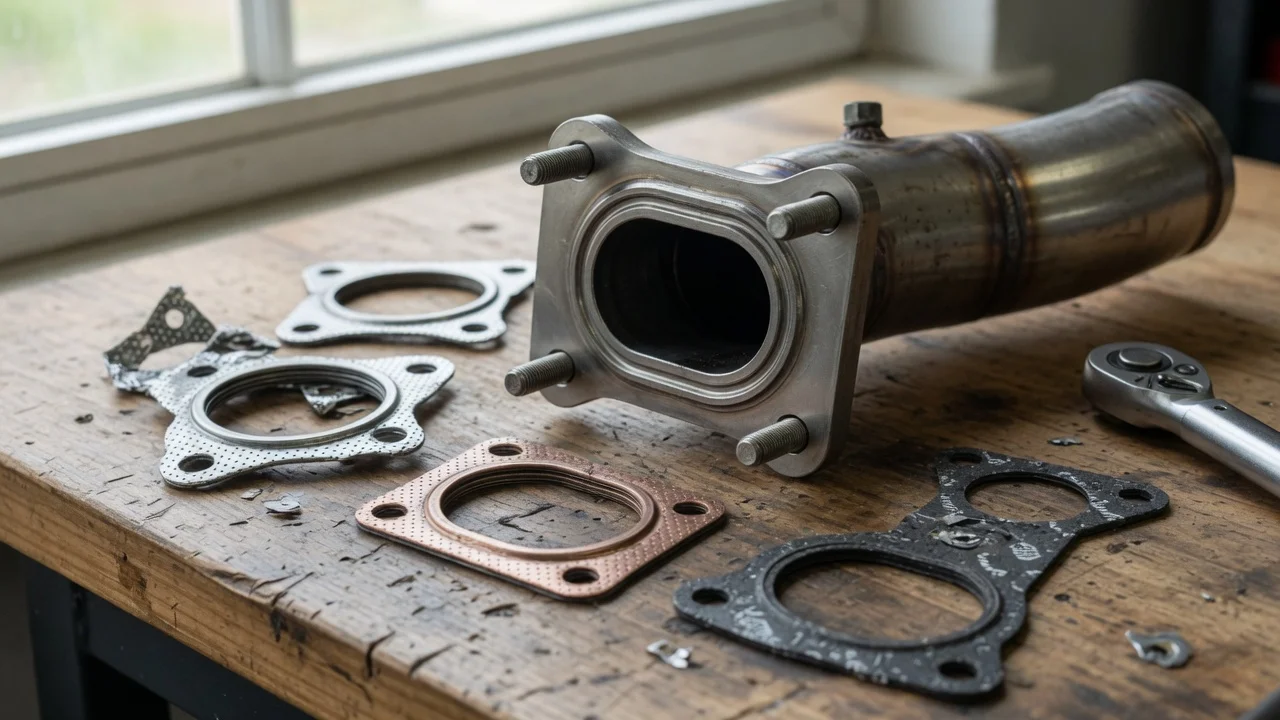
Multilayer steel (MLS): stacked steel layers, often with a coating. Common at cylinder heads and some manifolds where the clamp load is high and the faces are relatively rigid. Needs flat, clean surfaces and even torque; it does not fill deep pits or warpage. Graphite or composite sheet: more conformable on slightly imperfect cast manifolds and older flanges. Can be a practical factory-style replacement on a daily driver when the faces are serviceable. Less suitable where the joint sees extreme heat cycling or where the original design is a metal fire ring. Donut, ring, or ball-and-socket seals: used where pipes must flex or where the joint is a spherical cup rather than two flat faces. The seal must match the cup diameter and the pipe’s sealing surface; a flat gasket will not substitute. Crush rings and captured metal seals: used on some turbocharger and downpipe flanges. They work only in a recess or counterbore that matches the ring. Substituting a flat sheet on a joint designed for a ring leaves an unfilled gap. Copper or other solid-metal gaskets: sometimes used on performance or racing header flanges when both faces are machined flat and clamp load is controlled. They do not compensate for rusted or uneven stock flanges.
For an otherwise stock vehicle with serviceable flanges, the best fit is usually the gasket specified for that joint: same style as original, correct port map, and new fasteners as required. For aftermarket headers, match the header manufacturer’s flange pattern and recommended seal; many header leaks come from mixing a stock manifold gasket with a different port shape. For a turbocharger outlet or a high-heat downpipe, stay with the metal ring or MLS style the turbo and pipe were built around. For a high-mileage manifold that is mildly uneven but not cracked, a more conformable composite can seal where a stiff MLS sheet would leak, provided the manifold is still structurally sound. If the flange is badly warped, cracked, or rusted through, repair or replace the metal parts first; gasket material will not restore a joint that cannot clamp.
Installation checks that change the outcome
A correct part still fails if it is installed on dirty or distorted faces or if clamp load is uneven. Clean both flanges to bare sealing surface, check flatness with a straightedge where the joint is a flat face, and replace stretched or heat-rounded fasteners. Follow the vehicle’s torque sequence and values for that joint when they are published for your model year and engine; guesswork on turbo and manifold studs is a common way to warp a flange or break a fastener. Spring bolts and donut joints need the springs and the correct compressed height; tightening them like rigid bolts can crush the seal or leave the joint loose. After the repair, check for soot at the flange, exhaust smell in the cabin, and any new mixture or catalyst warnings, then recheck fastener tightness after a full heat cycle if the service information calls for it.
When the next step is not another gasket
If a new gasket of the right type still leaks, the joint itself is the problem: a warped or cracked manifold, a bent pipe flange, damaged turbo outlet threads, or an exhaust system hanging in a bind. Those conditions need machining, replacement of the manifold or pipe, or correction of hangers and alignment. If you cannot confirm year, engine, and joint style from the vehicle or from the parts already removed, identify those three facts before ordering. That is the check that most often prevents buying a gasket that looks similar and does not seal.