Exhaust Gaskets: Choosing the Correct Seal for a Repair
The short answer
Buy the gasket made for that exact joint on your engine and exhaust layout, not a generic “exhaust gasket.” The correct seal is defined by location (cylinder head, manifold collector, downpipe, catalytic converter, resonator, muffler, or tailpipe), flange shape and bolt pattern, pipe diameter, and whether the joint is a flat flange, donut, ball-and-socket, or crush ring. Material must also match the heat and movement at that joint: a manifold gasket sees far higher temperature and thermal cycling than a muffler gasket. If those details do not match the vehicle’s model year, market, engine, and exhaust configuration, the part will leak, crush unevenly, or fail quickly.
What an exhaust gasket is for
An exhaust gasket is a heat-resistant seal between two mating surfaces in the exhaust path. Its job is to keep hot gas inside the system so the engine can scavenge correctly, catalytic converters and oxygen sensors see the intended gas stream, and fumes do not enter the cabin or the engine bay. Exhaust joints expand, contract, and vibrate. The gasket has to tolerate that motion without burning through, blowing out, or taking a permanent set that leaves a gap.
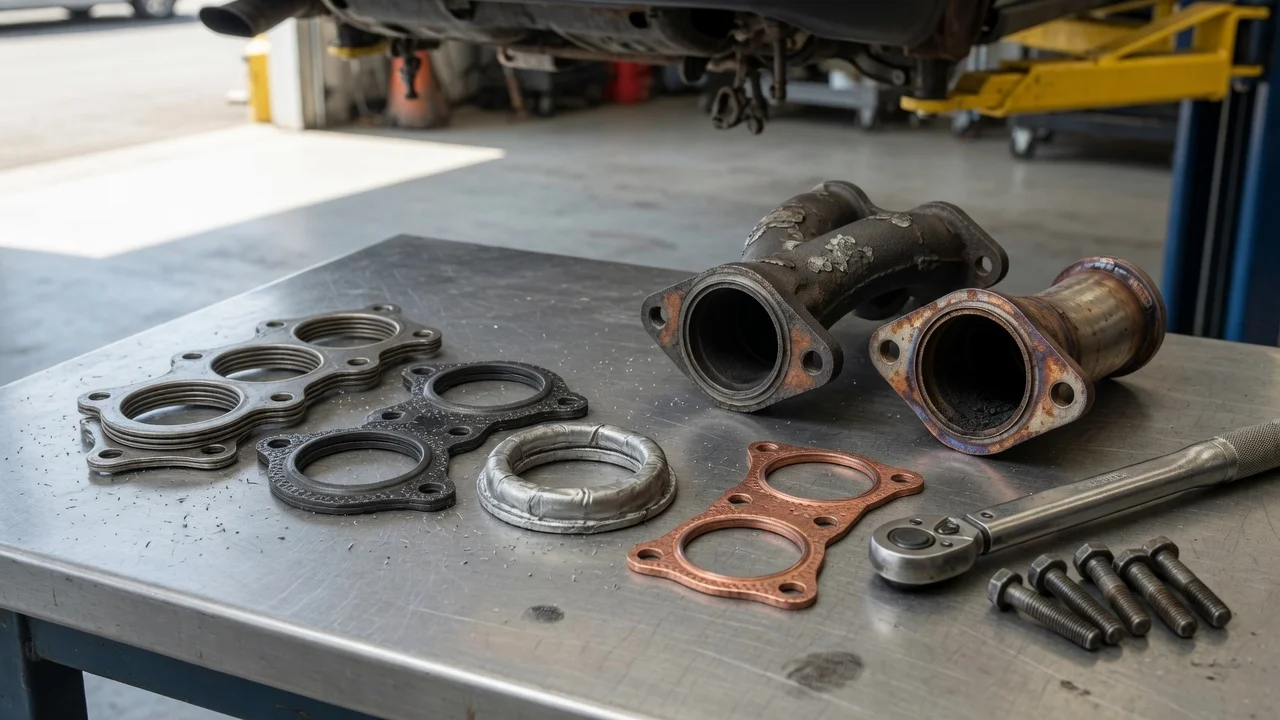
Different joints use different gasket styles because the flanges are not the same. A cylinder-head-to-manifold joint is usually a multi-port flat flange under high heat. A manifold-to-downpipe joint may be a flat two-bolt or three-bolt flange, a spherical donut, or a crush ring. Downstream pipe joints are often simpler formed gaskets or donuts. Treating all of these as interchangeable is a common reason a new gasket still leaks.
What to confirm before you buy
Start with the vehicle identity and the joint you are sealing. Model year, market, trim, engine code, and whether the exhaust is original, catalytic-equipped, or an aftermarket system all change which gasket is specified. Two cars with the same nameplate can use different manifolds, flange bolt patterns, or pipe diameters across years or powertrains. If you cannot resolve those differences from the parts listing, do not assume a “fits many models” gasket is correct.
Identify the joint: head-to-manifold, manifold-to-downpipe, flex-pipe, catalytic converter, resonator, muffler, or tailpipe hanger flange. Match flange geometry: port count and shape, bolt-hole count and spacing, inner and outer diameter, and whether the faces are flat, recessed, or spherical. Confirm one- or two-sided construction: some manifold gaskets are left and right specific; some downpipe gaskets are directional. Check whether the joint is designed for a reusable multilayer steel (MLS) or metal gasket, a graphite or composite sheet, a formed fiber gasket, a metal ring, or a donut that seats in a ball joint. Inspect the flanges before ordering a second gasket of the same type: warped, corroded, or hammered faces will leak even with a correct new seal. Plan fasteners at the same time: exhaust studs, nuts, and springs are often seized or stretched; a gasket alone does not restore clamp load. If the vehicle has an aftermarket header, catalytic converter, or cat-back, use the flange specification of that system, not the original-equipment listing, unless the seller states they share the same pattern.
Quoted prices for exhaust gaskets vary widely by joint, material, and whether you are buying a single seal or a manifold set, and advertised shelf prices are not the same as what a completed repair costs once fasteners, anti-seize or specified lubricant, and possible machining are included. This article does not assign dollar figures. Treat a very cheap gasket as a fitment and material risk until you can verify the same port layout, thickness, and temperature rating as the joint requires.
Gasket types and where they belong
Choosing among gasket types is a compatibility decision first and a preference second. Compare options only when they are made for the same joint, with the same port and bolt layout. Performance claims and thickness figures are only comparable when they refer to the same flange design and the same test or service condition.
Type | Typical joint | Strengths | Limits; Multilayer steel (MLS) or solid metal | Head-to-manifold; some high-heat collector flanges | Holds shape under high heat and repeated thermal cycling; often the specified type on modern engines | Needs flat, undamaged flanges and even clamp load; the wrong thickness can change port alignment or leave the joint short of crush; Graphite or graphite-coated composite | Manifold and mid-system flat flanges | Conforms to slightly imperfect surfaces and handles heat well | Can tear on install; some designs are single-use once compressed; Fiber or composite sheet | Lower-temperature pipe, converter, and muffler flanges | Inexpensive and adequate where heat is moderate | Burns or blows out if used on a manifold or close-coupled converter it was not designed for; Copper or metal ring / crush ring | Some manifold collectors and turbo or downpipe joints | Concentrates clamp load on a small sealing land | Usually single-use; reuse after flattening is a leak risk; Donut (often graphite-covered) | Ball-and-socket or flared pipe joints | Allows a few degrees of misalignment and movement | Wrong inner diameter or cone angle will not seat; a flat gasket cannot substitute; Spring-loaded or flex-joint seals | Joints designed to move with the engine | Protects the rest of the system from engine rock | Requires the matching springs, bolts, and donut; omitting hardware changes the joint
Which type fits which job
If you are replacing a failed original gasket, the first choice is the same style the joint was designed for, in the thickness the flanges expect. That is the default unless the flanges have been repaired, the exhaust has been changed, or the original material is known to be a poor match for a modified system.
Stock manifold-to-head repair: use the specified MLS, metal, or coated composite gasket for that engine’s port layout. Do not substitute a muffler-style fiber gasket. Downpipe or catalytic-converter flange with flat faces: a formed metal, graphite, or composite gasket that matches bolt pattern and bore is the usual fit. Confirm whether the converter inlet is two-bolt, three-bolt, or a unique OEM pattern. Ball, flare, or donut joint: buy a donut sized to the pipe and seat angle. A flat gasket will not seal a spherical joint. Aftermarket headers on a street engine: match the header flange, not the original manifold. If the header maker specifies MLS or a particular thickness, follow that; a thicker soft gasket will not correct a warped or poorly machined flange. High-mileage, slightly pitted pipe flanges downstream of the converter: a conformable graphite or quality composite gasket can seal better than a hard metal ring, provided the joint is in the temperature range those materials are made for. Turbocharger or close-coupled collector: use the metal ring, MLS, or specified multilayer gasket for that housing. Soft fiber gaskets are the wrong class of part at that heat.
A “universal” exhaust gasket is only a candidate when you can measure the flange and confirm bore, outer shape, and bolt holes yourself. Even then, it is a fitment gamble on multi-port manifolds. For a cylinder head or OEM collector, a vehicle-specific gasket is the safer purchase.
Condition of the joint can change the part you need
A correct gasket still fails if the mating surfaces cannot clamp it. Before you commit to a gasket-only purchase, look at flange flatness, rust scale, elongated bolt holes, broken studs, and whether previous repairs stacked extra gaskets or sealer. Exhaust sealer is not a substitute for the right gasket on a designed dry joint, and extra thickness from stacked gaskets can misalign ports or leave studs short of thread engagement.
Blown or soot-stained edges at one port often point to a warped manifold or uneven torque, not only a bad gasket. Machining or replacing the manifold may be required before any new seal will hold. A leak that returns immediately after a donut replacement often means the pipe flare is cracked, the springs are missing, or the pipes are no longer aligned. Catalytic-converter or oxygen-sensor trouble after an exhaust leak can follow from air entering the stream. Replacing the gasket does not by itself prove those parts are healthy, and a diagnostic trouble code alone is not proof that the gasket is the failed part. If studs are rust-welded or nuts round off, budget for stud replacement. Clamp load is part of the seal.
Installation choices that affect the purchase
Some gaskets are single-use. Crush rings, many graphite donuts, and some coated composites take a set on first torque and should not be reused after the joint is opened. MLS gaskets are sometimes reusable if they are undistorted and the manufacturer allows it; if the listing does not say so, treat the gasket as one-time. Buy the quantity the job needs, including both banks on a V-engine if both manifolds come off.
Torque sequence and dry versus lubricated threads matter as much as the gasket brand. Follow the fastener specification for that joint. Over-torque can split a composite gasket or distort a thin flange; under-torque lets the joint puff soot on the first heat cycle. Springs on flex joints are calibrated parts: replacing them with solid bolts changes how the donut seats.
A practical buying sequence
Name the joint and, if possible, photograph both flanges and the old gasket’s port layout. Decode the vehicle: year, market, engine, and whether the exhaust is original or modified. Select the gasket style that joint uses (MLS or metal, graphite/composite, ring, or donut), then match dimensions and bolt pattern. Add the hardware the joint needs: studs, nuts, springs, and any alignment sleeves specified for that connection. If flanges are damaged, resolve machining or replacement before ordering a premium gasket that cannot overcome a bent face. After install, check for soot, ticking on cold start, and fumes in the cabin. A new leak means the joint, not only the old gasket, still needs attention.
If a listing cannot show port shape, thickness, and the vehicles or header flanges it matches, keep looking. The cost of a wrong exhaust gasket is rarely the gasket itself; it is a second teardown, damaged studs, and a leak that can affect emissions equipment and cabin air.