Exhaust Gaskets: Choosing the Correct Replacement
The short answer
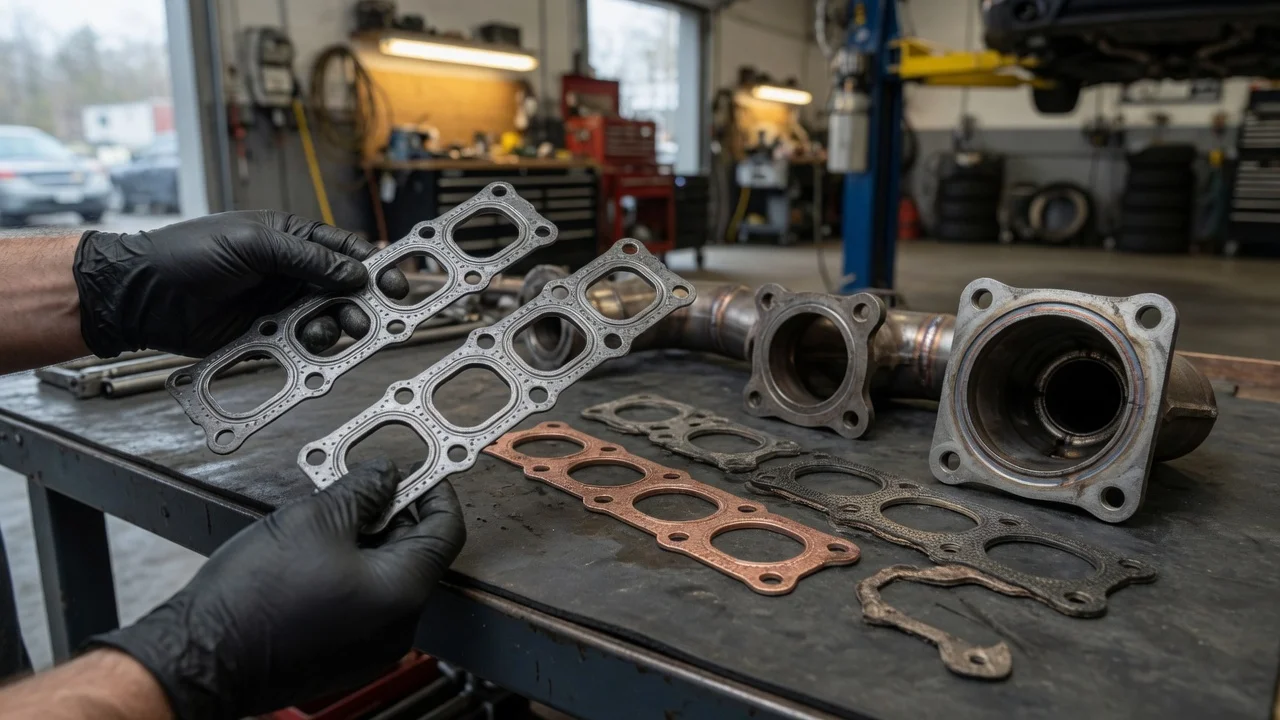
The correct replacement is the gasket made for that exact joint on that exact engine, not a look-alike of similar size. Exhaust gaskets seal hot, vibrating metal-to-metal joints. Shape, bolt pattern, thickness, material and coating all have to match the flange or port they sit between. A manifold-to-head gasket, a downpipe or collector gasket, a two-bolt or three-bolt pipe flange gasket, and a donut (ring) gasket are different parts and are not interchangeable.
Fitment is set by year, make, model, engine code and, on some vehicles, market or emissions package. If those do not line up, the part can sit off the ports, crush unevenly or blow out. Reused gaskets rarely reseal. Buy the gasket for the failed joint, inspect the mating faces before you commit, and replace related hardware when studs or flanges are damaged.
What an exhaust gasket does
An exhaust gasket fills tiny gaps between two machined or stamped faces so exhaust gas stays inside the system. Combustion gas is hot, under pulse pressure and mixed with moisture and soot. A failed gasket lets that gas escape as a tick, hiss or roar that often gets louder on cold start or under load. A leak at the manifold can also pull in extra air, confuse oxygen sensors and set a lean or catalyst-efficiency fault. Downstream leaks mainly cause noise, fumes and heat in the cabin or underbody.
The joint type decides the gasket type. Cylinder-head to exhaust-manifold joints see the highest heat and the most thermal cycling. Collector, catalytic-converter and pipe-flange joints see lower but still high heat and more movement as the system expands. Ball-and-socket or flared joints use a donut or ring gasket that compresses between two curved faces rather than two flat flanges.
What to check before you buy
Confirm the joint, then confirm the vehicle, then confirm the physical match. Skipping any of those steps is the usual reason a new gasket still leaks.
Identify the joint that failed
Manifold-to-head: leak at the cylinder head, often a tick that is loudest when the engine is cold. Manifold-to-downpipe or header collector: leak where the manifold or header meets the rest of the system. Converter, resonator or muffler flange: leak at a flat two-bolt, three-bolt or four-bolt pipe joint. Donut or ring joint: leak at a ball, flare or pipe-to-manifold socket, often with a crushed or broken ring still in place. Heat shield or hanger rattle can sound like a leak; look for soot, a black trail or a moving joint before you order a gasket.
Match the vehicle and engine
Use the vehicle identification number (VIN), engine code and model year together. Trim name alone is not enough when the same model sold with more than one engine, manifold or emissions layout. Left-hand and right-hand banks on a V-engine often take different gaskets. Turbo, non-turbo, dual-exhaust and single-exhaust layouts can change flange shape even when displacement is the same. If a catalogue lists more than one gasket for your year and model, the unresolved difference is usually engine, market or exhaust configuration, and that difference has to be settled before purchase.
Confirm shape, holes and thickness
Compare the new gasket with the old one and with the bare flange: port openings, bolt-hole count and spacing, and whether the part is a flat sheet, a layered steel sandwich or a donut. Port openings should line up with the ports, not hang into the gas path or leave an unsealed edge. Thickness matters because a gasket that is much thicker or thinner than the original can change pipe alignment or leave the joint under-clamped. Exact thickness, hole centres and temperature ratings are part-specific; they are not listed here and should come from the vehicle service information or the part specification for that listing.
Inspect the metal you are sealing
A new gasket cannot correct a warped manifold, a cracked flange, a pulled stud or a deeply pitted head face. Check for soot trails, rust scale, elongation of bolt holes, broken ears on pipe flanges and heat discoloration. Manifold warpage and cracked flanges are common reasons a correctly chosen gasket still fails. If the mating faces need machining, welding or replacement, budget for that work as part of the repair. Exhaust studs and nuts often stretch, seize or round off; many jobs need new hardware as well as the gasket.
Decide what else has to come with it
Gasket only: suitable when flanges are sound and the original hardware comes off cleanly. Gasket plus studs, nuts and, where used, springs: typical when fasteners are rusty, stretched or heat-soaked. Full joint kit: useful when a donut, springs and flange bolts are sold together for a ball joint. Manifold or pipe replacement: the better purchase when the casting or flange is cracked, warped or thin from corrosion.
No advertised or transaction prices, labour hours or total-repair ranges are supplied for this article, so ownership cost has to be checked locally. Ask whether the quote includes gaskets for every joint you will open, new fasteners, anti-seize where the maker allows it, and any machining or manifold replacement. A cheap gasket on damaged metal is usually a repeat leak, not a saving.
Checks that should stop the purchase
The listing is “universal” or sized only by pipe diameter when your joint is a shaped manifold or a specific bolt pattern. The photo shows a donut and you have a flat flange, or the reverse. The part is sold for several engines and the seller cannot confirm yours. You need a manifold gasket and the pack contains only a downpipe ring. The old gasket is MLS (multi-layer steel) or a coated metal sandwich and the replacement is a soft paper-style sheet not specified for that joint. You cannot inspect the flange and have no plan to repair it if it is damaged.
How the main types compare
Choose by joint first, then by material. Figures below are qualitative. Comparable lab ratings, crush loads and service temperatures were not supplied, so this is not a ranked performance table.
Type Where it belongs What it gives you Watch-outs; Multi-layer steel (MLS) Often head-to-manifold and other high-clamp, high-heat flat joints Holds shape under heat cycling; layers can recover a little as the joint moves Needs flat, clean faces and even torque; a warped manifold will still leak; Graphite or graphite-coated composite Many manifold, collector and flange joints Conforms to slightly imperfect surfaces and handles heat well Can tear on install; not a fix for a large warp or a cracked flange; Soft fibre or paper-style sheet Only where the maker specifies it; uncommon on modern hot exhaust joints Low cost and easy to cut Wrong for most high-heat exhaust joints; burns or blows out if used in the wrong place; Solid copper or other soft metal Some performance or older flat joints where specified Can be annealed and, in some designs, reused after proper preparation Must match the original design; over-thick copper can upset alignment; Donut / ring (graphite, mesh or metal-encased) Ball, flare and some manifold-to-pipe sockets Seals a pivoting or curved joint that a flat gasket cannot Must match inner diameter, outer profile and spring or bolt clamp style
Which option fits which job
If you are replacing a factory manifold gasket on a daily driver, stay with the construction the vehicle was built with, usually MLS or a coated composite listed for that engine. If the faces are clean and flat, MLS is the usual match for a high-clamp head joint. If the faces are slightly pitted but still serviceable, a specified graphite or composite gasket can fill small irregularities better than a hard steel sandwich, provided the listing is for that joint.
If the leak is at a pipe flange, match bolt pattern and port shape first. A three-bolt triangular gasket will not seal a two-bolt oval flange even if the pipe diameter looks the same. If the leak is at a ball or flare, buy the donut and the springs or bolts that set its crush. Installing a flat gasket on a curved joint, or a donut on a flat flange, is a mismatch, not a workaround.
If you are fitting aftermarket headers, do not assume the engine’s original manifold gasket still fits. Header flange thickness, port shape and bolt pattern often differ from the stock manifold. Use the gasket the header maker specifies for that header and that cylinder head. Mixing a stock gasket with a header, or a header gasket with a stock manifold, is a common leak path.
Original-equipment and quality aftermarket parts can both be correct when the listing matches the vehicle and joint. The decision criterion is documented fitment and material for that joint, not the brand name on the pack. Avoid unlisted “universal” sheets unless you are restoring a joint that was originally a cut gasket and you can duplicate the original shape, thickness and material.
Installation points that affect the purchase
Plan the job around access and extra parts, not only the gasket price. Manifold gaskets may require heat shields, engine mounts, steering or exhaust pipes to come off. Downstream flange gaskets are often a shorter job if the fasteners release. Penetrating oil, replacement studs and a torque sequence from the service information belong on the parts list before you start.
Do not use a hard-setting sealant on a joint that was designed as dry metal-to-gasket unless the vehicle maker calls for a specific product. Extra sealant can squeeze into ports, burn and hold the joint open. Clean both faces to bare, even metal; old graphite and carbon left on the flange act like a second, uneven gasket.
Tighten in the specified order and to the specified torque, then recheck after a heat cycle if the service information says to. Uneven clamp load is a frequent cause of a new gasket failing at one port or one bolt. Exact torque values vary by engine and fastener grade and are not given here; use the figure for your vehicle and hardware.
When the gasket is not the whole repair
Replace the manifold or pipe instead of stacking gaskets if the casting is cracked, an ear is broken, or a straightedge shows the flange is no longer flat enough to clamp. On turbo engines, a leak at the manifold or downpipe can also be a turbine-housing or dump-pipe joint; those take their own gaskets or sealing rings. If the engine has misfire, coolant loss or exhaust in the coolant, the leak may be a head gasket or cracked head rather than the exhaust gasket. Those are separate parts and a different diagnosis.
A practical next step
Find the soot trail, name the joint, then order the gasket listed for that joint on your year, model and engine, along with any studs or nuts that will not come off cleanly. Dry-fit the new part against the old gasket and the flange before you pay, or keep the option to return it if the holes or ports do not match. If the flange is damaged, price the metal repair or replacement at the same time so the gasket you buy has a surface that can actually seal.