Exhaust Manifold Gaskets: Choosing a Replacement
The short answer
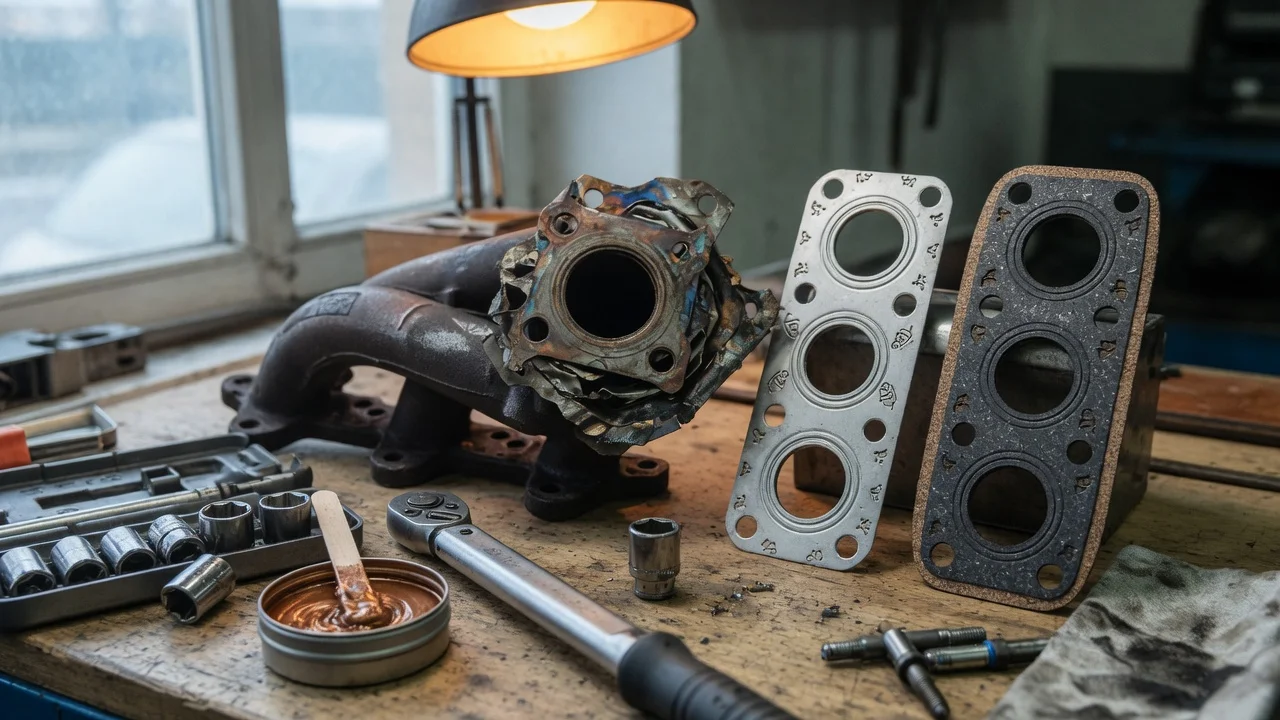
An exhaust manifold gasket is the seal between the exhaust manifold and the cylinder head. Replace it when that joint is leaking, and buy the gasket made for your engine’s exact manifold-to-head interface—year, make, model, engine code, and bank if the engine has more than one manifold. A generic exhaust gasket, a header gasket, or a part for a similar-looking engine is the wrong part even if the bolt holes look close.
The answer changes if the manifold itself is warped, cracked, or aftermarket. A new gasket will not seal a damaged or non-stock flange. In that case the manifold (or header) has to be repaired or replaced as well, and the gasket must match that hardware, not the original manifold.
What the gasket does, and how you know it has failed
The cylinder head and exhaust manifold meet at a hot, vibrating joint. Combustion gas leaves the ports under pulse pressure, so the gasket has to stay compressed as both parts expand and contract. When it burns through, crushes, or shifts, exhaust escapes at the flange instead of going down the pipe.
Common signs are a ticking or tapping that is loudest at cold start and often quiets as the metal expands; an exhaust smell in the engine bay or cabin; soot or discoloration at the manifold-to-head joint; and, on some engines, a lean or misfire-related code if a leak is upstream of an oxygen sensor. A leak at the manifold-to-downpipe joint is a different gasket. Confirm the leak is at the head before you order a manifold gasket.
What to check before you buy
Match the part to the engine, not just the vehicle name. Two trims of the same model year can use different heads, manifolds, or port shapes. Use the VIN or the engine code stamped on the block or listed on the under-hood label, and confirm whether you need one gasket or a pair. V6 and V8 engines usually have a left and right manifold; some kits include both, some sell them separately, and the two sides are not always identical.
Confirm year, market, trim, and powertrain, then the specific engine code and which bank is leaking. Check whether the manifold is original equipment or an aftermarket header; header flanges often need a header-specific gasket. Inspect the manifold flange and head surface. Warpage, cracks, broken ears, or pulled threads mean a gasket alone will not last. Decide whether you are replacing studs, bolts, and nuts at the same time. Exhaust fasteners often stretch, seize, or snap; a gasket kit that omits hardware is incomplete if the old fasteners are damaged. Ask whether heat shields, oxygen sensors, or the manifold must come off to reach the gasket, and factor that labour and extra parts into the job, not only the gasket price. On high-mileage engines, budget for the chance that a seized stud turns a gasket job into a head-repair or manifold-replacement job.
Advertised kit prices and completed job costs are not the same thing. A gasket that looks inexpensive can still be the smaller share of the bill once fasteners, anti-seize, a replacement manifold, and labour are included. Without a dated quote for your market and engine, treat any round number you see online as an advertisement, not a total cost.
How gasket types differ
Replacement gaskets are sold in a few constructions. The right choice is the one that matches the flange design and the way the joint is clamped, not the thickest or most expensive sheet.
Multi-layer steel (MLS): stacked steel layers, often with an embossed sealing bead. Common on later engines with smoother flanges and higher clamp loads. Needs flat surfaces and correct torque; it does not fill deep pits the way a soft gasket can. Graphite or graphite-coated composite: more conformable on older, slightly imperfect flanges. Can be a practical choice when the manifold is original and the surface is not perfectly true, provided the gasket is still the correct port shape. Fibre or composite: inexpensive and widely used on older designs. Less tolerant of repeated heat cycles and uneven clamp load than MLS on a modern flange. Solid or embossed metal (including copper-style gaskets): used on some performance and header applications. Sealing depends on flange flatness and even fastener stretch; they are not a universal upgrade over the factory type.
If the engine originally used MLS, stay with MLS or an equivalent OEM-style part unless the manifold has been changed. If you are fitting headers, use the gasket the header maker specifies for that flange thickness and port shape. Mixing a thick composite gasket into a joint designed for a thin MLS part can alter manifold position, stud engagement, or sensor and pipe alignment.
OEM-style versus aftermarket
An OEM-style gasket is built to the original port layout, thickness, and fastener pattern. That is the default choice when the manifold and head are stock and in good condition. Aftermarket gaskets vary: some copy the original closely, some enlarge the ports for headers, and some change thickness or material. Port openings that are smaller than the head ports can obstruct flow; openings that are larger can leave an edge exposed to exhaust pulse and burn through sooner.
There is no reliable public ranking of brands in the material supplied for this article, and catalogue claims of “better than OEM” are not comparable test results. Judge a part by fitment listing, material that matches the joint, and whether the kit includes the layers or hardware your engine actually uses. If the listing does not state the engine code and manifold type, keep looking.
Related parts that change the decision
A leaking gasket is sometimes the visible failure, not the only one. A warped manifold will crush a new gasket on the high spots and leak again. Broken or missing heat shields raise local temperature and can shorten gasket life. Exhaust manifold studs that have already stretched or rusted in the head are a reason to buy a complete fastener set before the job starts, especially on engines known for seized exhaust hardware.
If the manifold-to-head joint has been leaking for a long time, check nearby wiring, the oxygen sensor, and the valve cover or other adjacent gaskets for heat damage. Those items are separate parts; they do not come with a typical manifold gasket, but they can decide whether the repair is worth doing in isolation.
Installation checks that affect which gasket you should buy
Buy a gasket you can actually install on the hardware you have. Some engines need the manifold lifted only a small amount; a gasket that cannot be slid into a tight gap is the wrong service part even if the holes match on the bench. Others require the manifold fully off, which is the time to mill or replace a warped flange rather than stack a thicker gasket as a shortcut.
Verify port alignment against the head and manifold before sealant fantasies enter the picture. Most modern exhaust manifold gaskets are designed to seal dry; added sealant can squeeze into ports or burn out and is not a substitute for flatness. Plan to torque in the specified sequence and to the specified values for that engine. Uneven clamp load is a common reason a new gasket fails quickly. Replace one-time-use nuts, stretch bolts, or damaged studs rather than reusing them under a new gasket. After the repair, recheck for a cold-start tick and for soot at the flange once the engine has heat-cycled.
A practical way to choose
If the manifold and head are stock and the flange is flat, order the OEM-style gasket for that engine code and bank, plus new exhaust fasteners if the old ones are rusty or the service information calls them single-use. If you are installing headers, order the gasket specified for those headers. If the manifold is cracked or the flange is warped, replace or machine the manifold first, then fit the gasket that matches the repaired joint.
Skip the part if fitment is listed only by a broad model name, if the port shape does not match photos of your manifold, or if a seller cannot say whether the kit is for the left bank, right bank, or both. Specific street prices, labour hours, and thickness measurements are not included here; get those from a current quote for your vehicle and market before you commit.