Exhaust Joint Gaskets: Choosing the Correct Replacement Seal
Short answer
The correct exhaust joint gasket is the one matched to your specific vehicle, flange type and joint location. Fit depends mainly on the model year, market, engine, exhaust configuration and the shape of the mating surfaces. A gasket that looks close but has the wrong inside diameter, bolt spacing or seating profile can seal poorly or fail early.
What an exhaust joint gasket does
An exhaust joint gasket seals the connection between two exhaust components, such as a manifold and downpipe, a downpipe and catalytic converter, or a pipe and muffler. It prevents exhaust gas from escaping before it reaches the tailpipe while allowing for slight movement and heat expansion.
Match the gasket to the flange type
Exhaust joints use several seating styles. The replacement must match the original design because the flange shapes control how the gasket is compressed.
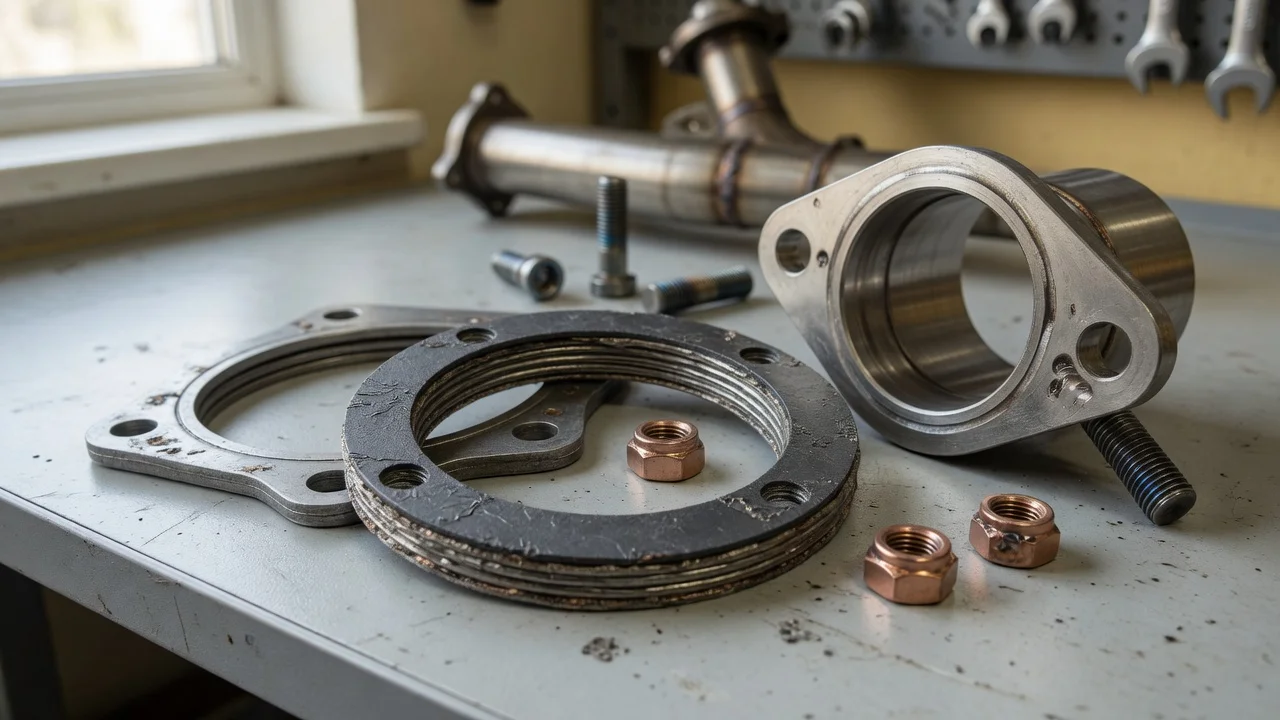
Flat flange gaskets sit between two flat machined faces and are usually punched from multi-layer or fiber-faced metal sheet. Donut gaskets are round, tapered rings that seat in a flared or ball-shaped joint and tolerate slight angular movement. Ring or crush gaskets fit a recessed groove in one flange and deform slightly when the fasteners are tightened. Metal O-ring and spring-loaded designs are used at flex couplings or slip joints where movement is greater.
Checks before choosing a replacement
First confirm the exact application: model year, market, engine and exhaust system variant. Vehicles can have different downpipe or converter flanges by engine or emissions package, so a catalog listing for the same model but a different engine may not fit.
Then compare the old gasket and the joint surfaces where possible. Measure the inside diameter, outside diameter, bolt hole spacing and thickness. Check whether the old part is a flat gasket, donut or crush ring. Rust, cracking or a heavily pitted flange may mean the gasket alone will not restore a reliable seal.
Material trade-offs
Material choice affects how the gasket handles heat and movement. The best option depends on the joint design and how much repair work you are willing to do.
Material type|Typical use|Trade-off; Graphite-faced composite|Flat flanges; conforms to minor surface irregularity|Good sealing, but can be less durable under severe movement; Multi-layer steel|Flat flanges and high-temperature joints|Strong and long-lasting, but needs clean, flat flange surfaces; Compressed fiber|General flat joints|Affordable and easy to install, but less tolerant of extreme heat or flex; Soft metal crush ring|Recessed or machined flanges|Seals well when torqued correctly, but is usually single-use; Donut composite or wire-reinforced ring|Ball-and-socket and flared joints|Allows flex, but must match the flare angle and seat diameter
Connect the correct part to the repair
Choose a gasket from a catalog that ties the part to your specific powertrain and exhaust configuration. Avoid selecting by appearance alone. If the joint has been leaking long enough to erode a flange or if the old gasket has deformed into the recess, replace or resurface the affected component rather than relying on a thicker gasket to hide the damage.
Fit and torque matter
A correct gasket can still fail if the flanges are not clean, the gasket is not centered, or the fasteners are tightened unevenly. Remove all old gasket material, check that the flanges sit parallel, and bring the fasteners down evenly. Use the torque value specified for your vehicle when one is available.
When the wrong gasket is already suspected
A replacement that burns out quickly, produces a ticking or chuffing leak at the joint, or catches on one edge during installation is probably the wrong profile or size. In that case, return to the application data and compare the new part directly with the original at the same location.
Limits of this guidance
No universal gasket fits all exhaust joints. Always verify the exact vehicle application and flange configuration before purchase. Where procedure, torque or resurfacing requirements are not stated for your specific model, consult the relevant service information for the applicable model year and market.