Why Does Remote Start Depend on Network Coverage?
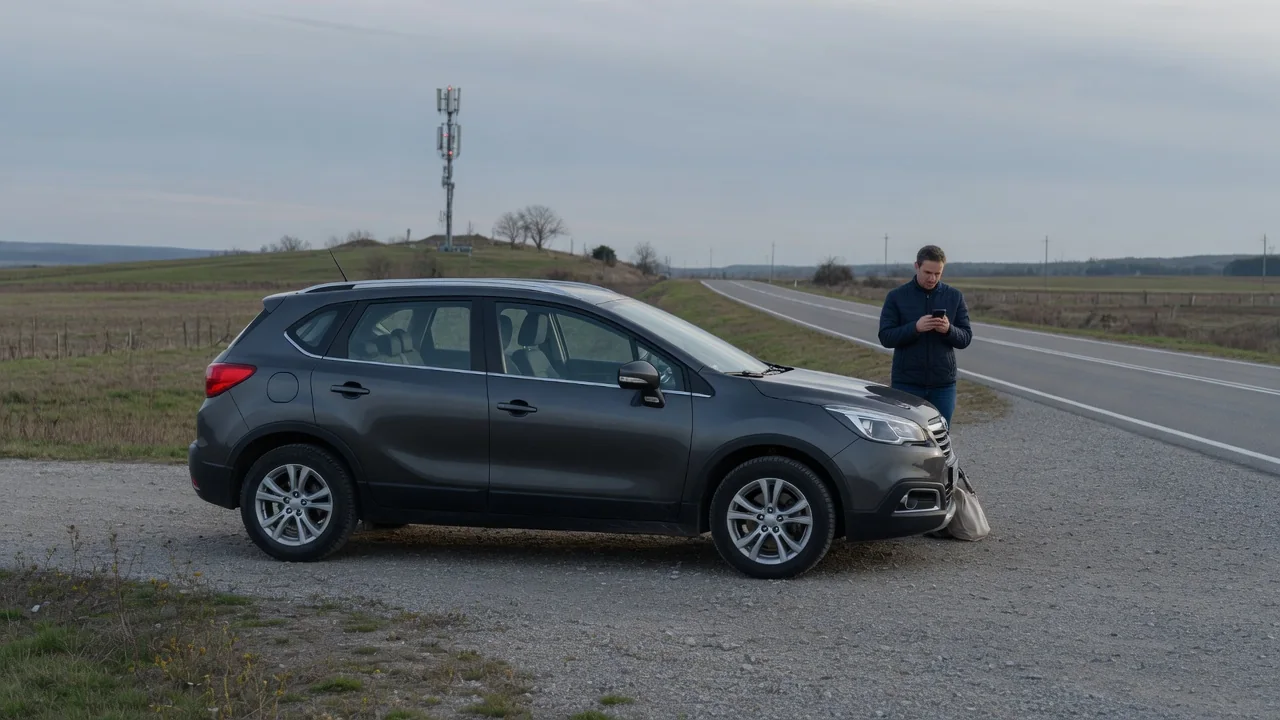
When you tap remote start in a car app, your phone does not talk to the engine directly. The request travels over the internet to the automaker's or service provider's servers, then across a cellular network to a modem built into the vehicle. If any link in that chain is weak or missing, the command can stall, arrive late, or never confirm. Here is how the process works, what the vehicle does with the command, and how to troubleshoot failures.
Command delivery
App-based remote start is a relay. The app sends your request through whatever data connection the phone has, whether Wi-Fi or cellular. A cloud platform run by the manufacturer or its connected-services partner receives it, confirms that your account is signed in, checks that the vehicle is linked to that account and that the required service is active, and then forwards the command toward the car. On the vehicle side, the receiving hardware is usually called a telematics control unit. It has its own cellular modem and SIM or embedded SIM, and it connects to a carrier network independently of your phone.
This design is what makes remote start work from across town, but it also explains the dependence on coverage. Your phone having a strong signal says nothing about the car's signal. The vehicle might sit in an underground garage, inside a concrete or steel parking structure, or in a rural area with thin coverage. Antenna placement and surrounding building materials affect reception, so a car can lose its connection a short distance from a spot where your phone works fine. If the server cannot reach the vehicle's modem, the command has nowhere to go.
There is also a timing factor. To avoid draining the 12-volt battery while parked, telematics units generally spend much of their time in a low-power state and wake up to check for incoming requests. Exact methods differ between manufacturers, but in general a weak or intermittent signal can delay that wake-up step or interrupt the data exchange that follows. That is why a command may take noticeably longer in poor coverage or time out completely.
Vehicle response
Once the command arrives, the telematics unit passes it over the vehicle's internal network to the modules that manage security, locks, and the powertrain. Before starting, the vehicle typically checks a set of conditions. Common examples include doors closed and locked, hood closed, transmission in park, no warning condition that blocks starting, and enough fuel or battery charge. The exact list varies by vehicle, so the owner's manual is the reliable source for what your car requires. If a condition is not met, the vehicle declines the request even though network delivery succeeded.
Many systems also limit how long the engine runs after a remote start and how many remote starts can occur in a row before someone must start the vehicle normally. A remotely started vehicle generally cannot be driven until a valid key is present and the driver completes the normal start procedure. On electric and some hybrid vehicles, the equivalent command may precondition the cabin or battery rather than start an engine, but it relies on the same connected path.
The response also has to travel back. After acting on the command, the vehicle reports its status through the same cellular link and cloud platform to your app. In weak coverage, that return message can be delayed or lost, so the app may show a timeout or failure even when the engine actually started, or it may display a pending state for a long time. This differs from remote start on a key fob, which sends a short-range radio signal directly to the car and does not use cellular service at all.
Troubleshooting
Start by working out which link in the chain failed. On the phone side, confirm the app has a data connection, try switching between Wi-Fi and cellular, and make sure you are still signed in. On the account side, check that the connected-services plan or trial that includes remote start is active and that the vehicle is still associated with your account, which can change after a sale or ownership transfer. If the app or provider reports a service outage, the problem lies outside both your phone and the car.
Next, consider where the vehicle is parked. If remote start works at home but fails in a particular garage or remote lot, coverage at that spot is the likely cause, and moving the car to an open-air location is the practical fix. Many apps display when the vehicle last reported its location or status; a timestamp that is hours or days old suggests the car has not been able to reach the network. Some vehicles also show a connectivity indicator on the infotainment screen.
If the network seems fine, look at the vehicle itself. An open door, a hood that is ajar, or a faulty hood or door sensor can block remote start. A weak 12-volt battery can prevent starting and, on some vehicles, causes the telematics system to reduce its activity to conserve power. The consecutive remote-start limit may also have been reached. When commands fail in every location and the account is in order, a dealer or qualified technician can check the telematics unit, its software, and its antenna connections.
Practical implications and limits
Treat app-based remote start as a convenience that works when conditions allow, not as a guaranteed service. Where the car is parked matters as much as where you are standing, so it helps to learn which of your regular spots give the vehicle reliable reception. If your vehicle also supports key fob remote start, that option can serve as a backup within radio range. In time-sensitive situations, such as clearing frosted glass before an early departure, leave extra margin rather than counting on an instant response.
Network dependence also affects long-term ownership. A telematics modem is built for specific cellular technologies, and carriers have retired older networks in the past. Vehicles whose modems relied on those networks lost connected features unless the hardware or service was updated. Connected-services terms can also change, and remote start is sometimes tied to a paid plan after an initial trial. If you are buying a used vehicle, it is worth confirming that its connected services can still be activated for a new owner.
Finally, a slow response is not always a failure. Because each step in the chain adds some delay, tapping the command repeatedly can create confusion about which request the vehicle acted on. Waiting for the app to finish reporting, or checking the vehicle status after a short pause, gives a clearer picture than sending the same command several times.