Why Does Old Car Paint Crack? Aging, Movement and Refinish
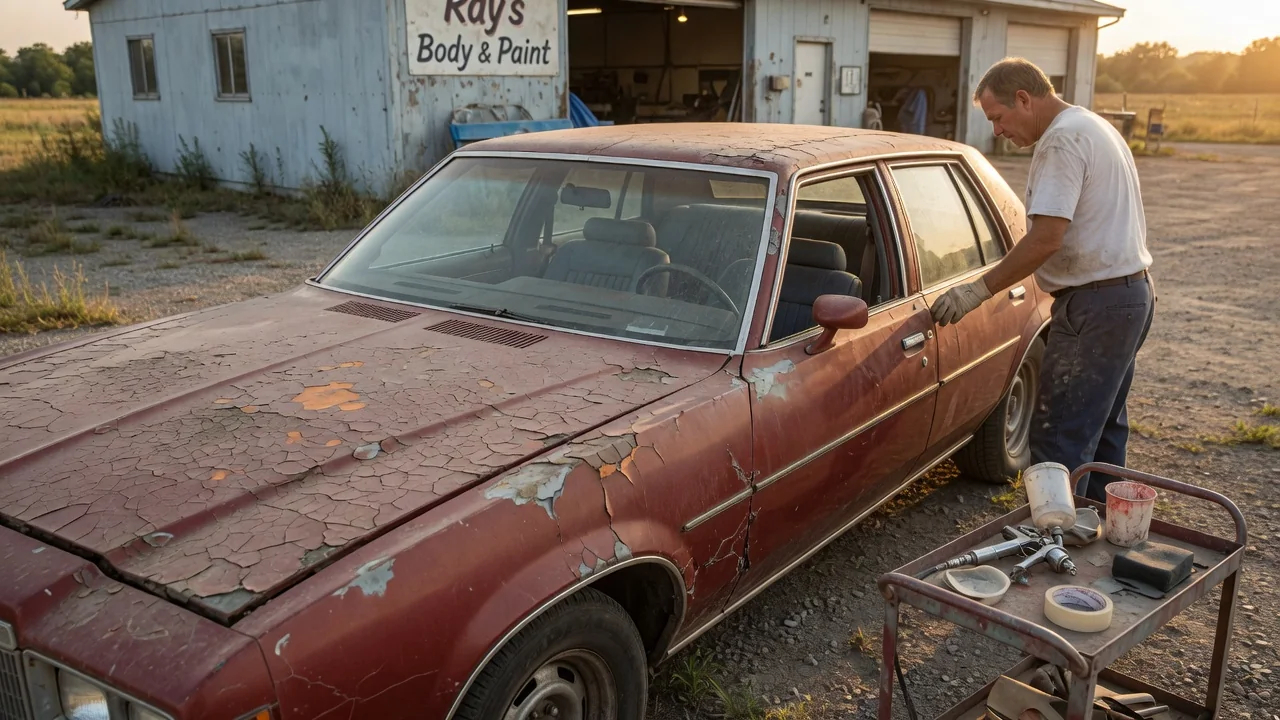
Cracking is one of the most common faults on older paint, and it rarely has a single cause. Old car paint cracks because a finish is a stack of layers bonded to a body that moves, and both the layers and the body change over time. This article explains the main classic paint cracking causes: aging of the film itself, movement underneath it, and refinishing choices that can either fix the problem or bring it back.
Aging layers: how the paint film itself breaks down
An automotive finish is not one coat. It is usually a system of primer, sometimes a sealer, one or more color coats and, on many later finishes, a clear coat. Each layer has to stay bonded to the one beneath it while staying flexible enough to handle heat, cold and minor flexing of the panel. When any part of that system loses flexibility, the film can no longer stretch and shrink with its surroundings, and it relieves the stress by cracking.
Older finish types age in characteristic ways. Lacquers, widely used on older vehicles, depend on plasticizers to stay pliable. Over the years those compounds can migrate out or evaporate, leaving a harder, more brittle film. Enamels and later urethane systems cure chemically, but ultraviolet light, heat and oxygen still break down their resins at the surface. The result is often fine checking or crazing, sometimes with chalky oxidation. It starts in the top layer and works deeper as the film deteriorates.
Repaint history matters as much as age. A car that has been resprayed several times may carry a very thick total film, and thick paint generally tolerates less movement than thin paint. Layers applied over an incompatible base can also fail. Strong solvents in a new coat may soften or wrinkle the old one. A hard film laid over a softer one can crack because the two expand and contract at different rates.
Movement: when the body underneath will not stay still
Paint sits on a substrate that is constantly moving. Steel panels expand in the sun and contract overnight. Doors and hoods flex every time they are closed, and the whole body shell twists slightly as the car drives over uneven roads. A young, flexible film follows these movements without trouble. An aged, brittle film does not. The same everyday stresses that were harmless when the car was new eventually open cracks, often first at edges, creases and other areas that flex repeatedly.
Hidden repairs are a frequent source of localized cracking. Body filler can shrink or move independently of the surrounding steel if it was applied too thickly, put over poorly prepared metal or not given enough cure time. The paint above it may then crack along the outline of the repair. Rust is another cause. Corrosion products take up more space than the original metal, so rust developing under the film pushes it outward and causes blisters that eventually split. Lead-filled seams and joints between panels can also show cracks in the paint if the joint moves.
Fiberglass and other composite bodies behave differently from steel. They flex more, and impacts or stress around mounting points can produce spider-web or star-shaped cracks that radiate from a single point. Often the gel coat or resin beneath the paint has cracked first, and the paint is simply showing the damage underneath. The crack pattern is therefore a useful clue. Uniform fine checking points toward film aging. Localized lines or radiating cracks suggest movement, impact or a failed repair below.
Refinish: why cracks come back and what a lasting repair involves
Cracks in an aged finish usually run through the film rather than sitting on top of it. Polishing, glazing or spraying another coat over them therefore rarely gives a durable fix. New paint applied over cracked paint tends to follow the old fractures, and as the new coat cures and the panel keeps moving, the cracks reappear in the fresh finish. Adding more material also increases total film thickness, which can make the next round of cracking more likely.
A lasting refinish generally means removing the failed paint across the affected area, often the whole panel. Removal goes down to a stable layer or to bare substrate. Common methods include sanding, chemical stripping and media blasting, and each has trade-offs. Careless, aggressive blasting, for example, can warp or thin large flat sheet-metal panels. Once the paint is off, the underlying cause has to be dealt with. Rust should be cut out or treated. Oversized filler should be replaced with properly shaped metal and a thin skim coat. Composite damage should be repaired and reinforced rather than merely filled.
Product choice and application also determine whether the new finish lasts. Primer, sealer, color and clear should be used as a compatible system, following the manufacturer's data sheets for mixing, film build and flash or cure times. Where some old paint has to stay, a solvent test on a hidden spot can help identify a sensitive finish such as lacquer, and a suitable sealer can isolate it. Keeping the total film within the recommended range preserves the flexibility the new finish needs.
Practical implications and limits for owners
If a car is not about to be refinished, the practical goal is to slow further damage. Storing it out of direct sunlight, away from large temperature swings and in reasonably dry conditions reduces the stresses that drive both film aging and corrosion. Cracks deserve attention even when they look cosmetic, because they can let water reach the primer and metal. Over time, that turns a surface problem into a structural one. Watching whether cracks grow, multiply, lift or blister helps you decide when action is needed.
Appearance alone has clear limits as evidence. The same crack pattern can have different causes on different cars. Original paint type, factory process and repaint history also vary widely, so general mechanisms cannot predict how a particular vehicle will behave. A thickness gauge suited to the body material, along with close inspection of suspect areas, gives better information than photos. Sometimes stripping a small test area is the only way to see what lies beneath. Collectors face one more judgment: preserving an original but cracked finish may matter more than a flawless refinish. That choice depends on value and priorities, not chemistry.