Why Does a Car's Compass Change Direction Slowly?
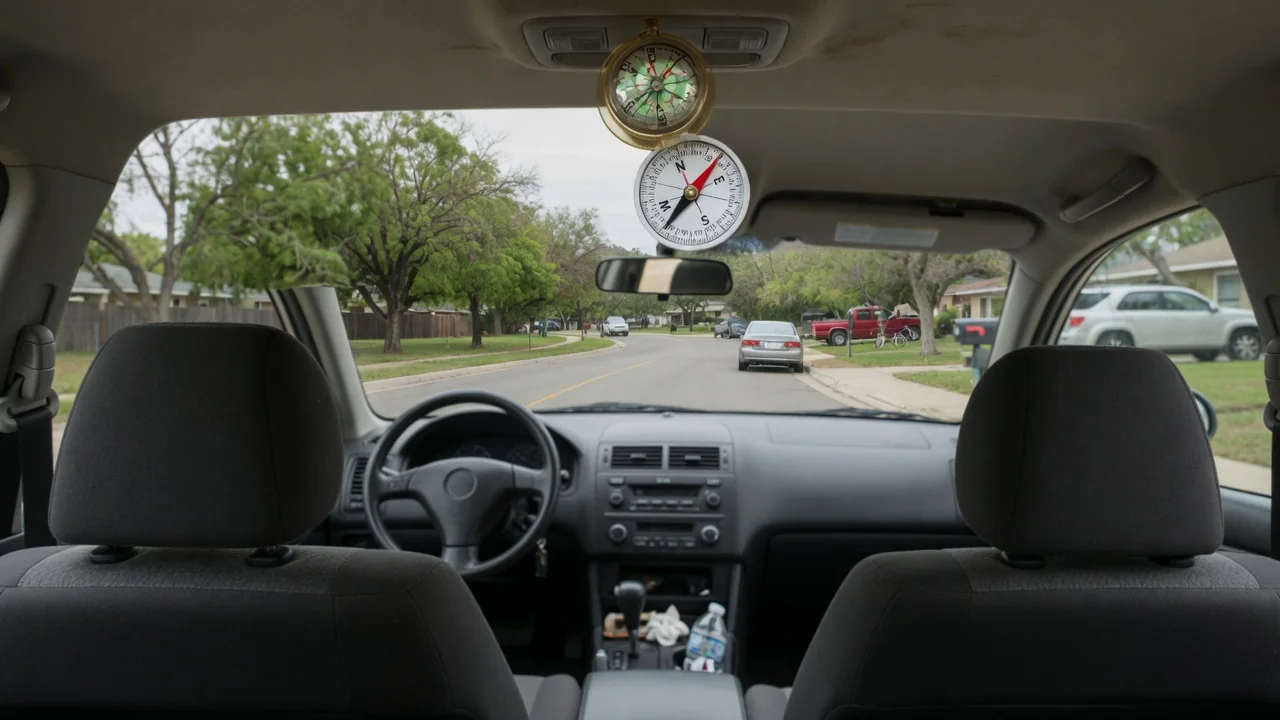
Drivers often ask why does a car's compass change direction slowly after a turn, with the display lingering on the old heading for several seconds. In most vehicles the delay is deliberate: the system smooths a weak, noisy magnetic signal before showing it. Understanding that filtering, and how calibration affects it, helps separate normal lag from a real problem.
Sensor input
A vehicle compass usually relies on a magnetometer, a small sensor that measures the strength of the earth's magnetic field along two or three axes. That field is weak, and the sensor sits inside a steel body surrounded by speakers, motors, wiring, and electronics that create their own magnetic influences. The raw signal therefore jitters constantly, even when the car is parked. Depending on the design, the sensor may live in the rearview mirror housing, an overhead console, the instrument panel, or a module elsewhere in the body.
Because the raw reading is so unsteady, the compass module averages many samples before updating the display. This filtering trades speed for stability: a heavily damped display will not flicker between north and northeast at a stoplight, but it also takes longer to acknowledge a real turn. Some vehicles supplement or replace the magnetic sensor with heading derived from satellite positioning, which behaves differently because it calculates direction from travel between position fixes rather than from the magnetic field itself. The owner's manual usually identifies which type is fitted.
Vehicle movement
How the car moves strongly shapes how quickly the heading updates. During a sharp turn at an intersection, the vehicle rotates faster than the averaging routine is willing to follow, so the display steps through intermediate points or holds the old heading briefly before settling. A gentle highway curve produces a gradual change the filter can track almost invisibly. Many displays also show only eight cardinal and intercardinal points, so the reading does not change at all until the heading crosses a boundary between two of them.
Satellite-based compasses add their own movement dependence. Since they infer direction from a sequence of positions, they need the car to travel some distance before a new heading is trustworthy. At walking speeds, in parking lots, or while stationary, such a system may freeze the last known direction or update sluggishly, then catch up once speed builds. Tunnels, parking structures, and dense urban streets with tall buildings can interrupt the signal and extend the delay. Systems that blend wheel speed or yaw information may respond faster, but that varies by manufacturer.
Abnormal behavior
A few seconds of lag after a turn is ordinary, but some patterns suggest something beyond normal filtering. A compass that stays on one heading through several turns, shows a direction clearly at odds with the road, or reads correctly in some directions and wrongly in others may have lost its calibration. Calibration teaches the module to subtract the vehicle's own magnetic signature, and that signature can shift after body repairs, windshield or mirror replacement, or installation of accessories near the sensor.
Local interference produces similar symptoms. Magnetic phone mounts, dash cameras, radar detectors, roof racks, and aftermarket lighting placed near the sensor can bias the reading or make it drift. External sources matter too: steel bridges, underground parking decks, and large power lines can pull the heading temporarily, with the display recovering slowly afterward because the filter still holds the distorted samples. Some compasses display a calibration prompt or a blank heading when the stored correction is no longer valid, though the exact message depends on the vehicle.
Everyday Use and Observations
In daily driving, a simple way to judge the compass is to watch it on a familiar route. On a long straight road with a known orientation, the display should settle on the expected heading and stay there. After a ninety-degree turn it should follow within a short, consistent interval. Consistency matters more than speed: a compass that always lags by the same amount is behaving as designed, while one whose delay or accuracy changes from day to day deserves closer attention.
Regional settings also influence what drivers see. Magnetic north and true north differ by an amount that changes with location, so many magnetic compasses use a variance or zone setting to correct the reading. After a long road trip or a move across the country, an outdated zone can leave the display consistently off by one point, which is easy to mistake for slow response. Comparing the car's reading with a phone held well away from the dashboard gives a rough cross-check, keeping in mind that phones have their own errors.
Limits and Next Steps
An in-car compass is a general orientation aid, not a precision instrument. The filtering that makes it readable also means it will never match the instant response of a navigation map, and the coarse display hides small heading changes entirely. Expecting it to swing immediately through a roundabout or a tight parking maneuver sets a standard the design was not built to meet. If the navigation system and the compass disagree briefly after a turn, the difference usually reflects separate data sources and update rates rather than a fault.
When behavior does seem wrong, the sensible first steps are simple ones. Removing magnetic or electronic accessories from the area around the mirror and overhead console rules out interference, and checking the zone setting addresses a consistent offset. The owner's manual describes the recalibration routine for that particular vehicle, which often involves driving slowly in circles in an open area away from large steel structures. If the compass still sticks, drifts, or goes blank after that, a dealer or qualified shop can test the module and its wiring.