Find Direction East: How to Identify Compass Directions at Your Breakdown Location

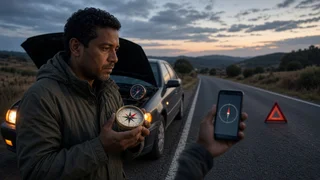
When your vehicle breaks down, a dispatcher, tow operator or emergency responder may ask which way you were traveling or which side of the road you are on. Saying "eastbound, on the right shoulder" can help them reach you faster than a vague description. This guide covers the practical ways to find east and the other compass directions from where you are, and how to pass that information on.
The Short Answer
The quickest way to find east is usually a compass or map app on your smartphone. It shows the direction you are facing and your position on a map. If your phone is unavailable, use these alternatives: a compass display in your vehicle, if it has one; the direction printed on highway route signs; or the sun, which rises roughly in the east and sets roughly in the west.
Once you know east, the other directions follow. Face east, and north is to your left, south is to your right, and west is behind you.
Precision matters less than clarity. Responders generally need your road, your direction of travel and a nearby landmark, exit or mile marker. They do not need an exact bearing.
Using Your Phone's Compass or Map
Most smartphones include a magnetometer, a sensor that detects the Earth's magnetic field. Compass apps and map apps use it to show which way you are facing. In a map app, your location usually appears as a dot. A cone or arrow shows your heading, and the map can be rotated so north is at the top. Browser-based online compass tools exist too, but they rely on the same phone sensor and may need permission to access motion and orientation data.
Open the compass or map app and allow location access if prompted. If the app asks you to calibrate, follow its on-screen motion, often a figure-eight movement. Hold the phone flat and away from the vehicle body, magnets or other electronics. Large metal objects and electrical systems can distort the reading. Read the heading, or orient the map so north is at the top, and note which way the road runs. Read out the coordinates or nearest address if the app shows them. These are often more useful to a dispatcher than compass directions alone.
Phone compasses point to magnetic north, which differs somewhat from true geographic north depending on where you are. Some apps can show true north instead. For describing a breakdown location, the difference is not significant.
Finding the Compass Display in Your Vehicle
Some vehicles show a compass heading, typically as a letter such as E, NE or SE. Where it appears varies by manufacturer, model, model year and trim. Common locations include:
A small readout built into the interior rearview mirror; The instrument cluster or a driver information screen between the gauges; The overhead console near the dome lights; The infotainment screen, especially when the built-in navigation map is active
Many vehicles have no compass display at all, and on others it is part of an optional package. Your owner's manual is the reliable source for whether your configuration includes one, where it is and how to calibrate it. Vehicle compasses can drift and may need recalibration. Also note that most show the direction the vehicle is pointing, which is useful only if the vehicle stopped facing its direction of travel.
Reading Road Signs and Highway Clues
On US highways, the road itself often tells you which way you are going:
Route signs usually carry a direction word above or beside the route number, such as EAST or WEST, for your side of the road. On the Interstate system, even-numbered routes generally run east-west and odd-numbered routes generally run north-south. Individual roads can curve well away from their nominal direction. On most Interstates, mile markers increase from west to east and from south to north. If the numbers are rising as you drive an east-west Interstate, you are typically heading east. There are exceptions, so confirm with a sign where possible. In many states, exit numbers are based on the mile marker, which helps you place yourself between exits.
Practices vary by state and by road type. Treat these patterns as strong hints rather than guarantees, and prefer a posted direction sign when you can see one.
Using the Sun or Stars Without a Device
If your phone is dead and there are no signs in view, natural cues can give a rough direction:
Morning: The sun is in the eastern part of the sky. Evening: The sun is in the western part of the sky. Midday: Across the continental US, the sun sits in the southern part of the sky, so shadows point roughly north. Shadow stick: Place a straight object upright, mark the tip of its shadow, wait a while and mark it again. A line from the first mark to the second runs roughly west to east. Night: In the Northern Hemisphere, Polaris, the North Star, sits close to true north. Facing it puts east on your right.
Sunrise and sunset points shift north and south of due east and west through the seasons. These methods are approximate, but they are usually enough to tell eastbound from westbound.
Describing Your Location to Responders
Direction is one part of a useful location report. When you call for help, give as much of the following as you can:
Road name or route number; Direction of travel, for example "heading east"; Which shoulder or lane you are in; Nearest mile marker, exit number or cross street; GPS coordinates from your phone, if available; Visible landmarks such as bridges, businesses or overpasses; Vehicle color, make and model
Stay off the travel lanes while you check signs or markers. If reaching a sign would put you near traffic, rely on your phone or on what you can see from a safe position.
What This Guide Does Not Cover
No model-specific data was available, so this guide cannot confirm which vehicles include a compass display, where it is located or how it is calibrated. Check your owner's manual for those details. Details of particular apps, roadside assistance programs or state signage practices are also outside its scope.