How to Use a Compass to Find North and Report Your Direction After a Breakdown
The short answer
To find north with a compass, hold it flat and level, away from your vehicle and other metal objects, and wait for the needle to settle. The marked end of the needle points to magnetic north. Magnetic north is the direction Earth's magnetic field pulls the needle toward. It is not exactly the same as true (geographic) north, but for describing which way you were driving, the magnetic reading is usually enough.
After a breakdown, the direction matters because it tells responders which side of a divided road you are on. On US highways, the most useful way to say it is the direction printed on the route signs, such as northbound or westbound. A compass helps you confirm that direction when you are unsure or there are no signs in sight.
Safety before taking a reading
Do not walk along a live traffic lane to get a cleaner compass reading. If leaving the vehicle is unsafe, use the in-car compass display, a phone compass, or road signs and map apps instead, and accept a less precise reading. A rough direction given from a safe position is more useful than a precise one taken near traffic.
Recognizing the north-pointing end and the compass display
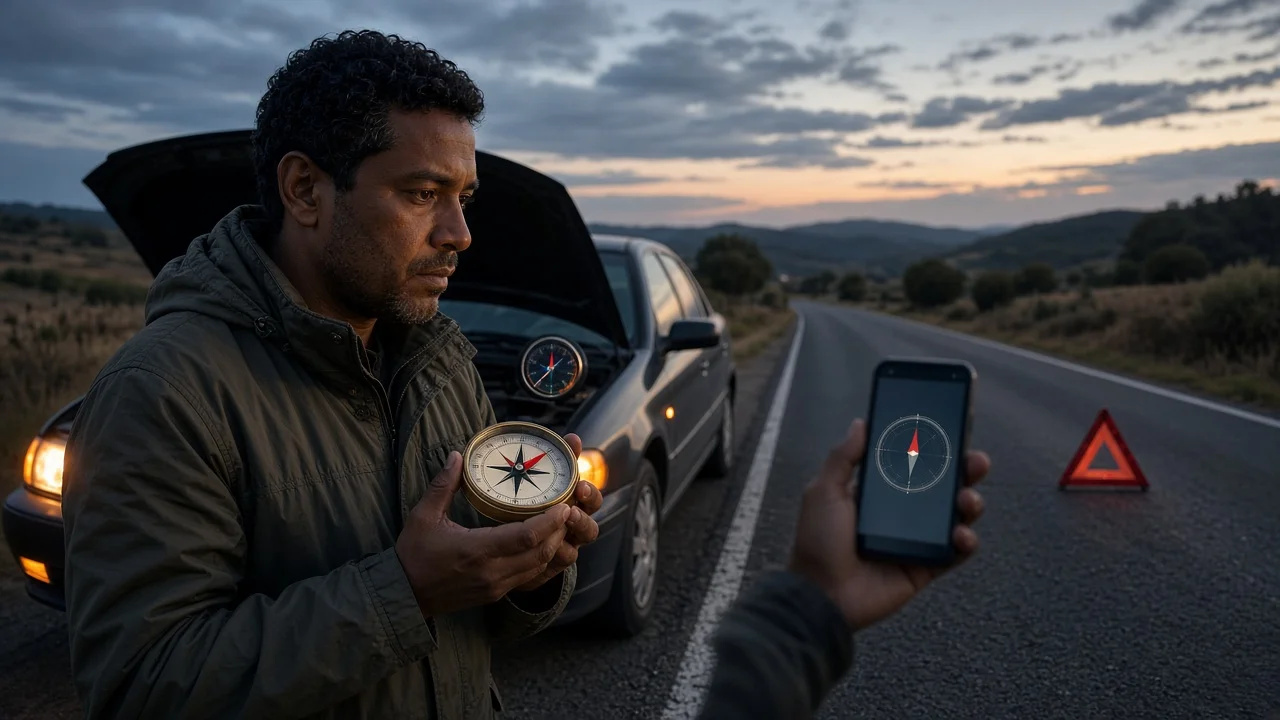
Handheld compass: one end of the needle is marked to show north. This is often a red end or an N, but designs differ, so check the markings on your own compass before relying on color. On a baseplate compass, also identify three parts: the direction-of-travel arrow on the clear base, the rotating ring (bezel) marked with directions or degrees, and the orienting arrow printed inside the ring.
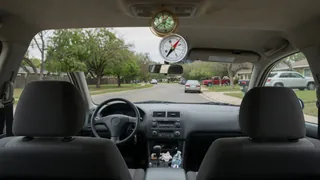
In-car compass: where fitted, it usually appears as letters such as N, NE, E or SW. Common places to look are the rearview mirror, the overhead console, the instrument cluster or the infotainment screen. It shows the direction the front of the vehicle is facing. Location, availability and calibration steps vary by make, model year and equipment, and no vehicle-specific documentation was supplied for this guide. Check your owner's manual to confirm where the display is and how to calibrate it.
Phone compass: most smartphones have a built-in compass or a compass view in their map app. Some let you choose between magnetic and true north in the settings. Magnetic phone mounts, cases with magnets and nearby metal can distort the reading, and the app may ask you to calibrate by moving the phone.
Step by step: working out your direction of travel
1) Get clear of interference. Steel body panels, the engine, and electronics can pull a magnetic needle off. If it is safe, step away from the vehicle and keep keys, phones and tools away from the compass. 2) Hold the compass flat and level. A tilted compass can make the needle drag or stick. 3) Let the needle settle. The marked north end now points to magnetic north. 4) Face the way the road runs in the direction you were driving. If you can see the vehicle's position on the road, use the direction its front is pointing. 5) Read the direction ahead of you. With a simple needle compass, compare where you are facing with where the north end points. If north is ahead, you are facing north. If north points to your left, you are facing east. If it points to your right, you are facing west. If it points behind you, you are facing south. 6) With a baseplate compass, point the direction-of-travel arrow along the road. Turn the bezel until the orienting arrow lines up under the north end of the needle. Then read the direction or degree mark at the index line where the travel arrow meets the bezel. 7) Write down or memorize the result before calling for help.
Verifying the result
Take a second reading from a slightly different spot. If the two readings disagree, metal or electronics may be interfering. Compare with a second source, such as the phone compass, the in-car display or a map app showing your position and heading. Check nearby route signs, which on US numbered highways show a cardinal direction alongside the route number. If sources conflict and you cannot resolve it safely, tell the responder exactly that, along with the other location details you have.
When the compass and the road signs disagree
A highway's signed direction is its overall direction, not necessarily the direction it runs at your exact spot. A road signed as eastbound can curve so that, on a particular stretch, a compass shows you heading north or southeast. When reporting a breakdown, give the signed direction if you know it, because responders use it to pick the correct carriageway. You can add the compass reading if it helps describe a bend, interchange or unsigned road.
Magnetic north versus true north
The angle between magnetic north and true north is called magnetic declination. It differs by location and changes slowly over time. When you only need a broad direction like northbound or southwest, declination rarely changes the answer. It can matter if your heading falls near the line between two directions, or if you need a precise bearing for navigating off-road. In those cases, look up the current declination for your area from an authoritative source and adjust, or use a phone compass set to true north.
Comparing compass sources
Source | What it shows | Main limitations; Handheld compass | Magnetic north from the needle | Easily pulled off by the vehicle and metal objects; needs a level hold; In-car compass display | Direction the vehicle is facing | Fitted only on some vehicles; may need calibration or a regional setting per the owner's manual; Phone compass or map app | Magnetic or true north, depending on settings | Affected by magnets and metal; may need calibration; relies on battery; Route signs | Signed direction of the highway | May not match the actual heading on a curved section
Communicating your location after a breakdown
Direction is one part of a usable location. When you call roadside assistance or emergency services, combine it with whatever else you can see or confirm safely.
Road name or route number; Direction of travel, ideally as signed, such as southbound; Nearest mile marker, exit number or last exit passed; Nearby landmarks, cross streets or overpass names; Which shoulder or lane the vehicle is in; GPS coordinates from a phone map app, if available
No data on responder procedures, response times or specific service providers was supplied for this guide. Follow the instructions given by the dispatcher or your assistance provider.