Why Do Wheel Openings Create Aerodynamic Drag?
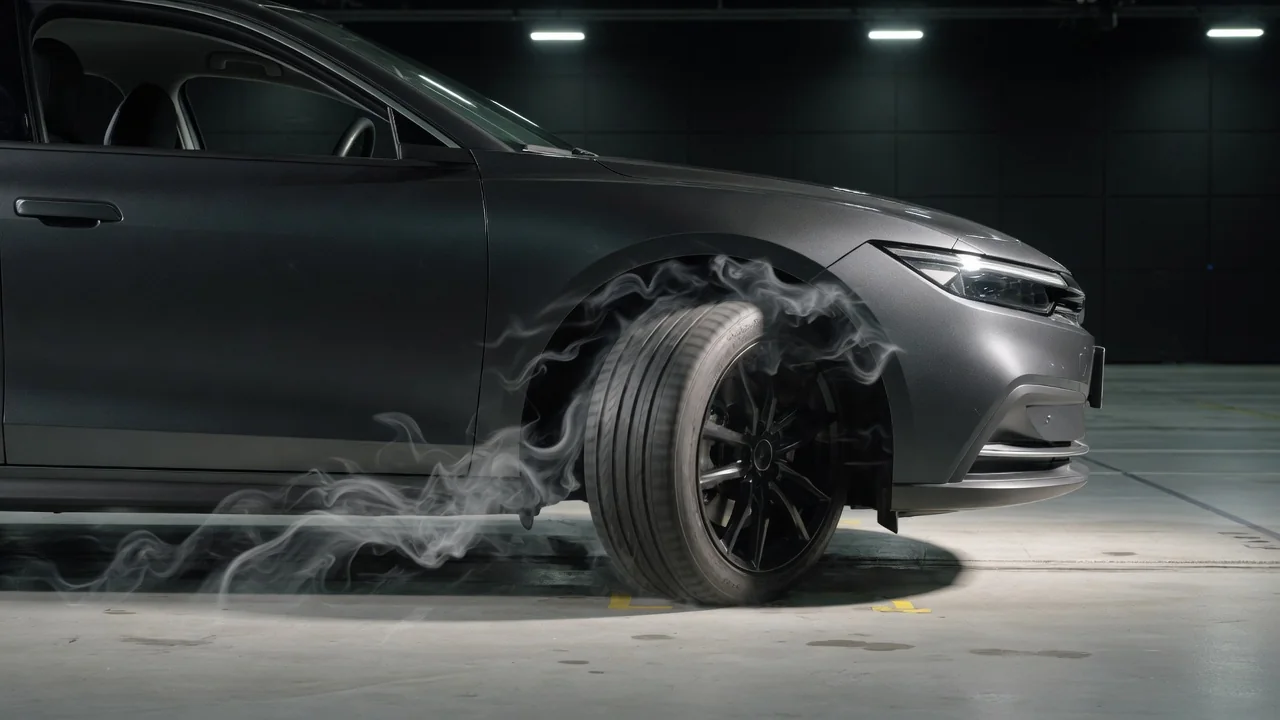
Wheel openings are among the hardest parts of a car to make aerodynamically clean. The body can be smoothed and tapered, but the wheels must turn, steer, and move with the suspension, so the arches around them stay open. Why do wheel openings create aerodynamic drag? Rotating tires disturb the airflow, pressure differences push air into and out of the arches, and the resulting turbulence spills onto the underbody and body sides.
Rotating wheels
A rolling wheel moves through air in a way no other part of the car does. Relative to the road, the contact patch is momentarily stationary while the top of the tire travels forward at roughly twice the vehicle's speed. The upper part of the tire is therefore moving into the oncoming air faster than the body is, and its surface drags a layer of air along with it. Inside the wheel arch, this rotating surface stirs the trapped air and keeps it in a constantly churning, unsteady state rather than letting it settle.
The lower part of the tire behaves differently. It hangs below the body, where it faces the incoming airflow almost directly, acting as a blunt obstacle with no tapering to help air rejoin cleanly behind it. Just ahead of the contact patch, air is squeezed between the tire and the road and tends to spurt out sideways, an effect often called jetting. This lateral flow rolls up into vortices along the sides of the tire that add to the disturbance in its wake.
The wheel itself contributes as well. Open spoke designs work somewhat like a centrifugal fan: as they spin, they draw air in and fling it outward through the rim openings. This ventilation effect consumes energy and pushes more disordered air into the flow along the side of the car. Its strength depends on spoke shape, the open area of the wheel face, and speed, which is why wheel design can matter even when tire size stays the same.
Pressure zones
Much of what is described as wheel arch airflow drag comes from pressure differences, and the arch sits at a junction of several of them. The front face of each front tire experiences high pressure as oncoming air slows against it. Air flowing beneath the car is generally at a different pressure from air flowing along the sides, and the arch provides an open path between those regions. As a result, air enters the arch from the underbody and from the front, swirls around the rotating tire, and looks for a way out.
The main exits are the gap between the tire and the outer edge of the fender and the open rear of the arch. Air escaping sideways through that gap meets the smoother flow traveling along the body side and disrupts it, thickening the turbulent layer and sometimes triggering local separation that persists toward the rear of the car. Air leaving the back of the arch joins the wake of the tire, a low-pressure region of recirculating flow. Low pressure behind an object effectively pulls it backward, so this wake is a direct contributor to drag.
Front wheels usually have the larger influence because they meet comparatively undisturbed air, and their wake then travels along the underbody. That disturbed flow can reach the rear wheels and the rear underbody, so what happens at the front arches is not confined to the front of the vehicle. The exact pattern of pressure zones varies considerably with bumper shape, ride height, underbody coverage, and tire geometry.
Design responses
Because the wheels cannot simply be enclosed on most road cars, designers manage the flow around them rather than eliminate it. One common approach is to shield the most exposed part of the tire. Small deflectors ahead of the front tires, sometimes called spats, reduce how directly the incoming flow strikes the tread. They must be tuned carefully, since a deflector is itself an obstacle and an oversized one can add more drag than it removes.
Air curtains take a different route. Inlets near the outer corners of the front bumper feed narrow ducts that release a fast sheet of air across the outer face of the front wheels. This sheet helps keep the side flow attached and limits the turbulence spilling out of the arch. Some designs add vents behind the front wheels that give pressurized air in the arch a controlled exit path, rather than letting it leak out wherever it can.
Other responses target the wheel and arch directly. Wheels with flatter, more closed faces reduce the fan-like pumping of open spokes, and smooth tire sidewalls help the flow stay organized. Inside the arch, liner shape and the size of the gap around the tire influence how much air circulates. On vehicles where efficiency is a priority, partial covers over the rear wheel openings are sometimes used, since rear wheels do not steer and leave more room for enclosure. Underbody panels and attention to ride height reduce how much flow feeds into the arches in the first place.
Practical implications and limits
For owners, the useful takeaway is that wheel and tire choices are aerodynamic choices, not only styling or grip decisions. Aerodynamic drag rises with the square of speed, so these effects matter most during sustained highway driving and are minor in slow urban traffic. Wider tires, larger open-spoke wheels, removed aero wheel covers, or a raised suspension can all change how air behaves around the arches, which may show up as somewhat higher fuel or energy consumption on long highway trips.
There are limits to what can be predicted without testing. The size of any effect depends on the specific combination of body, bumper, underbody, and wheel, and a modification that helps one vehicle may do little or even hurt on another. Wheel aerodynamics is also difficult to measure well: meaningful results require rotating wheels and a moving ground plane or an equivalent simulation, because a stationary wheel over a fixed floor does not reproduce the real flow. Claims about a particular part's benefit deserve caution unless they come from the vehicle manufacturer or a properly conducted test.
Finally, aerodynamic gains around the wheels always compete with other needs. Brakes require cooling air, front wheels need room to steer and travel with the suspension, arches must clear snow, mud, and tire chains, and owners need practical access for tire service. Closed wheel faces, tight arch gaps, and covered openings each trade some of these functions for lower drag. That balance explains why production cars still have open wheel arches, and why altering them without understanding the original design intent is rarely a good idea.