Why Is a Car's Underbody Important to Aerodynamics?
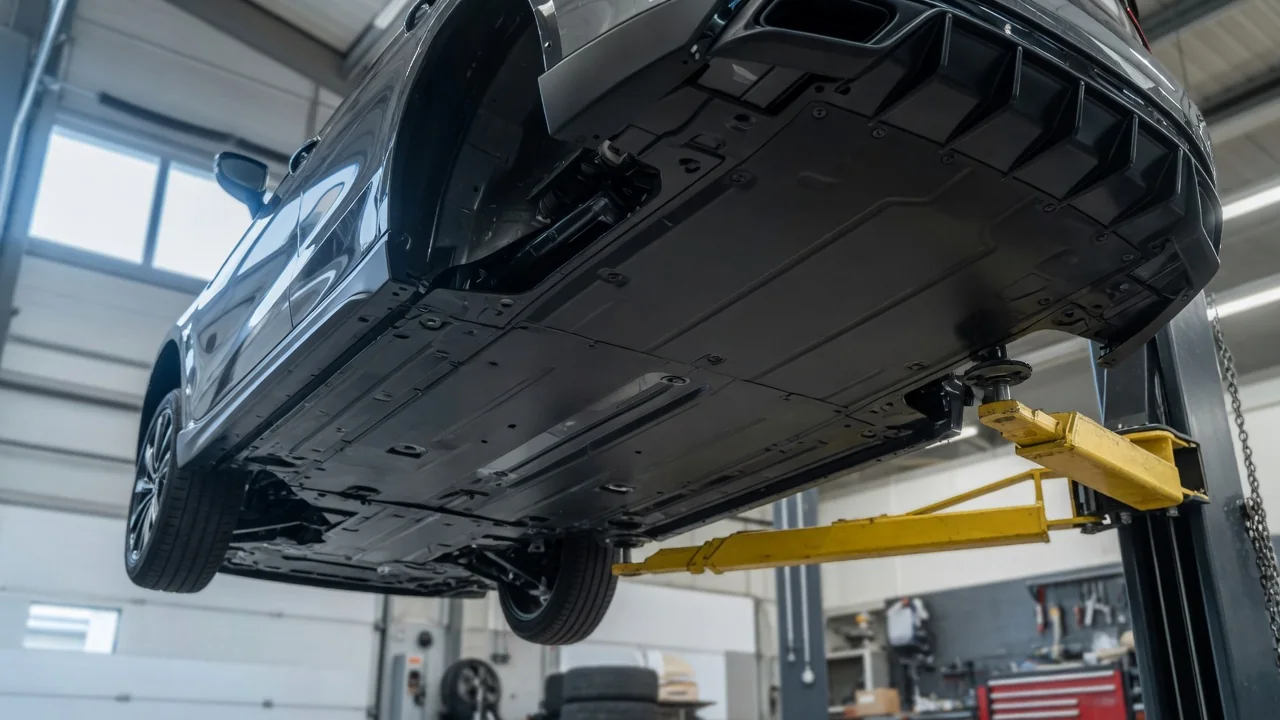
Most discussions of car aerodynamics focus on the shapes you can see: the windshield angle, the roofline, the mirrors and the tail. Yet a large share of the air a moving car disturbs passes underneath it, through a narrow gap filled with suspension parts, exhaust components and heat exchangers. Understanding underbody airflow explains why engineers pay close attention to this hidden surface, and why its condition can matter to drag, stability, noise and cooling.
Ground Airflow Beneath the Car
The air that passes under a car behaves differently from the air flowing over the roof. It is confined between two surfaces: the underbody, which moves with the vehicle, and the road, which is stationary while the car moves over it. From the car's point of view, the road surface is sliding backward, dragging a layer of air with it. The gap is also relatively small compared with the size of the body, so the shape of the underside and the height of the car above the ground both influence how much air enters, how fast it travels and where it leaves.
On a typical road car, the underside is far from smooth. Suspension arms, subframes, the exhaust system, the fuel tank, heat shields and the transmission all protrude into the airstream. Each protrusion forces the flow to separate and reattach, creating turbulence that converts the car's kinetic energy into wasted motion of the air. That turbulence adds to aerodynamic drag, and because a rough underbody slows the air down, pressure beneath the car can rise. Higher pressure underneath relative to the pressure above contributes to aerodynamic lift, which reduces the load on the tires at speed.
When the underside is smoother and the air can move through the gap with less disturbance, the flow can stay faster, and faster-moving air generally has lower static pressure. This is the basic reason a well-managed underbody can reduce lift or, on performance-oriented designs, contribute to downforce. The air also has to exit at the rear, where it meets the wake behind the car. How cleanly the underbody flow merges with that wake affects the size of the low-pressure region trailing the vehicle, which is one of the largest contributors to drag on most passenger cars.
Underbody Panels and What They Do
Underbody panels are the most direct tool designers use to manage this airflow. Depending on the vehicle, they may include an engine undertray, covers beneath the floor and fuel tank, wheel-well liners, and shaped panels near the rear. Their job is to replace a jagged collection of mechanical parts with a flatter, more continuous surface, so the air sees fewer edges and cavities. Small deflectors ahead of the tires are another common element, because exposed rotating wheels and the open wheel wells around them are a significant source of turbulence.
At the rear, some vehicles use an upward-sloping section often called a diffuser. By gradually expanding the area through which the underbody air exits, a diffuser can help the flow slow down and recover pressure in a controlled way rather than abruptly. On many everyday cars this shaping is modest and mainly aimed at tidying the wake, while more aggressive diffusers are associated with vehicles designed to generate downforce. The effect depends heavily on the rest of the underbody: a diffuser fed by disturbed, slow air does far less than one fed by smooth flow.
Panels involve tradeoffs. They add parts and some weight, must withstand road debris, water and occasional ground contact, and need to come off for oil changes and other service. They also have to account for heat from the exhaust and drivetrain, so designers include heat shielding, gaps or vents where needed. Drainage openings and access points are common for these reasons, which is why even a carefully covered underbody is rarely a perfectly flat sheet.
Cooling Openings and Underbody Airflow
Cooling is where underbody aerodynamics and engineering requirements meet most directly. Radiators, condensers, intercoolers and other heat exchangers need a steady flow of air, and that air has to go somewhere after it passes through them. In many cars, a significant portion of it exits through the engine compartment and out underneath the vehicle. If that exit path is crowded or poorly directed, hot, slowed air spills into the underbody flow, disturbing it and adding to drag. The energy lost as air passes through a radiator and a cluttered engine bay is often described as cooling drag.
Engineers can reduce this penalty by ducting air through the heat exchangers more deliberately and by placing outlets where surrounding pressure is lower, which helps draw air through rather than relying only on ram pressure at the front. Some vehicles use active grille shutters that close when less cooling is required, cutting the amount of air routed through the front end; their availability and behavior vary by model. Brake cooling ducts, transmission coolers and, on electric vehicles, battery and power-electronics cooling add further openings that have to be balanced against a clean underbody.
The key point is that cooling openings cannot simply be sealed for the sake of lower drag. A vehicle needs enough airflow for heat rejection across demanding conditions such as towing, hot weather and long climbs. Underbody design is therefore a compromise between letting enough air in and out for cooling and keeping the remaining flow as orderly as possible.
Practical Implications and Limits
For owners, the most relevant takeaway is that underbody panels are functional parts rather than optional trim. Undertrays and covers are sometimes left off after service, cracked by curbs or speed bumps, or held on by fewer fasteners than intended. A missing or hanging panel can change how air moves under the car, may increase wind noise, and can expose components to more water, salt and debris. Because some panels also help guide air through the cooling system, their absence can matter for more than drag alone. The service manual for a specific vehicle is the right reference for which panels are fitted and how they attach.
The size of any effect depends on speed and on the particular vehicle. Aerodynamic forces rise roughly with the square of speed, so underbody condition matters most during sustained highway driving and is far less noticeable in city traffic. How much a given panel contributes to fuel economy, range or high-speed stability varies by design, and without testing data for a specific car it is not possible to put a reliable number on it.
Modifications deserve similar caution. Lowering a car, adding aftermarket splitters or fitting diffusers changes the gap and pressure distribution under the body, but the result is not automatically better: it can upset the aerodynamic balance between the front and rear axles, interfere with cooling airflow, and reduce ground clearance. Vehicles built for rough roads deliberately trade some underbody smoothness for clearance and protection, which reflects a different set of priorities rather than a design flaw.