How Does Cooling Air Exit an Engine Bay?
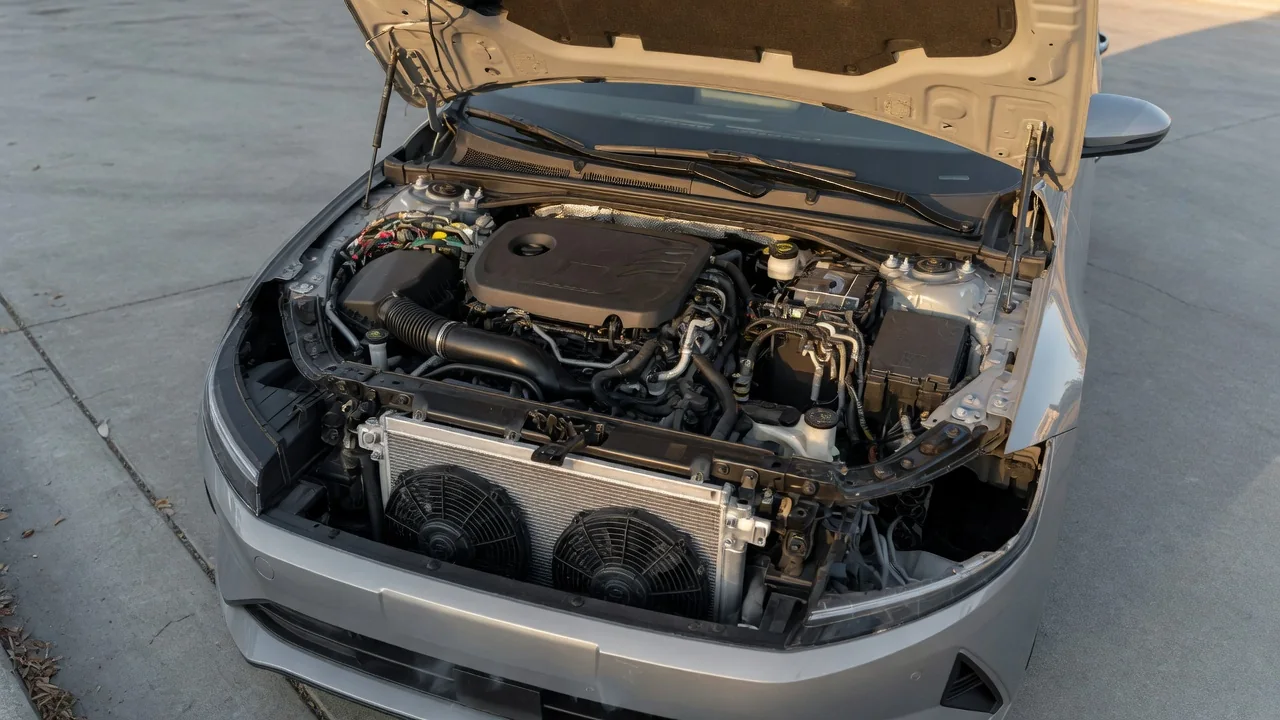
Cooling air does not simply pass through the radiator and disappear. After it picks up heat from the condenser, the radiator and the engine, it has to leave the engine bay, and how easily it escapes affects how well the whole system cools. This article explains engine bay cooling airflow in general terms: where air enters and exits, what pressure differences drive it, and why the underbody matters more than many owners expect.
Inlet and outlet
On most front-engine vehicles, air enters through openings in the grille and lower bumper. It typically passes first through the air conditioning condenser, then the radiator, and on some vehicles through additional heat exchangers such as a transmission or oil cooler. A shroud behind the radiator helps the electric or engine-driven fan pull air across the full core rather than only the area directly in front of the fan blades. Some vehicles also use active grille shutters that close at times to reduce drag and open when more cooling is needed.
After the heat exchangers, the warmer air spreads into the engine bay. There is rarely a single dedicated exit. Instead, air leaves through several paths: down past the engine and transmission toward the road, sideways toward the front wheel wells through gaps and openings in the inner fender area, and rearward along the transmission tunnel beneath the cabin. Some vehicles add hood vents, fender vents or dedicated ducts that route heated air out more directly, but many rely mainly on the downward and rearward paths.
The key idea is that an inlet only works as well as its outlet. If heated air cannot leave freely, it slows down, pressure builds inside the engine bay, and less fresh air can move through the radiator. Engineers therefore treat the inlet opening, the heat exchanger stack and the exit routes as one connected path rather than as separate parts.
Pressure
Air moves from higher pressure toward lower pressure, and that difference is what drives cooling flow at road speed. As a vehicle moves forward, air piles up against the front of the car, creating a region of relatively high pressure around the grille and bumper. That pressure pushes air into the openings and through the radiator. The greater the pressure difference between the front of the radiator and the space behind it, the more air flows through the core.
Behind the radiator, the goal is to keep pressure as low as practical. Air moving quickly beneath the vehicle tends to be at lower pressure than the air trapped in the engine bay, so the underside acts as a natural exit and helps draw hot air downward. Pressure also varies across the hood. The area near the base of the windshield is generally a higher-pressure zone, which is one reason cabin ventilation intakes are commonly placed there, while other parts of the hood can see lower pressure. Where vents are fitted, their location matters: a vent in a low-pressure zone tends to extract air, while one in a high-pressure zone can let air in instead.
At low speed or while idling, there is little ram-air pressure at the front. The cooling fan then does most of the work by creating the pressure drop across the radiator itself. This is why the fan, its shroud and the seals around the radiator matter most in slow traffic, while the vehicle's shape and exit paths play a bigger role at highway speed.
Underbody
Many modern vehicles have plastic undertrays, splash shields or lower engine covers beneath the front of the car. These parts are often thought of as simple protection from water and road debris, but they frequently shape cooling airflow as well. A front air dam or lower lip helps direct oncoming air into the radiator openings instead of letting it slip underneath, and it helps keep the area behind it at lower pressure.
Undertrays usually include specific openings or gaps, often toward the rear of the engine bay, where heated air can leave in a controlled way. By smoothing the flow under the front of the car, the panel helps air beneath the vehicle move faster, which supports the low pressure that pulls air out of the engine bay. Some designs also use small deflectors or foam seals around the radiator so that incoming air cannot bypass the core or recirculate back toward the front.
Because these parts are designed as part of the cooling path, their effect depends on the specific vehicle. On some vehicles a missing or damaged undertray has little noticeable impact; on others it can disrupt the intended flow, reduce air through the radiator or allow hot air to circulate back toward the inlet. Service information for the particular model is the reliable guide to which panels are required.
Practical implications and limits
For owners, the most useful takeaway is that a cooling concern is not always caused by the coolant system itself. Reinstalling splash shields and air dam pieces after service, keeping the space between the condenser and radiator free of leaves, insects and dirt, and making sure shrouds and air seals are in place all help the designed airflow work as intended. A radiator that looks clean on its visible face can still be partly blocked where cores are stacked together.
Driving conditions also change how the airflow behaves. Slow climbs while towing, long periods of idling in hot weather and stop-and-go traffic all reduce ram air and place more demand on the fan. Aftermarket changes such as different bumpers, grille covers, front-mounted accessories, skid plates or added hood vents can alter the inlet area or the exit paths in ways that are hard to predict without proper testing, so their effect on cooling should not be assumed to be positive.
General explanations also have limits. Exit paths, pressure zones and the role of each panel vary with vehicle layout, body shape and engine placement, and rear- or mid-engine vehicles use different arrangements altogether. If a vehicle runs hot, airflow is only one possible cause alongside coolant level, thermostat, water pump, fan operation and other faults, so diagnosis should follow the manufacturer's procedures for that model.