What Is an Underbody Shield?
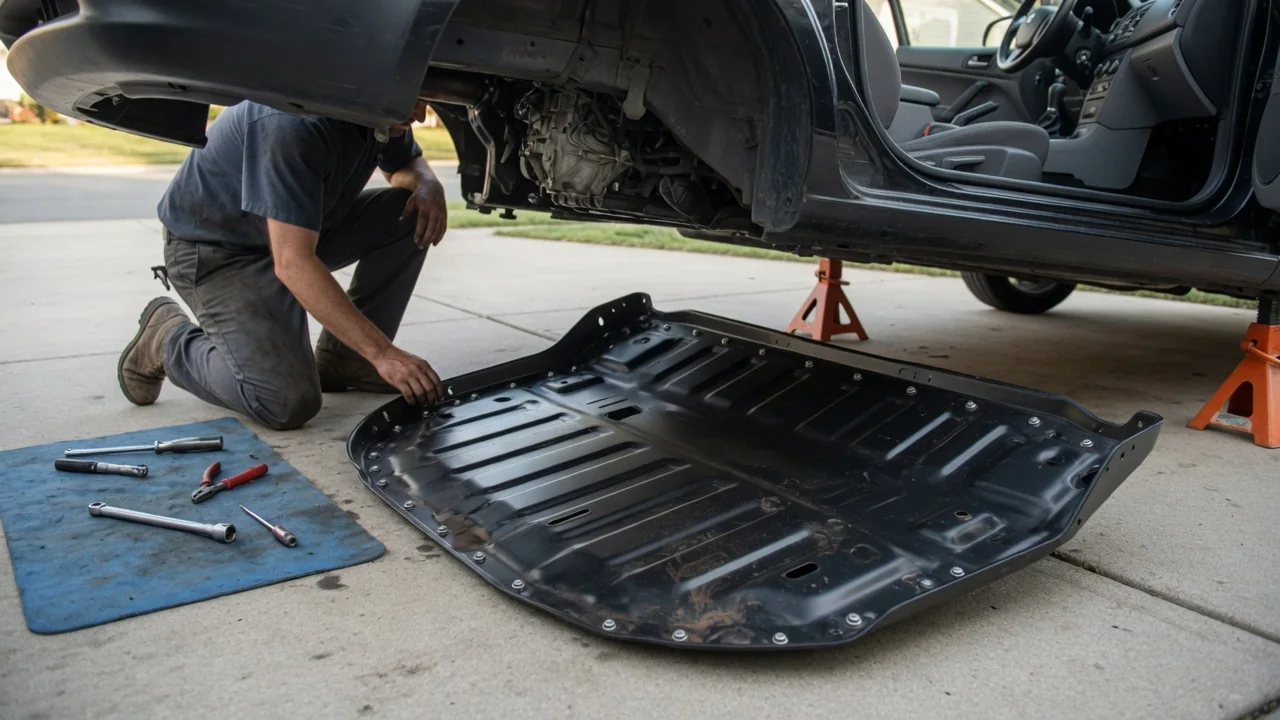
Anyone asking what is an underbody shield is usually looking at a flat panel hanging beneath a car and wondering what it does. In short, it is a cover mounted under the vehicle that guards exposed components from road debris and water while smoothing the air passing underneath. Its shape, material, and coverage differ widely between vehicles.
Placement
Most underbody shields sit beneath the front of the vehicle, spanning the gap between the lower edge of the bumper and the front subframe or crossmember. In that position the panel covers the bottom of the engine bay, keeping spray, grit, and small stones away from drive belts, wiring connectors, the oil pan, and the lower radiator area. Kneeling at the front bumper and looking rearward usually reveals a dark plastic or fiber panel filling the space where you might otherwise expect to see mechanical parts.
Coverage farther back depends heavily on the design. Some vehicles carry additional panels along the floor on either side of the exhaust tunnel, around the fuel tank, or ahead of the rear axle, creating a nearly flat underside that reduces turbulence and wind noise. Electric vehicles often have extensive covers beneath the battery area, while trucks and off-road models may use thicker metal skid plates instead of lightweight panels. Others leave most of the floor exposed, so the absence of a rear panel is not automatically a sign that something is missing.
Attachment
These panels are held in place by a mix of small fasteners rather than a few large bolts. Common hardware includes push-in plastic clips, quarter-turn fasteners, self-tapping screws, and small bolts that thread into spring clips or metal inserts on the subframe and bumper. The front edge frequently tucks into or overlaps the lower bumper cover, and the sides often join the wheel-arch liners, so the shield is really one piece of a linked set of trim that depends on its neighbors for support.
Because the fasteners are light and exposed to road salt, heat, and repeated removal, they are the weakest part of the system. Plastic clips become brittle and snap, screw holes in the panel elongate, and metal inserts corrode until a screw no longer grips. Many shields also include a small access flap or cutout for the oil drain plug and filter, though on other vehicles the entire panel must come off for routine service. Fastener type, count, and location vary by manufacturer, so replacement hardware should be matched to the specific vehicle.
Rattle clues
A loose shield tends to announce itself with sound before it becomes visible. A light flapping or buzzing that rises with road speed and fades when you slow down suggests a panel edge catching the airflow. A scraping noise over speed bumps, driveway ramps, or dips points to a section hanging low enough to touch the pavement. Rattles that appear at idle or at a particular engine speed can come from a panel vibrating against the subframe or exhaust where a fastener has gone missing.
Those sounds are easy to confuse with other problems under the car. A thin, tinny metallic rattle is more often an exhaust heat shield, which is a separate metal part mounted near the exhaust pipe or catalytic converter, while a clunk over bumps is more likely related to suspension components. A plastic underbody shield usually produces a duller slap or drag. Looking under the front bumper with the vehicle parked on level ground can often confirm it, since a sagging corner, a torn mounting hole, or a visibly dangling edge is hard to miss.
Everyday Use and Observations
In daily driving the shield works quietly in the background. By keeping water and slush from being thrown up into the engine bay, it helps electrical connectors and belt-driven accessories stay cleaner and drier. By presenting a smoother surface to the air, it reduces drag and turbulence beneath the car, which supports fuel economy or driving range and can lower wind noise at highway speeds. Some panels also incorporate ducts or vanes that direct air toward the radiator, brakes, or transmission, so their shape is not purely cosmetic.
The same panel takes a fair amount of abuse. Parking curbs, steep driveways, packed snow, and road debris are the usual causes of cracks and torn mounting points, and damage often shows up after winter or after an encounter with a concrete parking stop. Shields are also removed for oil changes and other service, and a panel refitted with fewer fasteners than it started with may loosen later. A glance underneath after service, or noticing fresh fluid collecting on top of the panel rather than dripping onto the ground, are both useful observations.
Limits and Next Steps
An underbody shield is a splash and airflow panel, not armor. Typical plastic or composite versions will deflect spray and small debris but will not protect the oil pan or other components from a hard strike on a rock or a high curb. Driving without one for a short time is generally not an emergency, yet leaving it off indefinitely exposes parts to more water and dirt and may alter the airflow the vehicle was designed around. A shield can also hide leaks, so a clean driveway does not guarantee a dry engine.
A panel that is dragging or partly detached deserves prompt attention, because at speed it can tear free, catch on the road, or contact hot or moving parts. Avoid crawling beneath a vehicle supported only by a jack; a shop with a lift can inspect the mounting points safely and determine whether new fasteners will do or the panel needs replacing. Improvised fixes placed near the exhaust are a poor idea. Since shapes and hardware are specific to each model, the correct part should be confirmed against the vehicle itself.