What Is an Exhaust Heat Shield?
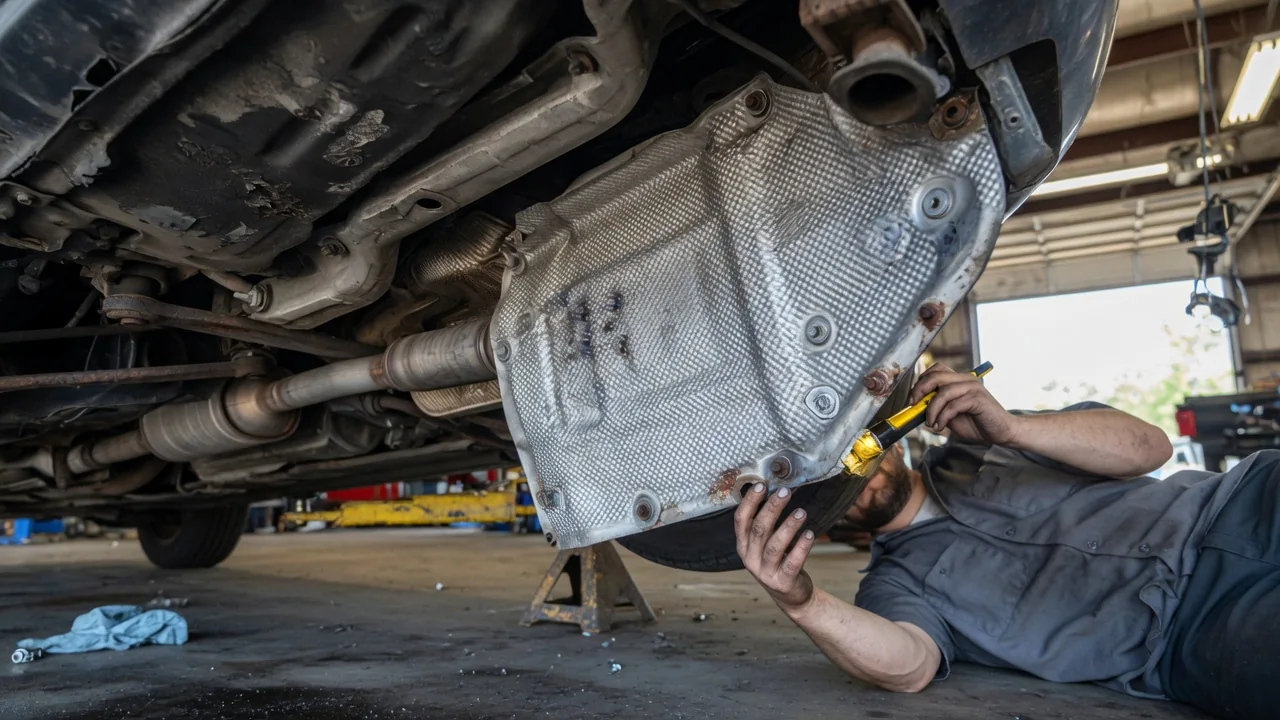
What is an exhaust heat shield? It is a thin barrier, usually stamped metal, mounted between hot exhaust parts and whatever sits nearby. The exhaust system carries combustion gases that leave pipes, converters, and mufflers hot enough to damage wiring, fuel lines, rubber, and the cabin floor. The shield reflects and disperses that heat so neighboring components survive years of ordinary driving.
Locations
Shields follow the exhaust from the engine to the tailpipe, clustering wherever a hot surface runs close to something vulnerable. Under the hood, one commonly covers the exhaust manifold or a turbocharger housing, protecting nearby wiring harnesses, plastic covers, brake fluid lines, and rubber hoses. Farther back, larger panels often sit above the catalytic converter, which runs especially hot, and over the muffler where it passes beneath the trunk floor or beside the fuel tank.
Looking under a parked, fully cooled vehicle, you can usually spot them as thin, dimpled or ribbed sheets of aluminum or steel, either clamped around a pipe or bolted to the underbody with an air gap between the panel and the floor. That gap matters, because still air is a poor conductor of heat. Layouts vary widely: some vehicles use a few large floor panels, others use many small pieces, and tightly packaged engine bays may add wrapped or fabric-style insulation.
Loose-shield rattles
Because shields are thin and live in a harsh place, their mounting points tend to fail before the panel itself. Road salt, water, and repeated heating and cooling corrode the small bolts, clips, and welded tabs, and the sheet metal can rust through around a fastener until the hole is larger than the bolt head. Once one corner is free, the panel vibrates against the pipe or the body, producing a tinny, buzzing rattle.
The noise often has a recognizable pattern. It may appear at idle, at one narrow engine speed, during acceleration, or just after startup, then fade as the vibration frequency changes. Many drivers describe it as a can of loose coins under the floor. That said, a metallic rattle is not proof the shield is the cause; a failing catalytic converter substrate, a loose exhaust hanger, or a broken clamp can sound similar, so the source deserves a visual confirmation.
Repair
Repair depends on what actually failed. When the panel is sound and only a fastener has corroded, a shop can often resecure it with new hardware, an oversized washer to span an enlarged hole, or a stainless band clamp around the pipe. When the metal has cracked, torn, or rusted thin, replacement of that shield is the better route, and availability differs by vehicle, since some panels are sold separately while others come attached to a larger exhaust component.
Simply tearing off a noisy shield and discarding it is a tempting shortcut, but it removes protection the manufacturer judged necessary for that location. The floor above may get hotter, nearby wiring or hoses lose their barrier, and the risk of igniting dry grass under a parked car increases. Any inspection or work should wait until the exhaust has cooled completely, and the vehicle must be properly supported, which is why many owners leave underbody repairs to a shop with a lift.
Everyday Use and Observations
In normal driving a working shield goes unnoticed, which is the point. It keeps the cabin floor and carpet from becoming uncomfortably warm on long highway runs, stops undercoating and sound deadening from baking, and helps keep fuel in the tank and lines cooler. It also limits heat reaching rubber suspension bushings, driveshaft boots, and the spare tire well, parts that harden and crack faster when exposed to sustained radiant heat.
A few everyday observations can hint at trouble. A new rattle after driving over debris, a speed bump, or a deep snow rut suggests a panel was bent or knocked loose. A warm spot on the floor or console that was not there before, a faint smell of hot plastic, or a shield visibly hanging below the car all merit attention. Parking over tall dry grass places hot exhaust parts close to flammable material, so intact shielding matters most there, though it does not eliminate the hazard.
Limits and Next Steps
A heat shield manages heat; it does not fix the causes of excessive heat. An engine that misfires or runs rich can send unburned fuel into the catalytic converter, driving temperatures well beyond what the shielding was designed to handle, and a glowing converter or scorched panel points to an engine problem that needs diagnosis. Shields also do nothing for exhaust leaks, and they cannot be judged reliably from sound alone, since several faults share the same rattle.
A sensible next step is to mention any rattle, warm floor, or hanging panel at the next service visit and ask for the exhaust to be checked on a lift, where every shield and hanger can be inspected along its full length. If a panel is dragging or touching a moving part, have it looked at sooner. Because designs, fastener types, and parts availability differ between makes and models, the correct fix should be confirmed against the specific vehicle rather than assumed.