Why Does a Car Have an Exhaust Hanger?
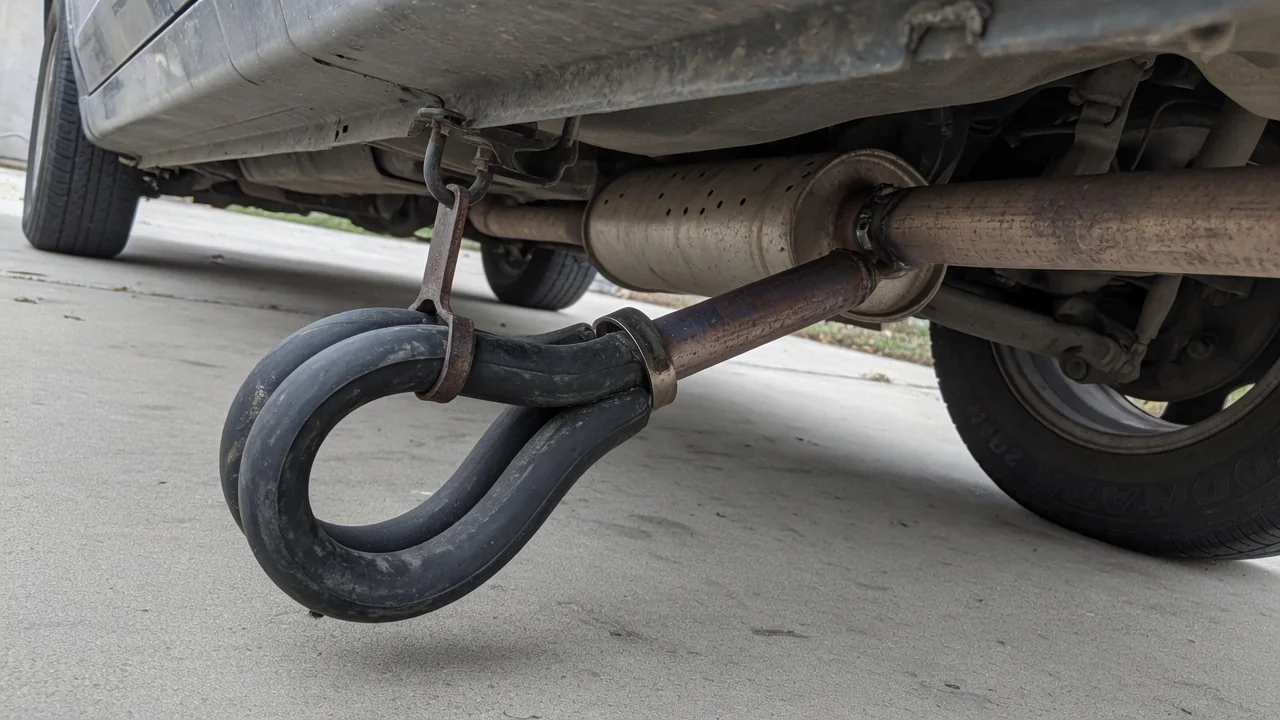
Anyone who has looked under a vehicle may wonder why does a car have an exhaust hanger at all, when the pipes could simply be bolted to the body. The answer lies in heat, vibration and motion. Hangers hold the exhaust system in position while letting it flex, protecting both the pipes and the cabin from stress and noise.
Rubber mounts
Most exhaust hangers pair a metal rod or bracket welded to the pipe or muffler with a rubber isolator that slips over a matching rod on the underbody. The rubber is the important part. It carries the weight of the system while absorbing the engine pulses and road shocks that would otherwise travel straight into the floor pan as a drone or buzz. A rigid steel connection would transmit that energy directly and would also concentrate stress at the welds.
Looking beneath a typical car, you can usually spot these mounts as dark blocks or loops with two or more holes, located near the muffler, the resonator and along the intermediate pipe. Their shape, number and material vary by manufacturer and model. Some vehicles use simple rubber rings, others use molded blocks with reinforcing inserts, and some applications near hotter sections use compounds chosen for higher temperature resistance. The layout on a compact sedan can look quite different from that on a pickup.
Movement
An exhaust system is never truly still. The engine rocks on its own mounts whenever it accelerates, decelerates or idles, and because the exhaust is attached to it at the manifold, the whole length of pipe follows that motion. Flexible hangers let the system swing slightly instead of fighting the engine. Without that give, the repeated twisting would work against joints, flanges and the manifold connection, encouraging cracks and leaks over time.
Heat adds a second kind of motion. Metal pipe grows longer as it warms from cold start to full operating temperature, then shrinks again as it cools. Over the length of a full system, that growth is enough to matter, so the hangers must allow the pipe to slide fore and aft a little. Many vehicles also use a flex section or sprung joint near the front to share this job, though the exact arrangement depends on the drivetrain layout and design.
Wear signs
Rubber ages. Years of heat cycling, road salt, oil mist and constant loading cause isolators to harden, crack or stretch. On inspection, a worn mount may show splits radiating from the holes, a hole elongated into an oval, or rubber that has torn completely through so the rod hangs free. The metal side can fail too, with rust thinning the rod or the bracket weld breaking away from the pipe or muffler shell.
Often the first clue is something heard or seen rather than found under the car. A tailpipe that sits lower or off center in the bumper cutout, a muffler that sways visibly when pushed by hand once cold, or a knock over bumps can all point toward a tired or missing support. These signs are evidence rather than proof, however, since a loose heat shield, a failed clamp or worn suspension parts can produce similar noises and deserve the same look.
Everyday Use and Observations
In daily driving, healthy hangers go unnoticed, which is exactly their purpose. The exhaust stays tucked up with consistent clearance from the body, driveshaft, fuel tank and suspension, and the cabin stays free of rattles. Drivers tend to notice changes during specific moments, such as a thump when starting or shutting off the engine, a clunk when shifting between drive and reverse, or a rattle on rough pavement when the system swings further than it should.
Driving conditions shape how long these parts last. Vehicles used in regions with salted winter roads usually see more corrosion on the metal rods and brackets, while frequent short trips, steep driveways, speed bumps and unpaved roads add loading or the chance of a scrape that bends a support. A heavier aftermarket muffler can also change how the weight is distributed across the original mounts. Glancing at the tailpipe position during routine washing or an oil change is an easy way to catch a change early.
Limits and Next Steps
Hangers can only do so much. They support and isolate the system, but they do not seal it, and they cannot compensate for a rusted pipe, a broken flange or collapsed engine mounts that let the powertrain move excessively. When one support fails, the remaining ones carry extra load and the pipe can sag, which strains joints and may bring hot components close to parts that should stay cool. A dragging or badly drooping exhaust is a reason to stop driving and have it checked.
Any inspection should wait until the exhaust has fully cooled, and the vehicle should be raised only with proper equipment on solid ground. Replacement mounts need to match the original design, because rod diameter, spacing and stiffness differ between vehicles, so confirming the correct part for the specific model matters. If a bracket has rusted off or a weld has broken, or if the noise persists after an obvious mount is replaced, a professional inspection on a lift is the sensible next step.