What Is a Rubber Exhaust Hanger? Support, Vibration, and Wear Explained
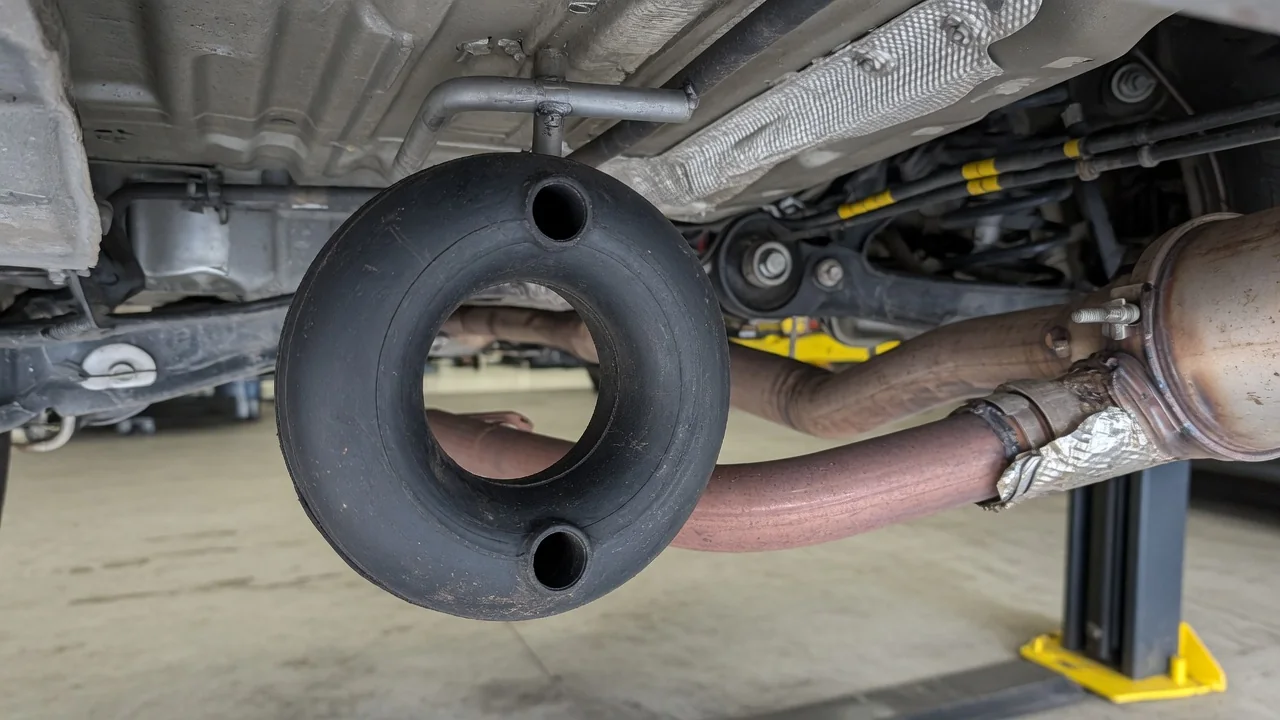
A rubber exhaust hanger is a small elastomer part that suspends the exhaust system from the underside of a vehicle. It connects steel rods or brackets on the pipes and mufflers to matching points on the body or frame, holding the exhaust in position while letting it move. The part is often called an exhaust rubber isolator, and it has three jobs: it carries weight, keeps engine and exhaust vibration out of the cabin, and absorbs movement as the system heats and cools. Like any rubber component, it eventually wears out.
Support
An exhaust system is long and relatively heavy, and it is fixed rigidly at only one end, where it bolts to the engine's exhaust manifold or turbocharger outlet. Everything downstream needs additional support along its length, including the catalytic converter, resonator, mufflers, and tailpipe. Hangers provide that support at several points. They are usually spaced so that no section of pipe acts as an unsupported lever on the joints ahead of it. Without them, the weight of the rear components would bend pipes, load the manifold studs, and strain the connections between sections.
In a typical arrangement, a steel rod or pin is welded to the exhaust, and a second rod or bracket is attached to the vehicle body or frame. The rubber hanger links the two. One common form is a solid or ring-shaped block with two holes that slip over the rods. Another is a round, donut-style isolator. A third is a bracket-mounted design, where the rubber is bonded to a metal plate that bolts to the chassis. The exact shape, number, and placement of hangers depend on the design of the vehicle and its exhaust.
Support also means positioning. Hangers hold the exhaust at a set height and distance from the fuel tank, floor pan, suspension parts, driveshaft, and heat shields. That clearance matters because the exhaust runs hot. If the system droops or shifts, it can contact nearby components and cause noise, heat transfer, or physical damage. The hangers keep the exhaust where the designers intended while still allowing controlled movement.
Vibration
Most engines sit on rubber or hydraulic mounts, which let them rock and shake without passing all of that motion into the body. The exhaust is attached to the engine, so it moves with it. Combustion pulses, idle shake, and the engine's torque reactions during acceleration and braking all travel into the exhaust pipes. If the exhaust were bolted solidly to the body, those vibrations would reach the floor. Occupants could then hear and feel them inside the cabin as a drone or buzz.
The rubber hanger acts as an isolator. The elastomer is flexible and damps motion, so the exhaust can move a limited amount relative to the body while less vibration passes through the mounting points. This is why the part is often described as an exhaust rubber isolator rather than simply a hanger. Many exhaust systems also include a flexible joint or flex pipe near the engine for a similar reason. The hangers work together with that joint to manage motion along the whole system.
The hangers also accommodate thermal expansion. Steel exhaust components lengthen slightly as they heat up and shrink again as they cool. A rigid mount would resist that movement and concentrate stress at welds and joints. A rubber hanger stretches and flexes, so the system can grow and contract through each drive cycle. The balance is deliberate. The rubber must be soft enough to isolate vibration and absorb expansion, yet firm enough to stop the exhaust from swinging into nearby parts.
Wear
Exhaust hangers work in a demanding environment. They sit close to hot pipes and are exposed to water, road salt, dirt, and ozone. They also stay under constant load from the weight they carry. Over time, rubber can harden, lose elasticity, crack on its surface, or slowly stretch. Heat-resistant elastomers are commonly used for this application, but no rubber compound is immune to aging. Oil or other fluid leaks can also soften or degrade some rubber materials.
As a hanger wears, its behavior changes in predictable ways. A stretched hanger lets the exhaust sag lower than intended. A hardened one transmits more vibration and may cause a buzz or drone inside the vehicle. A cracked or torn hanger can break completely, which leaves the remaining hangers to carry extra load and lets the exhaust drop or swing. Common signs include rattling or clunking from under the car, especially over bumps or when the engine starts or stops. An exhaust tip may also sit lower or at an angle, or pipes and mufflers may knock against heat shields or the body.
Hanger failure rarely stays isolated. When one support point is lost, the exhaust puts added stress on the remaining hangers, joints, and clamps, and on the flexible section near the engine. That can contribute to cracked pipes, broken welds, or exhaust leaks. The steel rods that hold the rubber can also rust or bend. A worn hanger therefore sometimes points to a problem with its mounting hardware, not only the rubber.
Practical implications and limits
For owners, the most useful habit is a quick visual check whenever the vehicle is raised for an oil change, tire service, or other work underneath. Look for cracks, tears, obvious stretching, or a hanger that has slipped partly off its rod. Also check whether the exhaust hangs evenly along its length. Gently moving a cool exhaust by hand can show whether it is loose or touches anything nearby. Only work under a vehicle that is properly supported on stands or a lift, and let the exhaust cool before touching it.
Replacing a rubber hanger is often a simple job, since many slide on and off their mounting rods. Corroded rods and tight access can make it harder on some vehicles. Fitting a hanger of the correct shape and size matters. A part that is too stiff, too soft, or the wrong length can change the exhaust's position and how it transmits vibration. Temporary fixes such as wire, straps, or rigid clamps may hold the pipe up, but they remove the isolation the rubber provides. They can also pass vibration into the body or wear through nearby components. Some aftermarket hangers use polyurethane, which is typically stiffer than rubber. That can reduce exhaust movement but may also send more vibration into the body.
There are limits to what a general explanation can tell you. Hanger count, design, and mounting points vary between vehicles and exhaust configurations. Some vehicles use isolators built into brackets or heat shields rather than standalone hangers. A rattle under the car can also come from loose heat shields, failing clamps, or suspension parts, so a new noise does not prove a hanger has failed. For the correct part and procedure, use the vehicle's service manual or ask a qualified technician.