What Is a Center Support Bearing? Driveshaft Support Explained
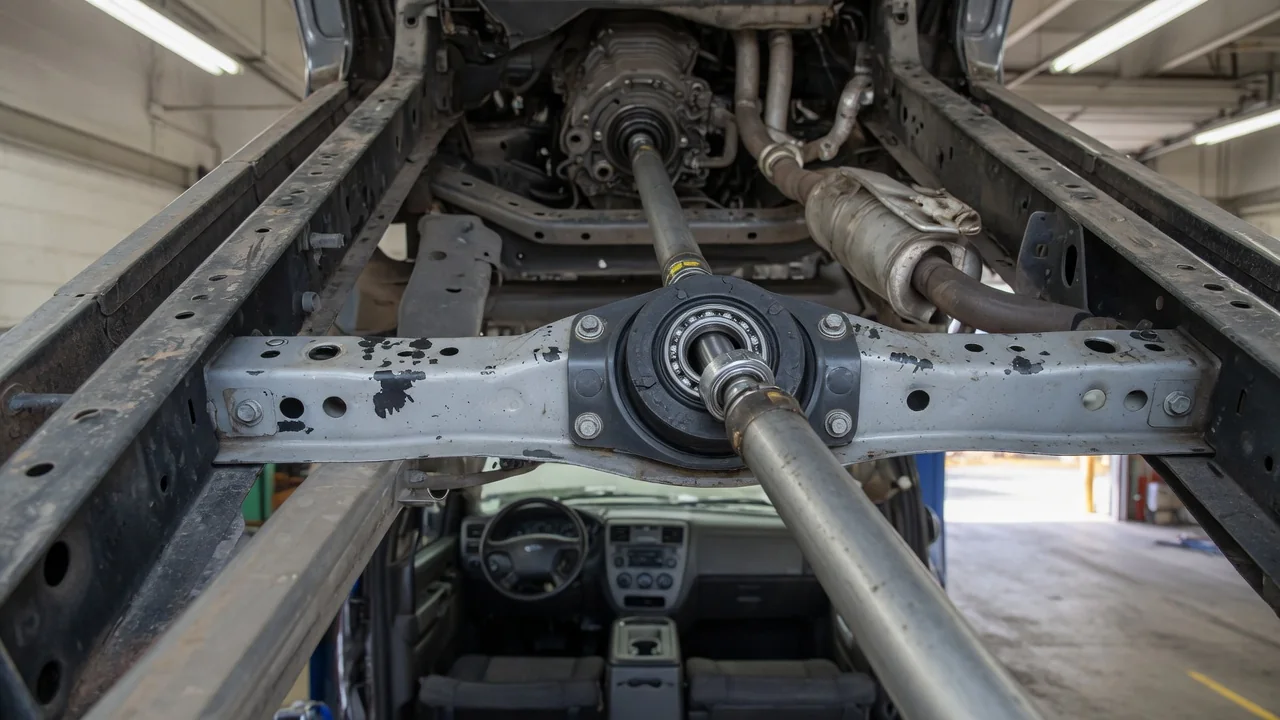
A center support bearing, often called a carrier bearing, holds up the middle of a two-piece driveshaft. If you have wondered what a center support bearing is or what the driveshaft center bearing purpose is, the short answer is that it keeps a long shaft steady where it would otherwise sag and vibrate. It combines a rolling bearing with a rubber cushion and a bracket, and when either part wears, the driveline usually lets you know.
Shaft support: what the bearing actually holds
Rear-wheel-drive vehicles and many four-wheel-drive or all-wheel-drive vehicles send power from the transmission or transfer case to the rear axle through a driveshaft. On shorter vehicles, a single tube can span that distance. When the gap gets longer, as it often does on pickups, vans, and some long-wheelbase cars, a single long tube becomes harder to keep stable at speed. Every rotating shaft has a speed at which it tends to bow and whip, and a longer, unsupported shaft reaches that point sooner. Splitting the driveshaft into two shorter sections and supporting them in the middle is a common engineering answer.
The center support bearing provides that middle support. It is usually a sealed ball bearing pressed onto the front shaft section near its rear end. The bearing lets the shaft spin freely while its outer housing stays still, bolted to a crossmember or a bracket on the underbody. Behind it, the front section connects to the rear section through a universal joint or, on some designs, a constant-velocity joint. Because the bearing fixes the shaft's position at that midpoint, it also helps set the operating angles of the joints on either side, which matters for smooth power delivery.
In other words, the bearing does not transmit torque itself. Its job is location: keeping the shaft centered, at the right height, and in line so the joints can do their work without extra strain.
Rubber mount: why the bearing floats in a cushion
The bearing is rarely bolted directly to the vehicle. Instead, it sits inside a rubber isolator, which is in turn held by a stamped or cast metal bracket. That rubber layer is just as important as the bearing. Engines and transmissions move on their own mounts as torque is applied and released, and the rear axle moves with the suspension. The driveline has to tolerate those small shifts without fighting the body of the vehicle.
The rubber mount gives the bearing a limited amount of freedom. It absorbs vibration from the spinning shaft so less of it reaches the cabin, it cushions the shock of sudden throttle changes, and it allows slight fore-aft and side-to-side movement while still holding the shaft roughly in place. Some designs use a solid rubber ring, while others use a molded shape with voids that tune how soft or firm the mount feels. The exact construction varies by manufacturer and application.
The tradeoff is that rubber ages. Heat from the exhaust, road salt, oil contamination, and constant flexing gradually harden, crack, or tear it. Once the rubber loses its shape, the bearing can sag or move more than it should, even if the bearing itself still turns smoothly. Many replacement parts combine the bearing and rubber in one assembly, so both are renewed together.
Failure clues: signs the center bearing needs attention
A worn center support bearing tends to show up in a few recognizable ways. A common one is vibration or shudder when accelerating from a stop, especially with a load, which often eases once the vehicle is cruising. That pattern can point to a mount that lets the shaft drop or shift under torque, upsetting the joint angles. Another is a vibration that builds with road speed rather than engine speed.
Noise is the other big clue. A dry or damaged bearing may produce a growl, rumble, or whine that rises and falls with vehicle speed and continues whether you are accelerating or coasting. A clunk when shifting into drive or reverse, or when getting on and off the gas, can indicate a torn rubber isolator letting the shaft move until metal contacts metal. A squeal at low speed sometimes comes from a bearing that has lost its lubricant, since most are sealed and not meant to be regreased.
Visual inspection, done with the vehicle safely supported and the engine off, often confirms the suspicion. Look for rubber that is cracked, split, separated from the metal, or visibly sagging, and for bearing grease flung around the area. With the shaft stationary, excessive movement at the center when pushed by hand, or roughness felt when slowly turning the shaft, suggests wear. Loose or missing bracket bolts are worth checking too, since they can mimic a failed mount.
Practical implications and limits
None of these symptoms is unique to the center bearing. Worn universal joints, an out-of-balance driveshaft, tire problems, wheel bearings, differential wear, and incorrect driveline angles after a lift or lowering can all produce similar vibrations and noises. That overlap is why a careful diagnosis checks the neighboring parts instead of assuming the carrier bearing is at fault. A failing center bearing and a worn U-joint also commonly appear together, because extra movement at one point adds load to the other.
Replacement is generally simple in concept but can be fussy in practice. On many designs the bearing is pressed onto the shaft and must be pressed off, which may call for a press or a specialized puller rather than ordinary hand tools. Before taking a two-piece shaft apart, it is standard practice to mark how the sections and yokes line up so the joints go back in the same phase and the shaft keeps its balance. Mounting bolts, any shims under the bracket, and torque values should come from the service information for the specific vehicle, because they affect driveline angles.
Driving on a badly failed center support carries real risk. If the rubber gives way completely or the bearing seizes, the shaft can contact the floor pan, damage nearby lines, or in severe cases separate, which can leave the vehicle without drive and damage the underbody. A mild, early symptom is not an emergency in every case, but it is a reason to have the driveline inspected rather than ignored. The general mechanism described here applies broadly, yet layouts, part designs, and recommended procedures differ between vehicles, so the owner's manual and the factory repair manual remain the final reference.