Why Do Some Cars Use a Two-Piece Driveshaft?
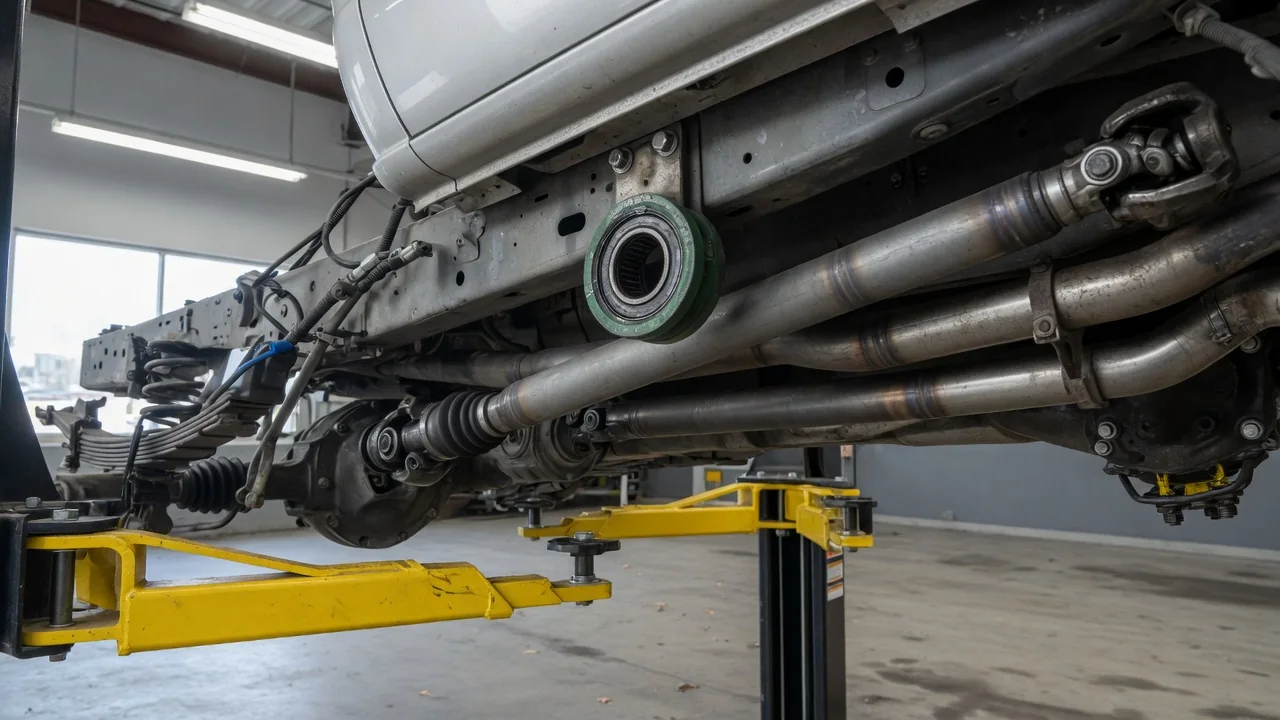
A driveshaft carries torque from the transmission or transfer case to the rear axle. On many vehicles it is a single tube with a joint at each end, but others split that path into two shorter sections joined in the middle and held up by a support bearing. So why do some cars use a two-piece driveshaft? The answer comes down to three linked issues: the distance the shaft must span, how it is supported, and how vibration is kept under control.
Length support: why distance matters
Every rotating shaft has a natural bending frequency. If the shaft spins fast enough to reach that frequency, it starts to bow outward and whip, a condition engineers call critical speed. A longer tube of the same diameter and wall thickness is more flexible, so its critical speed is lower; in simple beam theory it falls roughly with the square of the length. On a vehicle with a long wheelbase, or one where the transmission sits far forward of the rear axle, a single tube long enough to bridge the gap could approach its critical speed within the normal driving range.
Designers have several ways around that. They can increase the tube diameter, which raises stiffness but takes up more room in the floor tunnel and adds rotating mass. They can use stiffer or lighter materials, such as aluminum or composite tubes. Or they can divide the span into two shorter sections, each with a much higher critical speed than one long tube would have. When packaging space, cost and durability are weighed together, splitting the shaft is often the most practical answer.
Length is not only a vibration issue. A long shaft has to clear the exhaust, fuel tank, crossmembers and body floor while the rear suspension moves up and down. Two sections give the designer an intermediate support point that can be placed to keep the shaft close to the floor and to set more favorable joint angles at each end. That is why the layout is often found on pickups, vans, longer rear-drive cars and some all-wheel-drive vehicles, though whether a given model uses it depends on its own engineering.
The center bearing and how the halves connect
The point where the two sections meet needs support, because otherwise the connection between them would sag and wander. That job falls to the center bearing, also called a carrier bearing or hanger bearing. It is usually a sealed ball bearing fitted onto the front section and surrounded by a rubber cushion, all held in a bracket that bolts to a crossmember or the underbody. The bearing lets the shaft spin freely while the bracket fixes its height and lateral position.
The rubber cushion matters as much as the bearing itself. It absorbs small vibrations before they reach the body, and it allows a limited amount of movement as the engine and transmission rock on their mounts under load. A cushion that is too stiff would pass noise into the cabin. One that has cracked, softened or torn with age lets the shaft move further than intended and can change the joint angles while the vehicle is driving.
Behind the bearing, the two sections are joined in one of several ways depending on the design. Many use a universal joint, often combined with a splined slip yoke so the shaft can change length as the suspension moves. Others use a constant-velocity joint, and some use a rubber flexible coupling. Either way, the driveline ends up with three joints instead of two, and the center support determines where the middle one sits.
Vibration: balance, joint angles and phasing
A conventional universal joint does not transmit rotation at a perfectly even speed when it operates at an angle. The output side speeds up and slows down twice per revolution, and the fluctuation grows as the angle increases. In a driveline, this is managed by arranging joints so that the fluctuation created at one is canceled at another. That requires suitable joint angles and yokes aligned, or phased, in the correct orientation relative to each other.
Adding a third joint makes this arrangement more involved, but it also gives engineers more freedom. The center bearing height and the angle of each section can be chosen so the joints work together to cancel speed variation, while each shorter section stays well below its critical speed. When the angles are right, the driveline runs smoothly across a wide speed range. When they are wrong, the cancellation is incomplete and the leftover variation shows up as a vibration felt through the floor or seat.
Each section is also balanced during manufacture, and on many designs the assembled shaft is balanced as a unit. Reassembling the halves in a different rotational position can upset both balance and phasing. Typical complaints on a two-piece driveshaft car or truck include a shudder when accelerating from a stop, which can appear when a worn center support lets the shaft shift under torque, and a vibration that builds with road speed, which points more toward imbalance or a worn joint. A failing center bearing may also produce a rumble or whine that changes with speed.
Practical implications and limits
For owners, the main consequence is that a two-piece driveshaft adds parts that wear. The center bearing and its cushion age with heat, road salt, oil contamination and mileage, and the extra joint is one more item to inspect for play or dryness. When the shaft must come out for transmission or axle work, technicians typically mark how the sections and flanges line up before separating them so the original orientation can be restored. Some center bearings can be replaced on their own, while other designs are serviced as a complete shaft assembly.
Changes to ride height affect this layout more than many people expect. Lifting or lowering the vehicle alters the angles between the transmission, the center support and the axle, so the joint cancellation may no longer work as intended. Some vehicles allow spacers or shims at the center support to correct angles after such changes, but the right correction depends on the specific driveline and should come from its service information rather than guesswork.
It also helps to keep expectations realistic. A two-piece shaft solves a packaging and rotational speed problem; it does not guarantee smoother operation than a one-piece design. Many vibrations blamed on the driveshaft actually come from tires, wheels, brakes or engine mounts, so careful diagnosis checks those too. Replacing a two-piece shaft with a single long tube is not a simple swap, because the new shaft would need suitable material, diameter and balance to stay clear of its critical speed. Exact procedures, torque values and inspection limits vary by vehicle and belong in that model's repair manual.