Symptoms of a Bad Driveshaft: Diagnosing Vibration and Noise
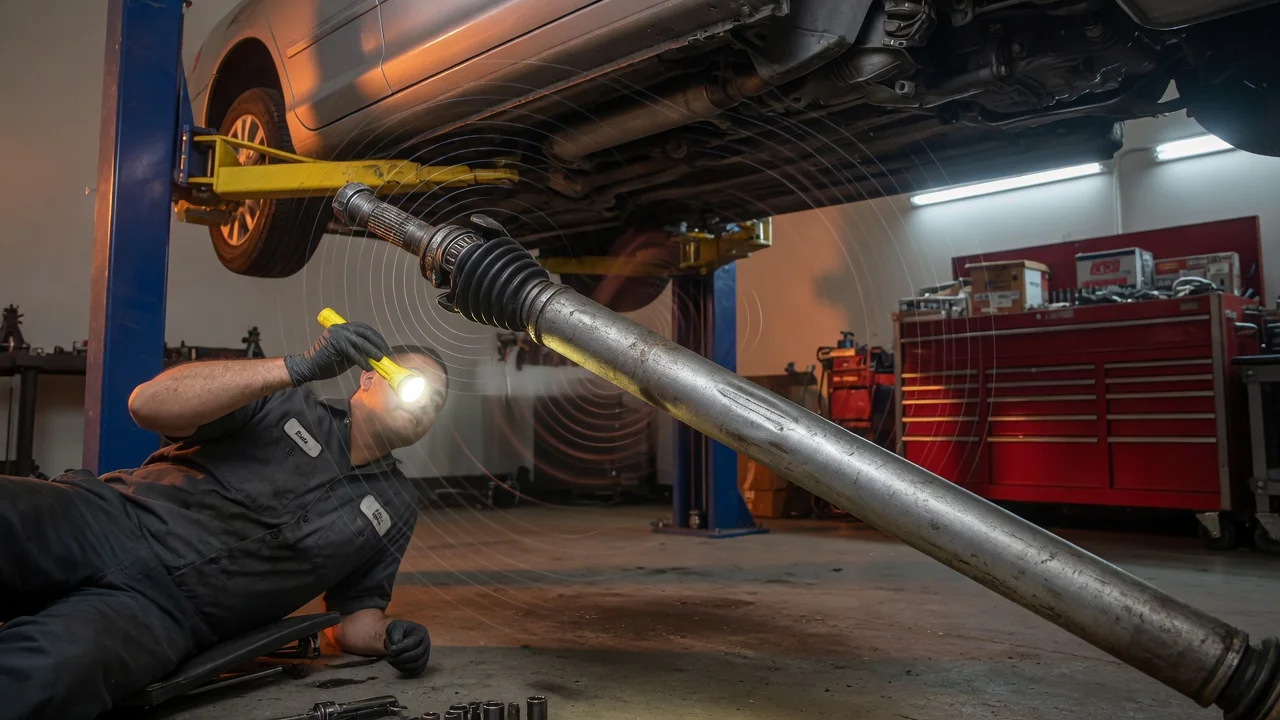
A driveshaft carries torque from the transmission or transfer case to the axle, so wear usually shows up first as vibration and noise from under the vehicle. Tires, mounts and differentials can produce very similar complaints. This guide explains how to recognize bad driveshaft symptoms, how to separate them from look-alike problems, which checks to do in which order, and how urgently to act on what you find.
Establish the Symptoms
Start with your vehicle configuration. Rear-wheel-drive, four-wheel-drive and many all-wheel-drive vehicles use a driveshaft, sometimes called a propeller shaft. Four-wheel-drive models usually have both a front and a rear shaft, and longer vehicles may use a two-piece shaft supported in the middle by a center bearing. Most front-wheel-drive cars have short CV axles instead of a traditional driveshaft, so a vibration in one of those cars points elsewhere. Knowing which layout you have narrows the list of suspects before anything is taken apart.
The symptoms of a bad driveshaft tend to fall into a few patterns. A vibration felt through the floor or seat that builds with road speed is the most common. A clunk when shifting into drive or reverse, or when getting on and off the throttle, often points to looseness in a universal joint or slip yoke. A rhythmic squeak or chirp at low speed that rises in pitch as you speed up is typical of a dry U-joint. A shudder when pulling away from a stop can come from a worn center bearing or incorrect driveline angles. Fluid at the rear of the transmission or transfer case can accompany a worn slip yoke.
Write down the operating conditions: the speed at which the problem starts and stops, whether it happens while accelerating, cruising, coasting, braking or turning, and whether load, towing or temperature changes it. Note recent changes such as new tires, a lift kit or lowered suspension, an off-road impact, or any driveline work in the service history. These details are what make the later checks meaningful.
Distinguish Plausible Causes
Tires and wheels cause more speed-related vibration than driveshafts do. An unbalanced wheel, a lost balance weight, an out-of-round tire or a separated belt can all mimic driveline trouble. A shake felt mainly in the steering wheel leans toward the front tires, while a driveshaft vibration is more often felt in the seat and floor and may change between accelerating and coasting. If balancing or rotating the tires changes or moves the vibration, the driveshaft becomes a weaker suspect.
Other competing causes include worn engine or transmission mounts, which can produce a clunk on shifting along with visible engine movement; differential wear, which tends to whine or howl and change with throttle; wheel bearings, which growl and often change when turning; warped brake rotors, which act up only during braking; and exhaust parts touching the body. A vehicle whose ride height was changed can vibrate from incorrect driveline angles even when every part is in good condition.
Observations that support the driveshaft include play in a U-joint, rust-colored powder around the joint caps, a missing balance weight, a dented tube, a torn boot on shafts that use CV joints, or cracked rubber in a center bearing. A symptom that started right after an impact, or after the shaft was removed and reinstalled, also points toward the shaft, its balance or its orientation.
Checks in a Useful Order
Begin with observations that need no tools. Check tire pressures and look for bulges, flat spots or uneven wear. On a quiet road where it is safe, note whether the vibration follows road speed or engine speed; a vibration that stays at the same road speed regardless of gear or engine rpm points toward tires, wheels, the driveshaft or the axle rather than the engine. With the vehicle parked on level ground, look underneath without crawling under it for drips near the transmission or transfer case and anything hanging low.
Hands-on inspection should be done only with the vehicle on a lift or on properly rated jack stands on solid, level ground with the wheels chocked; never work under a vehicle held up only by a jack. With the shaft accessible, grip it near each U-joint and try to twist and push it; any clicking or free movement is a finding. Check the slip yoke for excess movement, inspect the center bearing rubber, look for missing balance weights and dents, and confirm boots on any CV joints are intact.
Some tests require tools, service information and often a qualified technician: measuring shaft runout with a dial indicator against manufacturer specifications, measuring driveline angles, balancing the shaft on proper equipment, using electronic vibration analysis to match a vibration frequency to a component, and inspecting the differential. These need the correct values for your exact vehicle, so do not substitute guessed numbers.
Interpret the Findings
Perceptible play, binding or a notchy feel in a U-joint establishes a worn joint that needs repair. Rust dust around the caps is strong evidence but should be confirmed by feeling for play. A worn joint does not automatically mean the whole shaft must be replaced; many shafts accept replaceable joints, while others are serviced as an assembly according to the manufacturer. A dent or missing weight can explain a vibration, but simply reattaching a weight without balancing does not confirm the fix.
Clean results matter too. If the tires are balanced, the joints are tight and runout is within specification yet the vibration remains, driveline angles, the differential and the mounts move up the list. A clunk with tight U-joints points toward the slip yoke, differential backlash or worn mounts rather than the shaft itself.
Before replacing parts, make sure the abnormal finding actually explains when the symptom happens. After a repair, road test under the same conditions you recorded at the start. If the vibration or noise is still there, the diagnosis was incomplete and further inspection is needed rather than additional parts.
Urgency and Next Action
Stop driving and arrange a tow if you hear loud banging or clanking from underneath, feel a sudden severe vibration, notice a knock that worsens quickly, lose drive, or see the shaft hanging or touching the ground. A failed U-joint or center bearing can let the shaft drop or separate, damaging the transmission, fuel and brake lines or exhaust and potentially affecting control of the vehicle. Milder signs such as a faint chirp still warrant prompt inspection, because there is no reliable way to predict how long a worn joint will last.
When you contact a shop, provide the year, make, model, engine, transmission and drivetrain, whether the shaft is one-piece or two-piece, any suspension or tire size modifications, mileage, service history and where the vehicle stands on its maintenance schedule, along with your notes on when the symptom occurs. Ask what was measured and which specification it was compared against, so the repair is based on confirmed findings.