What Is a Driveshaft?
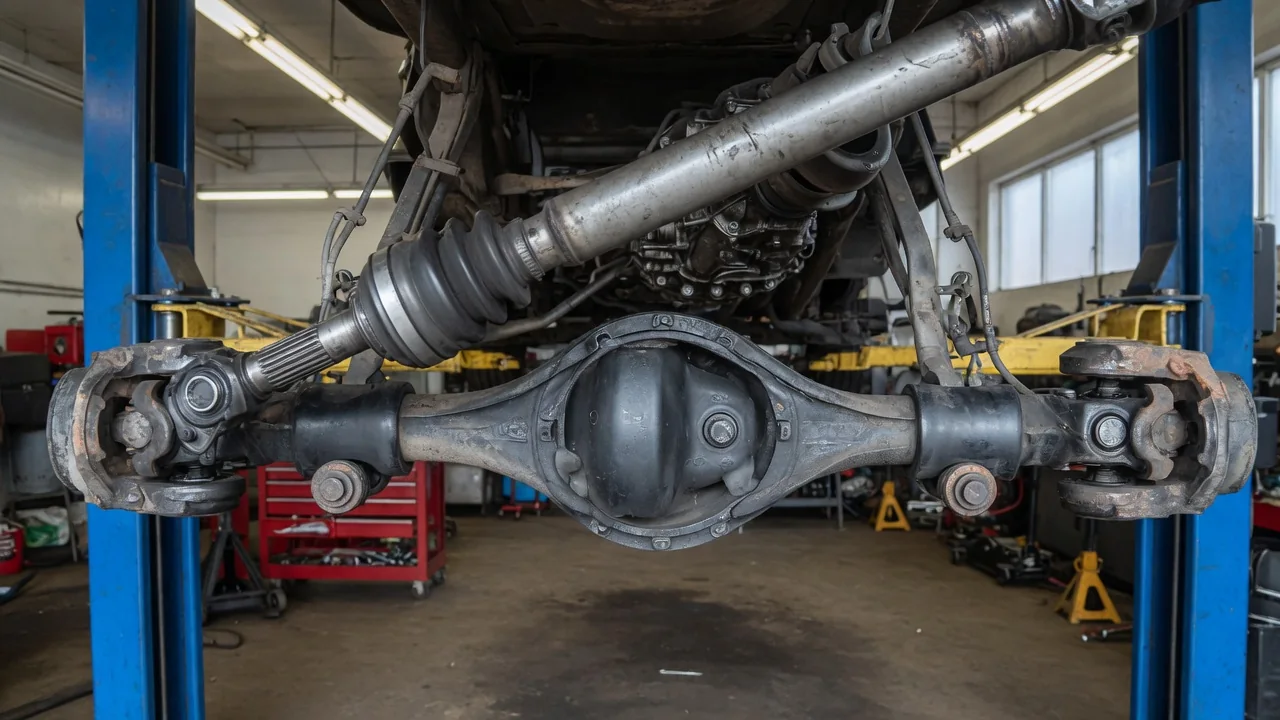
If you have ever wondered what is a driveshaft, the short answer is that it is a rotating tube or bar that carries engine torque from one drivetrain component to another. It links the transmission or transfer case to a differential, letting the wheels receive power even as the suspension moves. This guide explains where it sits, how its joints work, and which symptoms deserve attention.
Location by layout
On a rear-wheel-drive car or pickup, the driveshaft, often called a propeller shaft, runs lengthwise beneath the floor from the back of the transmission to the rear differential. It is usually a steel, aluminum, or occasionally carbon fiber tube, visible if you look under the middle of the vehicle. Longer vehicles, such as extended-cab trucks and vans, often split the shaft into two pieces supported by a center bearing mounted to a crossmember, which keeps each section short enough to spin smoothly at highway speed.
Four-wheel-drive and all-wheel-drive vehicles add a second shaft running forward from the transfer case to the front differential, so there may be two propeller shafts under the body. Front-wheel-drive cars generally have no long center shaft at all; instead, a transaxle sends power through two short half shafts, commonly called CV axles, directly to the front wheels. Rear-engine and mid-engine layouts follow a similar pattern at the back. Because terminology and packaging differ between manufacturers, the service information for your specific vehicle is the best guide to what is fitted.
Joints
A driveshaft cannot be a rigid link, because the axle rises and falls with the suspension while the transmission stays fixed to the body. Joints at each end let the shaft keep turning while its angle changes. The traditional design is the universal joint, a cross-shaped piece with four bearing caps that pivots in two planes. Many trucks and older rear-drive cars use one at each end, arranged so the slight speed fluctuation created by the first joint is cancelled by the second.
Constant velocity joints do the same job without that speed fluctuation, which is why they are used on front half shafts that must steer as well as flex, and on many modern propeller shafts. They are packed with grease and sealed by a flexible rubber boot you can see near the wheel or differential. A slip yoke or splined section also lets the shaft change length as the suspension travels. Some vehicles use rubber flex couplings instead, and some joints are greasable while others are sealed for life.
Vibration clues
Because the shaft spins several times faster than the wheels in most vehicles, a small imbalance or worn joint tends to show up as vibration. A common pattern is a shudder or buzz felt through the floor or seat that grows with road speed rather than engine speed, sometimes appearing only in a certain speed range. A lost balance weight, a dented tube, caked-on mud, or a worn center bearing can all produce this kind of sensation, so the feeling alone does not identify the cause.
Noises add useful detail. A clunk when shifting between drive and reverse, or when getting on and off the throttle, can point toward play in a universal joint or slip yoke, while a rhythmic squeak at low speed may suggest a dry joint bearing. A clicking sound during tight turns is more typical of an outer CV joint on a half shaft. Tires, wheel bearings, engine mounts, and brakes can mimic every one of these symptoms, so vibration is a clue to investigate, not a diagnosis.
Everyday Use and Observations
In normal driving, a healthy driveshaft is silent and unnoticed. Each time you accelerate, torque leaves the gearbox, twists through the shaft, and reaches the differential, which turns it ninety degrees and divides it between the wheels. Under engine braking the load reverses, and the shaft carries force the other way. Towing, hauling heavy cargo, hard launches, and lifted or lowered suspension all increase stress or operating angles on the joints, which is why vehicles used for work often show wear sooner than lightly driven commuters.
A few simple observations help owners stay ahead of trouble. Dark grease flung onto the inside of a wheel or the underbody near a joint often indicates a split CV boot. Rust-colored dust around a universal joint cap can signal a bearing that has lost its lubricant. Fresh scrapes or dents on the tube after off-road driving or striking road debris are worth noting too. Maintenance needs vary: some designs have grease fittings that require periodic attention, while others have none, so the owner's manual should be the reference.
Limits and Next Steps
There are limits to what a look underneath can tell you. Balance problems, slightly incorrect joint angles, and internal joint wear are often invisible, and confirming them usually requires the vehicle to be raised safely and the shaft checked for play and runout with proper equipment. On newer all-wheel-drive models, a warning light or stored fault code may accompany a driveline complaint, but a code is evidence to interpret rather than proof that a part has failed, and manufacturer-specific codes need vehicle-specific confirmation.
If vibration is strong, worsening quickly, or accompanied by loud clunking, reducing speed and arranging an inspection promptly is the sensible course, because a joint that separates can let the shaft drop or flail and damage nearby components. Working beneath a vehicle or near a rotating shaft carries real risk, so diagnosis and repair are best left to a qualified technician. Sharing when the symptom occurs, at what speed, and under what load gives them a head start, and the right fix depends on the design fitted to your vehicle.