What Is an Exhaust Manifold?
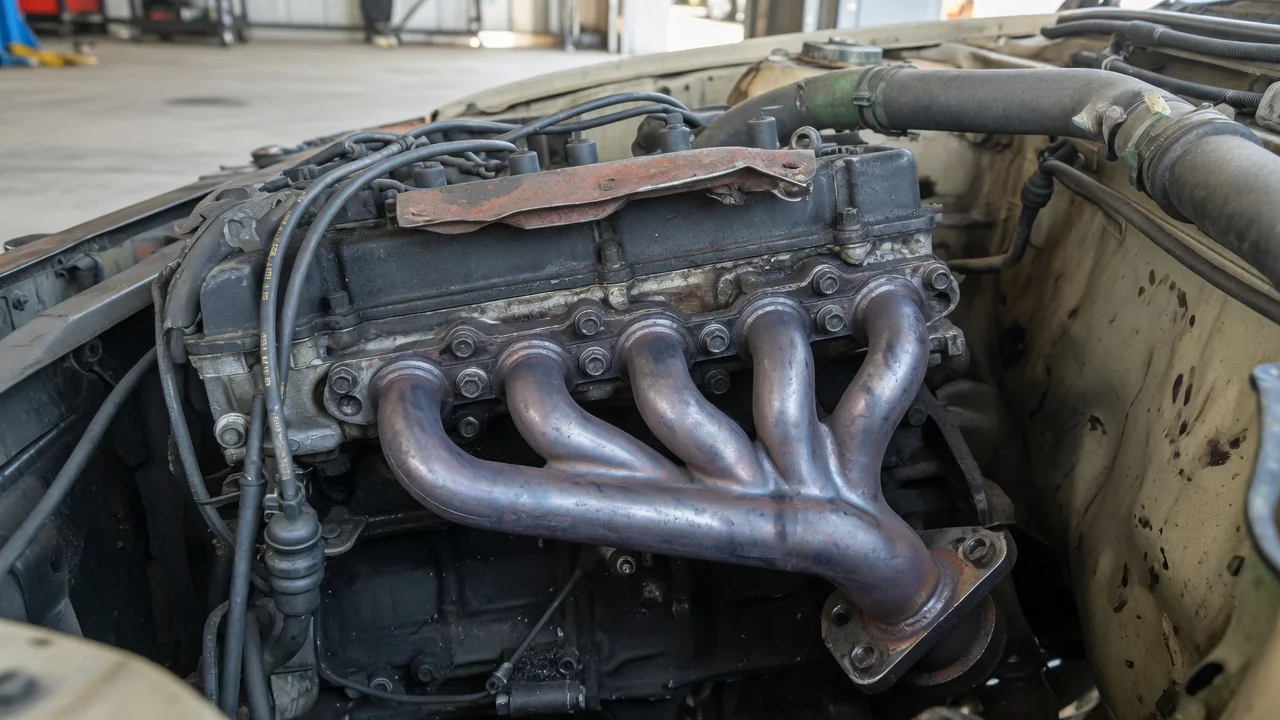
What is an exhaust manifold? It is the first component of the exhaust system, bolted directly to the cylinder head, where it collects the burned gases leaving each cylinder and channels them into a single outlet. Understanding how it routes flow, handles extreme heat, and shows signs of leaking helps drivers make sense of noises, smells, and warning lights.
Flow path
Each time an exhaust valve opens, a pulse of hot gas leaves the combustion chamber through a port in the cylinder head. The manifold has one passage, often called a runner, lined up with each port. These runners merge into a collector, which hands the combined stream to the rest of the system, typically a catalytic converter, pipes, and muffler. On turbocharged engines, the manifold instead feeds the turbine housing first, so the gathered gas energy spins the turbocharger before continuing downstream.
Layout depends on the engine. An inline four-cylinder usually has a single manifold on one side of the head, while V6 and V8 engines generally use two, one per cylinder bank. Some designs are compact cast pieces with short runners, others are tubular headers with longer, more equal-length pipes meant to keep pulses from interfering with one another. Certain modern engines integrate the manifold into the cylinder head casting or combine it with the catalytic converter, so what you see under the hood varies considerably.
Heat
Exhaust gas leaves the cylinder at very high temperatures, and the manifold absorbs that heat before any other exhaust part. That is why manifolds are commonly made from cast iron or stainless steel, materials that tolerate repeated heating without quickly losing strength. Under hard load, such as towing or sustained highway climbing, a manifold can get hot enough to glow in the dark. Thin metal heat shields are often fitted over it to protect nearby wiring, hoses, and plastic components.
The bigger challenge is the cycle rather than the peak. The manifold expands as it warms and contracts as it cools, every single drive, while bolted to a cylinder head that expands at a different rate. Over years, that movement can stress gaskets, stretch or break studs, and eventually crack the casting. Retaining heat also has a purpose: a hot gas stream helps the catalytic converter reach working temperature sooner after a cold start, which is one reason manufacturers place converters close to the manifold.
Leak signs
A leaking manifold or gasket often announces itself with a ticking or tapping noise that follows engine speed. The sound is frequently loudest on a cold start and may fade as the metal expands and closes the gap, which can make it easy to dismiss. Because the rhythm resembles valvetrain noise, the two are sometimes confused. Black soot streaks around a flange, a port, or a hairline crack are a useful visual clue that gas has been escaping at that spot.
Other signs are less direct. An exhaust smell in the engine bay or cabin deserves prompt attention, since exhaust contains carbon monoxide, which is dangerous to breathe. A leak ahead of the upstream oxygen sensor can also draw in outside air between pulses, skewing the sensor's reading and possibly leading to fuel trim changes or a check engine light. Any stored fault code in that situation is evidence to interpret alongside a physical inspection, not proof that a sensor or the manifold itself has failed.
Everyday Use and Observations
In normal driving, a healthy manifold does its job without drawing attention. You will not feel it working; the engine simply sounds smooth and consistent. On many vehicles you can spot it by opening the hood and looking along the side of the cylinder head for a heavy metal casting or a stamped heat shield with pipes leading downward. On others, especially transverse engines, it sits against the firewall or beneath covers, so it may be nearly hidden from above.
A few habits make observations more useful. Listen during the first minute after a cold start, when small leaks are most audible, and note whether the noise changes as the engine warms. Light ticking from the metal as it cools after shutdown is ordinary contraction, not a fault. Surface rust on a cast iron manifold is also common and usually cosmetic. What matters more are changes over time: a new noise, a new smell, or fresh soot where the surface used to be clean.
Limits and Next Steps
Observation only goes so far. A tick could come from the manifold, a gasket, a loose heat shield, an injector, or the valvetrain, and a crack may be on a side you cannot see. Technicians can confirm a leak with methods such as smoke testing or careful listening tools while the engine runs. Looking and listening from a safe distance is reasonable, but the manifold stays hot long after shutdown, so touching or probing around it invites serious burns.
If the evidence points toward a leak, the sensible next step is a professional inspection rather than assuming a particular part needs replacing. The remedy might involve a gasket, hardware, or the manifold itself, and the labor varies widely with engine layout and how the fasteners have aged; seized or broken studs can complicate otherwise simple work. Service information for your specific vehicle should guide part choice and procedure, since designs, integrated converters, and turbocharger arrangements differ from one model to the next.