Why Does a Car Exhaust Pipe Have Flexible Sections?
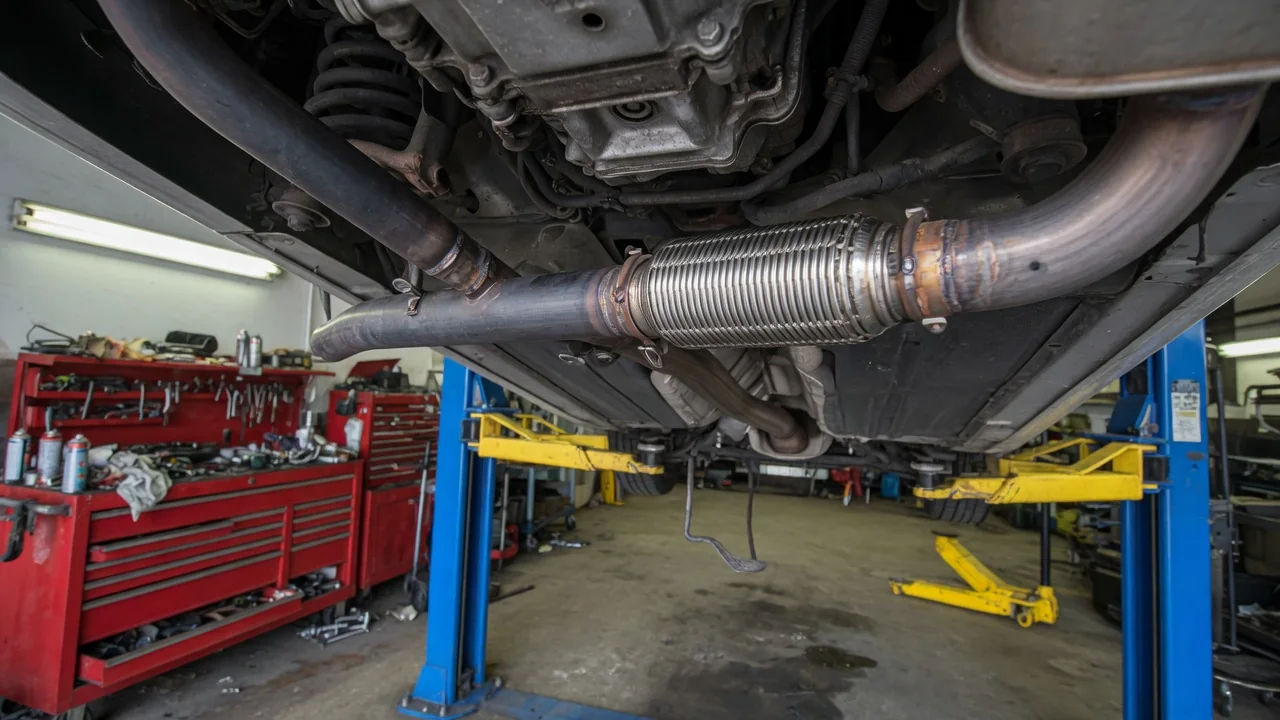
Drivers who look under a vehicle often ask why does a car exhaust pipe have flexible sections when the rest of the system is rigid steel tubing. The short answer is movement: the engine rocks and vibrates on its mounts while the body stays comparatively still, and something in the exhaust has to absorb that difference without cracking.
Engine motion
An engine is not bolted rigidly to the body. It sits on rubber or fluid-filled mounts that let it rock slightly as torque rises and falls. Press the accelerator and the powertrain twists one way; lift off or shift gears and it rolls back. On vehicles with a transversely mounted engine, this rocking tips the exhaust manifold forward and backward, which pushes and pulls directly on the pipe attached to it. Longitudinal layouts twist along a different axis, but the exhaust still receives a steady stream of small motions.
Heat adds a second kind of movement. Exhaust tubing grows measurably longer as it warms from cold to operating temperature, then shrinks again after shutdown. Meanwhile the rear of the system hangs from the underbody on rubber isolators that follow the body, not the engine. Anyone can see the principle by watching an idling engine with the hood open while a helper briefly blips the throttle: the engine visibly rolls on its mounts. How much it moves depends on mount design, engine layout, and mount condition.
Flex joint
The flex joint is the component that soaks up this motion. A common design uses a thin corrugated stainless steel bellows, which seals the gas inside, wrapped in a woven wire braid that protects the bellows and limits how far it can stretch. Some versions add an interlocking inner liner to shield the bellows from direct gas flow. The result is a short length of pipe that can bend, compress, and extend slightly while remaining gas-tight, sparing the manifold, welds, and catalytic converter from repeated bending loads.
Placement and style differ between manufacturers. Many front-wheel-drive cars locate the braided section in the front pipe, close to the engine, where the rocking is greatest. Other vehicles rely on a spring-loaded ball or donut joint that pivots like a shallow socket, and some use more than one flexible element along the system. From underneath, a braided joint looks like a short, slightly fatter section covered in metal mesh. The exact design and position on a particular vehicle are best confirmed from its service information.
Leak symptoms
Because the flex section works constantly, it is a frequent place for an exhaust leak to develop. The typical sign is a change in sound: a ticking, puffing, or raspy noise from the front of the car that is loudest on a cold start or under acceleration, when the engine rocks and opens a split in the bellows. The exhaust note may turn deeper or harsher overall. Visually, a failing joint can show frayed or unraveled braid, black soot streaks around the mesh, or obvious sagging.
Other symptoms deserve more caution. Exhaust odor in the cabin, especially when stopped or with the windows down, suggests gases escaping ahead of where they should, and carbon monoxide exposure makes that a safety concern rather than an annoyance. A leak upstream of an oxygen sensor can also let outside air in and skew its readings, sometimes setting a fuel trim or sensor-related fault code. Such a code is evidence to interpret alongside a physical inspection, not proof that the sensor or any single part has failed.
Everyday Use and Observations
In normal driving the flexible section does its job unnoticed. Pulling away from a stop, driving over speed bumps, and shifting between drive and reverse all flex the joint a little, and a healthy one simply follows along. The benefit shows up as refinement: less vibration transmitted through the hangers into the floor, and less drone or buzzing at idle. Without that decoupling, engine vibration would travel down the pipe and stress every rigid connection along the way.
Several conditions shorten the joint's life. Worn or collapsed engine mounts allow the powertrain to move farther than intended, forcing the bellows to bend beyond its comfortable range on every throttle change. Road salt and moisture corrode the braid, scraping on steep driveways or debris can crush it, and broken hangers leave the joint carrying weight it was never meant to support. Vehicles used for short trips, towing, or rough roads may see different wear patterns, so the condition of one car says little about another.
Limits and Next Steps
A flex section accommodates movement only within limits. It is not designed to hold up the exhaust, correct misaligned pipes, or compensate for failed mounts indefinitely. For that reason, a split joint is often a symptom as well as a problem: replacing it without checking the engine mounts and hangers can lead to the new part failing early. Repair approach also varies, since on some vehicles the joint can be replaced as a separate section while on others it is integrated with a pipe assembly or converter.
When a leak is suspected, a sensible first step is a look underneath with the engine off and the exhaust fully cooled, since these parts stay hot enough to burn long after a drive. Fraying, soot, or a drooping pipe are worth noting, but confirming the source usually takes a lift and a trained eye, because manifold gaskets and cracked pipes can sound similar. Any exhaust smell inside the cabin justifies prompt professional inspection, and local emissions or noise rules may also influence which repair is acceptable.