Exhaust Flex Pipe Repair: Repair Options and Service Considerations
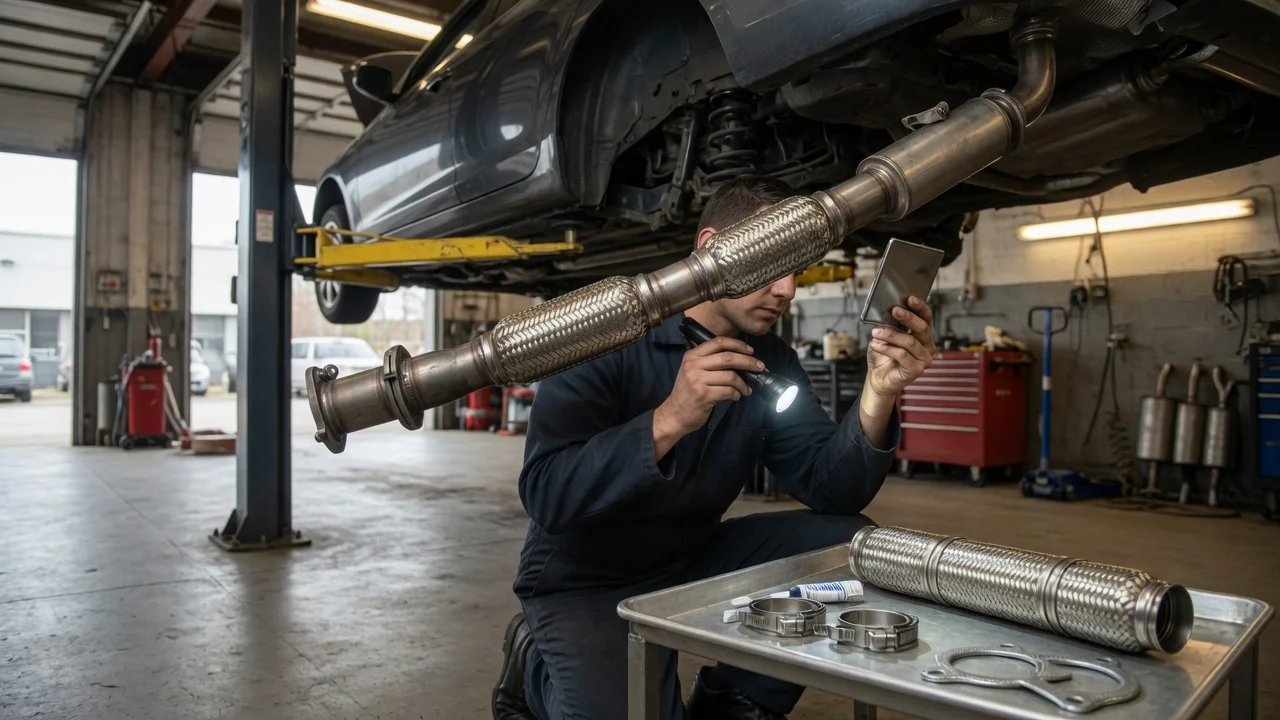
What Is an Exhaust Flex Pipe?
An exhaust flex pipe is a short, reinforced section in the exhaust system designed to absorb movement and vibration between the engine and the fixed exhaust piping. It usually combines a corrugated stainless steel liner with an outer braided mesh, which protects the flexible inner layer while allowing a limited range of bending and axial movement.
Flex sections are commonly located near the exhaust manifold, downstream of the catalytic converter, or in front of the mid-pipe. Their main job is to prevent engine movement, torque reaction and road vibration from cracking rigid exhaust components and stressing gaskets or flanges.
Immediate Answer: Exhaust Flex Pipe Repair Scope
An exhaust flex pipe can sometimes be repaired if the damage is limited to a small crack, pinhole or failed weld. However, a torn braid, deep internal split or a flex section that is rusted across its full circumference is not reliably repairable and should be replaced. The flex bellows is a working part that continuously moves and expands, so any patch must tolerate heat cycling, vibration and exhaust pressure without becoming brittle.
Temporary products such as exhaust bandages, epoxy putty, muffler cement and metallic repair tape can quiet a leak for a short period, but they are not equivalent to a structural repair. The answer also depends on vehicle configuration: some flex sections are welded into an assembly and are simpler for a shop to cut out and weld, while others are flanged or clamped and can be swapped as separate service parts.
Repair Options Compared
Option | Typical Fit | Durability | Better When; Cutting out and welding in a new flex section | Broad fit for custom or welded exhausts | Longest-lasting structural repair | The surrounding pipe is sound and access permits a clean welded joint; Replacing a flanged or clamped flex section | Direct fitment on vehicles designed for a service part | Long, with correct alignment and hardware | The failed part is available separately; Local weld repair of small crack or broken seam | Narrow fit to minor accessible damage | Variable, depending on metal condition | Damage is small and the braid or bellows is otherwise intact; Exhaust wrap, epoxy or sealer as temporary patch | Broad fit but nonstructural | Short, temporary only | Owner needs a stopgap before proper service
Welding in a new flex section is usually the preferred permanent repair when the original part is welded or difficult to source. A competent exhaust shop cuts the failed section, verifies the replacement flex is long enough for the required range of movement, and welds it without distorting the bellows. For flanged service parts, replacement is generally preferable because the manufacturer has already matched flex length, diameter, flange alignment and sealing hardware.
Local welding may work for a single clean crack near a weld or seam, but it is a weaker choice if the braid is frayed or the inner liner has split away from the surrounding pipe. A repair that leaves the bellows bound, stretched or misaligned can transfer stress into the manifold, downpipe, catalytic converter or nearby hangers and create new failures.
Symptoms and Diagnostic Checks
Common signs of a failing exhaust flex pipe include increased exhaust noise under acceleration, a ticking or fluttering sound near the front of the vehicle, an exhaust smell inside the cabin, visible black soot around the mesh, and a change in exhaust note when the engine rocks on its mounts. A torn flex section may also allow the downpipe to move more than intended, causing rattles or contact with nearby heat shields.
Inspect the braided mesh for fraying, broken strands and soot stains concentrated around the leak. Check the joints where the flex section joins solid pipe for cracks, pinholes or failing welds. With the vehicle securely supported, gently observe the flex section while an assistant moves the gear selector between Drive and Reverse with the brake applied only when safe to do so, or while loading the drivetrain briefly. Look for adjacent hanger wear, cracked downpipe brackets or a sagging exhaust that transfers extra force into the flex bellows. Note whether the noise changes only under load, which often points to a small split opening under engine movement rather than a loose flange.
If the flex section is visibly torn across the braid, heavily rusted, leaking near the catalytic converter or allowing the exhaust to hang lower than normal, stop using the vehicle for extended driving and have it inspected promptly. A separated exhaust can contact fuel lines, brake lines or wiring, direct hot gases under the cabin, or increase the risk of exhaust gases entering the passenger compartment.
What Affects Repair Cost and Feasibility
Feasibility is driven more by access and surrounding metal condition than by the flex pipe alone. If the nearby downpipe or mid-pipe is thin from corrosion, a weld may not hold cleanly and replacement piping becomes the safer solution. On turbocharged vehicles, the flex section often sits close to the turbocharger and heat shielding, so removal and reinstallation can take more labor than on a naturally aspirated car with open access.
The required replacement flex must match the inside diameter and outer diameter of the surrounding pipe, provide enough flex length for engine movement, and use a braid compatible with the exhaust temperature. A shorter or undersized flex will tear again quickly. Mounting position also matters: the replacement should preserve the original routing angle and leave enough clearance for suspension movement and steering components.
Service Considerations and Next Action
For a permanent outcome, the practical next action is usually a professional inspection and repair. A temporary patch is acceptable only as an emergency measure to reach a repair facility, and it should be clearly treated as temporary. When the vehicle has a flanged or slip-fit service flex pipe in good condition at the surrounding connections, direct replacement is often the cleanest option with the least risk of future leaks.
For welded systems or unavailable service parts, ask the shop to replace the flex section rather than weld over the failed area. The repair should include fresh sealing hardware if flanges are reused, inspection of nearby hangers, and a final check that the new flex section is not stretched or compressed at rest. That alignment check is important because installing the part in a preloaded position can shorten its service life.
Evidence Gaps
This guide does not provide vehicle-specific part numbers, model-specific labor times, or local pricing because those vary by model year, powertrain configuration, market and shop rates. It also avoids claiming it has tested specific aftermarket flex sections. Before purchasing parts, confirm the exact internal diameter, overall flex length, braid material and connection style for your vehicle and year.
No procedure was performed, and no torque specifications or welding parameters are included because the required settings depend on the specific assembly and the condition of the surrounding exhaust. A repair shop should follow the applicable service information for the vehicle and inspect the complete exhaust path before making a final repair recommendation.