Exhaust Pipe Repair: Options for a Damaged Pipe
What is the essential answer?
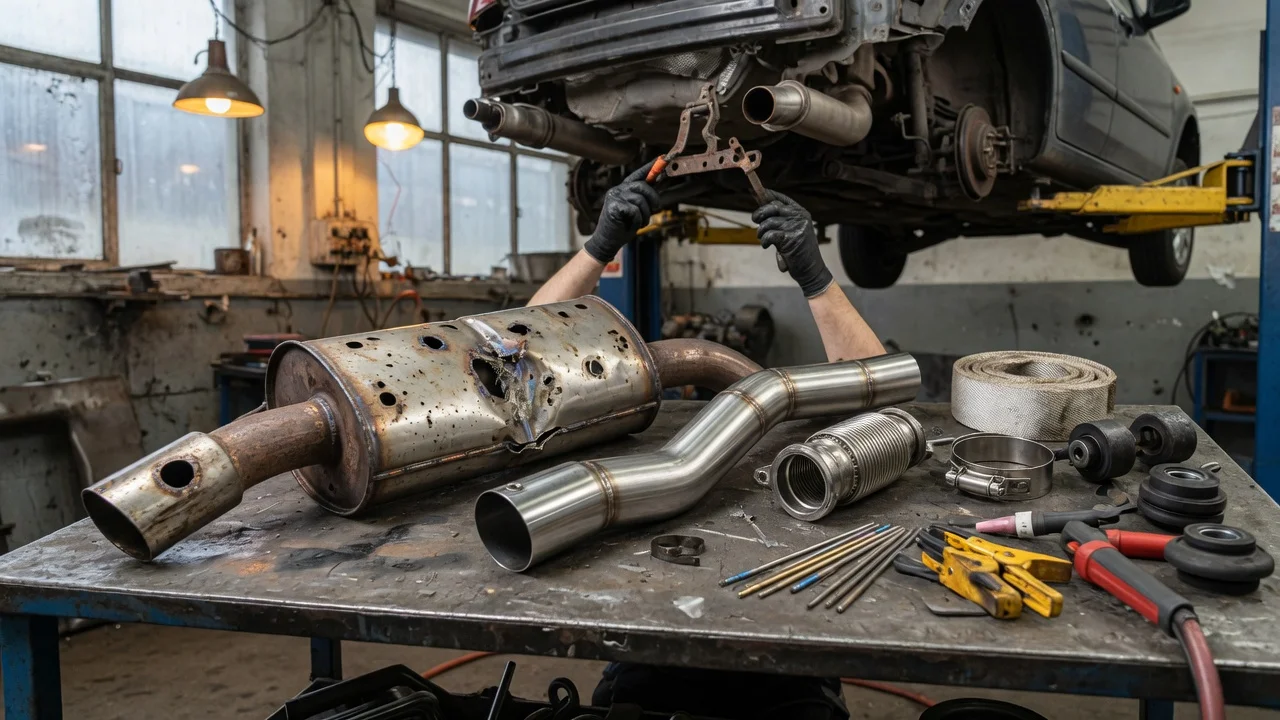
A damaged exhaust pipe can often be repaired rather than replaced, but the right method depends on the size, location, and type of damage. Small holes, cracks, or rust-through areas in an otherwise sound pipe may respond to a temporary patch, a repair bandage, or a welded-in sleeve. More extensive corrosion, damage near a flange or flex joint, or failure of a catalytic converter connection usually makes replacement the more durable choice. The repair is only practical when the surrounding metal is thick enough to support a patch or weld and when the damaged section is accessible.
Exhaust repairs matter for more than noise. A leaking pipe can allow exhaust gases to enter the cabin, affect oxygen sensor readings, and fail a vehicle inspection. A correct repair should restore gas-tight flow and preserve the pipe's support and clearance from the body, fuel lines, and heat-sensitive parts.
Repair options compared
For a small, localized hole in a stable pipe, a high-temperature exhaust repair bandage, paste, or epoxy can seal the leak without welding. These products are most useful as short-term or emergency fixes because they depend on clean, rust-free metal and controlled curing. They should not be used on a split seam, a separated joint, or a section weakened by widespread corrosion.
A welded patch or a replacement sleeve is generally stronger for a moderate rust hole or crack. This requires removing surface rust, cutting back to sound metal, and welding a patch or insert over the area. It is preferable when the rest of the pipe is still structurally sound and the owner wants a longer service life than a chemical patch can provide.
Replacement of the damaged pipe section is preferable when corrosion is widespread, the pipe is thin or splitting in several places, damage is close to a hanger or flange, or the leak involves a flex section. A new section restores consistent wall thickness and avoids a patch that merely moves the failure to another weak point.
Option | Best for | Limitations; Exhaust paste or bandage | Small holes, emergency seal | Temporary; needs clean surface; not for structural damage; Welded patch or sleeve | Moderate localized rust or crack | Requires sound surrounding metal and welding access; Pipe section replacement | Widespread corrosion, flange/flex damage | Higher cost; may require cutting and fitting
What should I check when diagnosing a damaged pipe?
A louder or deeper exhaust note, a rhythmic hiss or ticking, a fuel smell, or reduced fuel economy can point to an exhaust leak, but none of these symptoms alone proves the pipe needs replacement. Begin with a visual check of the pipe from the engine to the rear of the vehicle, preferably on a raised vehicle with secure supports. Look for black soot streaks, rust bloom, holes, cracks, separated joints, and loose hangers.
If a leak is suspected but not visible, the engine can be run briefly and the pipe checked for escaping gas, but carbon monoxide exposure should be avoided. Do not crawl under a running vehicle without proper ventilation and secure lifting equipment. A leak that causes exhaust odor inside the cabin, a significant increase in noise, or a visible separation at a joint or hanger should be treated as requiring prompt professional inspection.
Surface rust alone does not always mean replacement. Light rust can be removed and treated if the metal remains solid, while deep flaking or a pipe that crushes easily under light pressure indicates wall loss. The repair method should be chosen based on whether the remaining pipe can support the patch or weld without distorting.
A fault code or sensor reading should be treated as evidence to investigate, not proof that the exhaust pipe is the problem. Other leaks, sensor faults, or engine conditions can produce similar symptoms.