Why Do Wheel Nuts Have a Torque Specification?
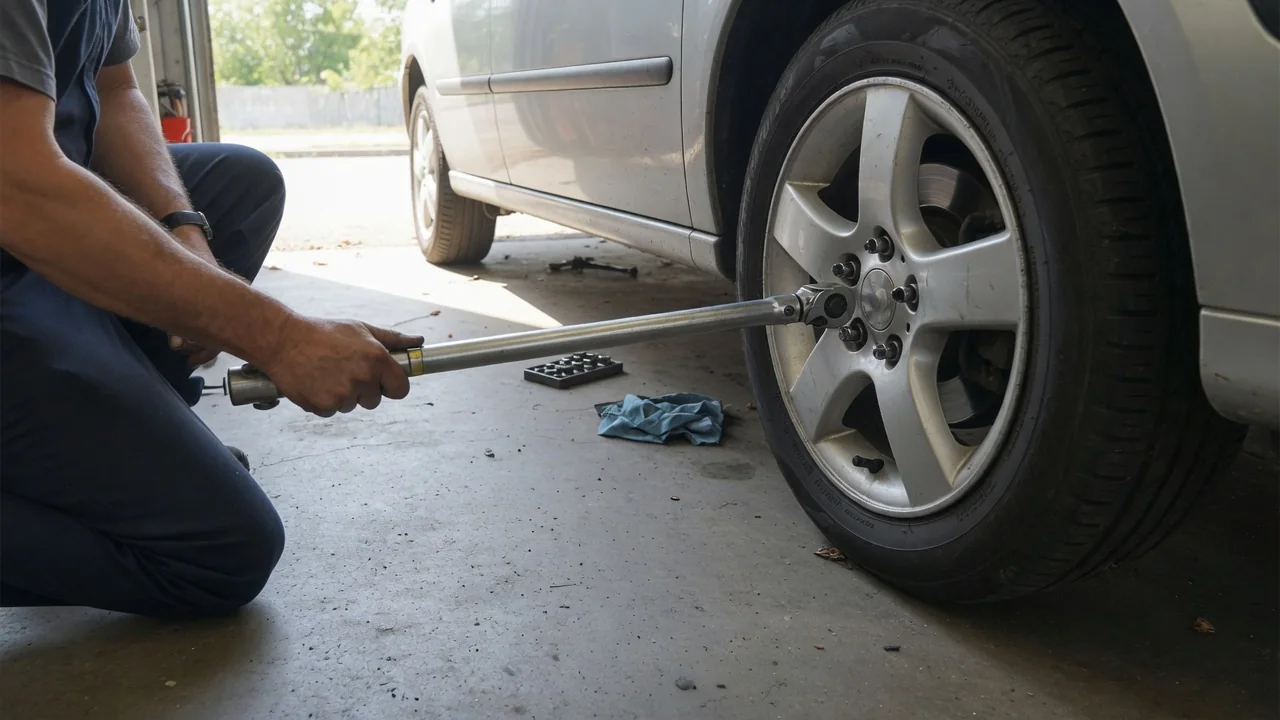
Many drivers wonder why do wheel nuts have a torque specification when simply tightening them firmly seems good enough. The answer lies in how a wheel is actually held on: not by the nuts themselves, but by the stretch they create in the studs. Too little or too much tightening changes that clamping force, and uneven tightening creates problems of its own.
Stud tension
A wheel stud behaves like a very stiff spring. As the nut is turned, the stud stretches by a tiny amount, and that stretch pulls the wheel tightly against the hub face. This clamping force, not the stud's resistance to bending or shearing, is what keeps the wheel from shifting under braking, cornering and acceleration. A torque figure is the manufacturer's practical way of reaching the intended stud tension, because stretch itself cannot easily be measured with ordinary workshop tools.
If the tension is too low, the wheel can move slightly against the hub, and that movement gradually loosens the nuts and wears the seats. If it is too high, the stud can be stretched beyond its elastic range, weakening it and damaging threads or the wheel's seating surfaces. Because torque is partly consumed by friction, thread condition matters as well. Rust, dirt or lubricant on the threads changes how much tension a given torque produces, which is why manufacturers state whether threads should be clean and dry.
Correct sequence
Reaching the right torque on each nut is only half the task; the order in which they are tightened matters too. Working around the wheel in a circle can pull one side down first, leaving the wheel slightly tilted against the hub. A crisscross or star pattern draws the wheel down evenly, so the mounting face seats flat and every stud ends up sharing the load. On a four-stud wheel this means tightening opposite pairs, while five-stud patterns skip to every second nut.
Tightening in stages also helps. Nuts are usually run down lightly by hand first so the wheel centers itself, then snugged in the pattern, and finally brought to the specified figure with the vehicle's weight on the ground. Skipping straight to full force on one nut can trap the wheel off center or clamp the brake disc unevenly between wheel and hub. That uneven clamping is one reason some drivers notice a brake pedal pulsation or steering vibration developing after a wheel has been refitted carelessly.
Recheck guidance
Clamping force can settle slightly after a wheel has been fitted. Paint, corrosion, or small high spots between the wheel and hub compress during the first miles of driving, and alloy wheel seats can bed in against the nuts. When that happens the stud loses a little of its stretch, even though the nut has not turned. For this reason many manufacturers and tire shops recommend rechecking the nuts after a short initial distance, though the exact guidance differs between vehicles and wheel types.
A recheck simply means applying a torque wrench set to the specified figure, in the same crisscross pattern, and confirming each nut holds without further movement. It should not turn into adding extra force for reassurance, since repeated overtightening stretches studs a little more each time. Owners who had wheels fitted at a workshop can ask whether a recheck is advised and at what distance. The owner's manual or the wheel maker's instructions remain the right reference for the figure and any interval.
Everyday Use and Observations
In daily driving, properly torqued wheels give no sign at all, which is exactly the point. Trouble tends to announce itself gradually. A loosening wheel may produce a rhythmic clicking or knocking at low speed, a vibration through the steering wheel or floor, or a vague wobble that worsens with speed. Visual clues can include rust-colored streaks radiating from the nuts, shiny witness marks around the seats, or a nut that visibly sits further out than its neighbors.
Overtightening leaves different evidence. Nuts that are extremely hard to remove at the roadside, studs that look necked or have damaged threads, and cracks or distortion around the bolt holes on a wheel all suggest excessive force, often from an impact gun used without control. A pulsing brake pedal after recent wheel work can also point to uneven clamping. None of these signs proves a single cause, but each is a good reason to have the fasteners and mounting surfaces inspected before driving much further.
Limits and Next Steps
A torque specification is only as reliable as the conditions it assumes. The figure depends on stud diameter, thread pitch, seat design and wheel material, so it varies between vehicles and sometimes between wheel options on the same model. Aftermarket wheels may call for different nuts or seat types than the originals, and vehicles that use wheel bolts instead of studs and nuts follow the same principle with their own values. A number borrowed from another car, or remembered loosely, is not a safe substitute.
The sensible next step is to find the correct figure in the owner's manual or from the vehicle manufacturer, and to use a torque wrench that is in good condition rather than judging by feel. Damaged studs, seized nuts, corroded hub faces or cracked wheels are beyond a simple retightening and deserve professional attention. Anyone who suspects a wheel is loose while driving should slow down and stop somewhere safe, because continued driving can turn a minor fastening problem into a detached wheel.