What Is a Torque Wrench for Car Work?
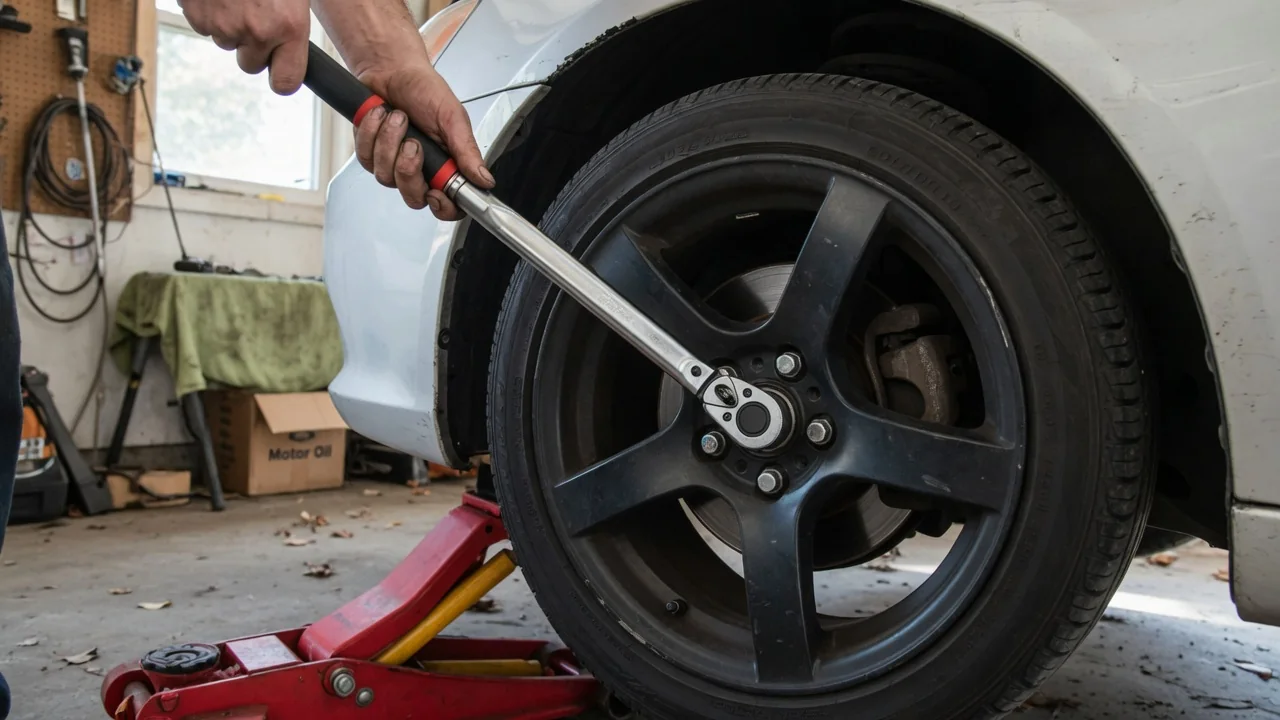
What is a torque wrench for car work? It is a hand tool that tightens a fastener to a measured amount of twisting force instead of leaving the result to guesswork. Owners use one on wheel lug nuts, drain plugs, spark plugs, and similar hardware, where too little clamping lets parts loosen and too much can stretch threads or distort components.
Torque concept
Torque is twisting force: effort applied at a distance from the center of a fastener, expressed in pound-feet or newton-meters. Pulling harder or using a longer handle both increase it, which is why a long breaker bar can overtighten a small bolt with very little effort. A torque wrench measures that twisting force as you pull and signals when a preset value is reached, so the result does not depend on arm strength or the feel of the handle.
The real goal is clamping force. As a bolt is tightened it stretches slightly, like a stiff spring, and that tension holds the wheel, cover, or bracket in place. Torque is an indirect way to reach that tension, because much of the effort goes into overcoming friction in the threads and under the bolt head. This explains why dirty, rusty, or oiled threads change the outcome, and why some manufacturers specify dry threads while others call for a lubricant or a fresh fastener.
Correct specification
A torque wrench is only as useful as the number set on it. The correct specification comes from the owner's manual or service information for the exact vehicle, since wheel fastener values differ between a compact car and a heavy pickup, and sometimes between wheel types on the same model. Values for oil drain plugs, spark plugs, and brake caliper bolts vary just as widely, depending on thread size, material, and whether the part threads into steel or softer aluminum.
Units deserve equal attention. Specifications may appear in pound-feet, pound-inches, or newton-meters, and confusing them can cause a serious error; small fasteners listed in pound-inches are easily overtightened if the figure is read as pound-feet. Some instructions also add a tightening sequence, such as a star pattern across wheel lugs, or several stages finishing with an angle of rotation. Those details are part of the specification, and a general bolt-size chart should not replace the figure published for your vehicle.
Storage
The common click-type wrench relies on an internal spring, and how it is stored affects how long it stays accurate. Makers generally recommend turning the adjustment back to the lowest marked setting on the scale after use, which relaxes the spring without unloading it completely. Leaving the tool wound to a high setting for months can let the spring take a set, so the click arrives at a different force than the scale indicates.
The case supplied with the wrench is worth using, because a drop onto concrete or a knock from heavier tools can shift the mechanism without leaving visible damage. A dry spot away from moisture limits corrosion on the ratchet head and scale. Beam-style wrenches have no spring to relax but need a straight pointer, while digital models need healthy batteries and protection from extreme temperatures. If a wrench has been dropped or feels inconsistent, having its calibration checked is wiser than trusting it.
Everyday Use and Observations
Wheel work is where most owners first use the tool. After a tire rotation or flat repair, the lug nuts are snugged by hand in a crisscross pattern, the car is lowered until the tire carries weight, and the wrench finishes each nut to the listed value. A smooth, steady pull on the handle grip gives a cleaner result than a jerk, and with a click-type wrench one click is the signal to stop; pulling again adds torque beyond the setting.
A few observations help confirm the job is going well. A fastener that keeps turning without the wrench signaling, or that feels gritty or spongy, may have damaged threads and deserves inspection instead of more force. Extensions used straight in line with the socket generally do not change the reading, but adapters that lengthen the tool's effective reach can. Many wheel and vehicle manufacturers also advise rechecking lug nuts after a short period of driving, with the distance given in the vehicle's documentation.
Limits and Next Steps
A torque wrench has clear limits. It is a tightening instrument, not a breaker bar, and using it to free stuck fasteners can harm the mechanism. Each tool is accurate only within its marked range, and typically less so at the very bottom, so a large half-inch-drive wrench suited to lug nuts is a poor choice for small valve cover or sensor bolts. Many home garages eventually keep a smaller wrench for delicate fasteners alongside the larger one.
Some jobs go beyond what a basic wrench can confirm. Torque-to-yield bolts, used on some cylinder heads and suspension parts, are stretched deliberately, tightened by angle, and often must be replaced instead of reused. Safety-critical work on brakes, steering, or suspension warrants the published procedure or a qualified technician if any step is unclear. A sensible next step for owners is to look up the values for their own vehicle, choose a wrench whose range covers them, and have it calibrated periodically.