What Is Valve Lash? Thermal Expansion, Measurement, and Service
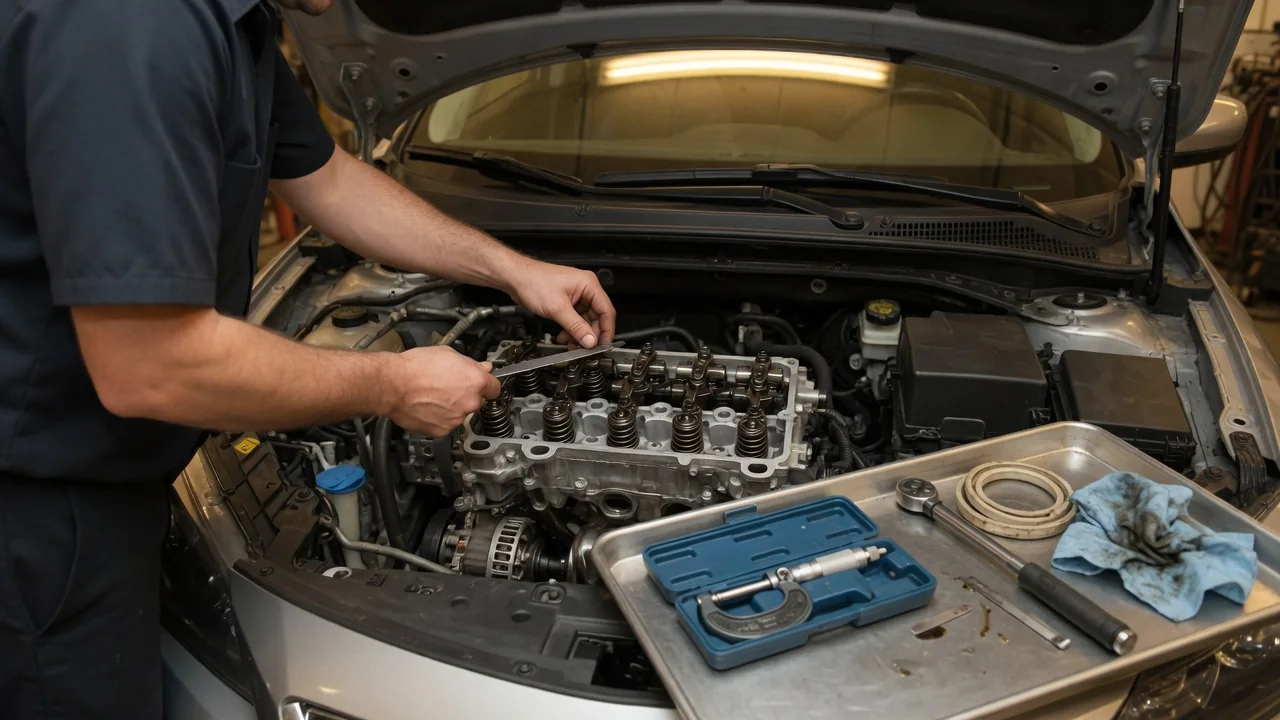
Valve lash is the small, deliberate gap in an engine's valvetrain between a closed valve and the part that opens it, such as a rocker arm, tappet, or camshaft lobe. If you have come across the term valve clearance in a service manual, it means the same space. The gap gives metal parts room to grow as the engine heats up while still letting every valve close completely. Too little or too much clearance changes how the valves open, close, and wear.
Thermal Expansion: Why the Gap Exists
Every metal component in the valvetrain grows as it gets hot. Valve stems, pushrods, rocker arms, the cylinder head, and the engine block all expand, but not by the same amount. They are often made from different materials, such as steel valves in an aluminum head, and they reach different temperatures in service. Exhaust valves in particular run very hot because combustion gases rush past them on the way out of the cylinder. If the valvetrain were assembled with zero clearance on a cold engine, this uneven growth could take up all the available space and hold a valve slightly off its seat once the engine warms up.
A valve that cannot close fully causes problems beyond a leak. When a valve rests on its seat, much of its heat flows into the seat and then into the cylinder head and coolant. That brief contact during each cycle is a major part of how the valve stays cool enough to survive. If clearance disappears at operating temperature, the valve loses that cooling path and combustion gases can leak past it, which can burn the valve face and seat over time. This is why manufacturers specify lash at a defined temperature condition, and why intake and exhaust clearances are frequently listed as separate values on engines with adjustable valvetrains.
The gap also works together with the shape of the camshaft. Cam lobes are typically ground with gentle opening and closing ramps that take up the clearance gradually before the valve begins to lift and after it returns. With the correct lash, the valvetrain makes contact on these ramps instead of slamming together, which helps limit noise and impact loads on the components.
Measurement: How Valve Clearance Is Checked
Valve lash can only be measured accurately when the valve is fully closed and the follower is resting on the base circle of the cam lobe, the round portion with no lift. Service procedures usually achieve this by rotating the crankshaft until a given cylinder is at top dead center on its compression stroke, when both of its valves are closed. Many manuals then give a sequence that lets a technician check several valves at one crankshaft position before turning the engine to the next position, so every valve is measured in the correct state.
The most common tool is a feeler gauge, a set of thin steel blades of known thickness. The blade is slid into the gap at the point the manufacturer specifies, which depends on the engine design. On a rocker arm engine this is often between the rocker and the tip of the valve stem. On many overhead cam engines with bucket tappets, the gauge goes between the cam lobe and the top of the bucket or shim. A correct reading is usually described as a light, even drag on the blade. Some technicians use a go and no-go method with two blades, one that should fit and one that should not, to confirm the clearance falls inside the allowed range.
The temperature condition matters as much as the technique. A cold specification generally means the engine has sat long enough to reach ambient temperature, while a hot specification is measured shortly after the engine reaches operating temperature. Checking a cold engine against a hot figure, or the reverse, produces a misleading result. Engines with hydraulic lifters are a different case: they are designed to run with essentially no lash, so there is typically no clearance to measure during normal maintenance.
Service: Adjusting Valve Lash
How lash is corrected depends on the valvetrain design. Engines with screw-type adjusters on the rocker arms are set by loosening a locknut, turning the adjusting screw until the feeler gauge shows the correct drag, and then tightening the locknut while holding the screw in place. Engines that use shims or selectable buckets require a different approach. The technician measures the existing clearance, notes the thickness of the installed shim or bucket, and calculates the replacement size: the new part should be thicker or thinner by the amount the measured clearance differs from the specification. This often requires removing the camshaft or using a special tool to hold the tappet down while the shim is swapped.
Inspection intervals vary widely by engine and are listed in the maintenance schedule for each vehicle. Some designs call for regular checks, while others with very stable valvetrains may go a long time between inspections. The job typically involves removing the valve cover, so a new valve cover gasket or seals are commonly part of the service. After adjustment, the engine is rotated by hand and the clearances are often rechecked to confirm nothing shifted when locknuts were tightened or shims were installed.
Hydraulic lifters adjust themselves using engine oil pressure, so they do not need routine lash setting. Their service centers on keeping the oil at the correct level and condition and diagnosing a lifter that becomes noisy or collapses, rather than on periodic adjustment.
Practical Implications and Limits
Loose and tight lash affect an engine in very different ways. Excess clearance often announces itself with a rhythmic ticking that speeds up with engine speed, and it shortens the effective time the valve stays open, which can reduce performance and increase wear on contact surfaces. Ticking is not proof of loose valves, however, because exhaust leaks, fuel injectors, and failing hydraulic lifters can make similar sounds. Tight clearance is the more dangerous condition because it is usually quiet. As valve faces and seats wear, the valve tends to sit deeper in the head, which gradually reduces clearance. Hard starting, a rough idle, misfires, or low compression on one cylinder can be the first signs.
Adjustment has clear limits. Setting lash cannot repair a worn cam lobe, a bent valve, worn valve guides, or a valve that has already burned, and those problems usually require cylinder head work. Clearance figures are specific to each engine, so generic numbers from another vehicle should never be used. When a valve sealing problem is suspected, a compression or leak-down test can help confirm whether the cause lies in the valves before deciding on further repairs.