What Is Bearing Clearance in an Engine? Oil Film, Wear and Measurement
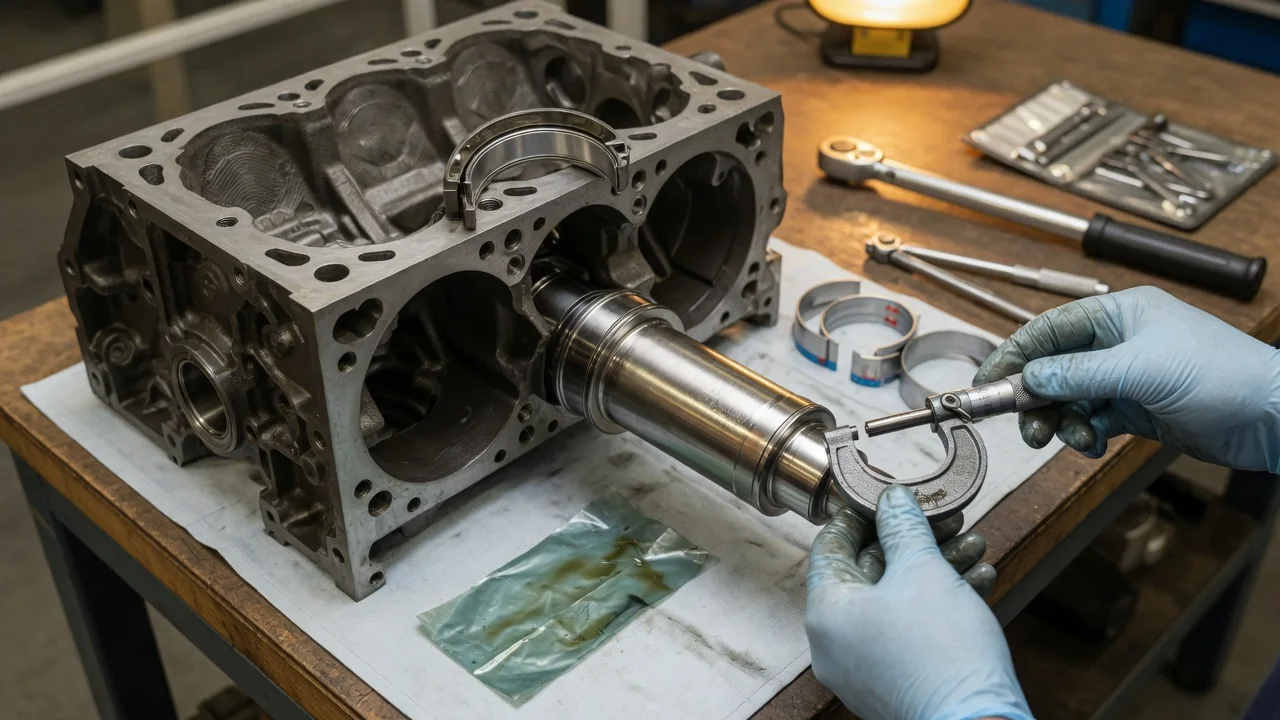
Bearing clearance in an engine is the small, deliberate gap between a rotating journal, such as a crankshaft main or connecting rod journal, and the bearing shell that surrounds it. That gap is not empty slack. It is the space the oil film occupies, and the film is what actually carries the load. Understanding the engine bearing clearance meaning helps explain oil pressure, bearing wear, and why rebuild specifications are so precise.
Oil film space
Plain bearings in most automotive engines rely on hydrodynamic lubrication. When the crankshaft turns, the journal drags oil into the clearance. Because the journal sits slightly off center under load, the gap becomes wedge-shaped, narrower on the loaded side and wider opposite. Oil pulled into the converging part of that wedge builds pressure, and that pressure keeps the journal from touching the bearing during normal running. The oil pump supplies oil to the bearing, but the film pressure that supports the load is generated mainly by rotation, which is why pressure in the loaded zone can be far higher than the reading on an oil pressure gauge.
Clearance sets the conditions for that film. If the gap is too small, there is little room for oil to flow through, so less heat is carried away and the film can thin out under high temperature or load. Thermal expansion, slight housing distortion, and small particles also have less room to be accommodated. If the gap is too large, oil escapes from the bearing edges more easily, the wedge is less effective at building pressure, and more flow is needed to keep the system pressurized. The right clearance balances load capacity, oil flow, cooling, and tolerance for real-world imperfections, and the engine designer chooses it together with the specified oil viscosity.
It also helps to separate terms. Oil clearance, sometimes called running clearance, is the difference between the installed bearing's inside diameter and the journal's outside diameter. Connecting rod side clearance and crankshaft end play are separate measurements that control axial movement. When people ask what bearing clearance is in an engine, they usually mean oil clearance, and this article uses the term that way.
Wear
Most bearing wear does not happen while a full film is established. It happens when the film is thin or absent: during cold starts before oil reaches the bearings, during brief oil starvation, under heavy load at low engine speed, or when oil is diluted, overheated, or contaminated. In those moments the journal and bearing surface can touch, and the soft outer layers of the bearing wear away. Engine bearings are typically built in layers, with a steel back for strength and softer lining and overlay materials on the surface. The soft surface is meant to conform to small misalignment and to embed small particles so they do not score the harder crankshaft.
As the bearing surface and, to a lesser degree, the journal wear, clearance grows. More clearance lets more oil leak out of the bearing, which can lower oil pressure, especially at hot idle when oil is thinnest. A larger gap also allows the journal more movement within the bearing, and repeated impact under combustion loads can produce knocking and accelerate fatigue of the bearing material. Wear is rarely uniform: debris can score grooves, a restricted oil passage can starve one bearing, and an out-of-round or tapered journal creates clearance that varies around the circumference or along its length.
Clearance that is too tight fails differently. With little room for oil and heat, the bearing can run hot, the overlay can smear or wipe, and in severe cases the bearing can seize to the journal or spin in its housing. That is why both ends of the specified range matter, not just the maximum.
Measurement
Oil clearance cannot be checked from outside a running engine; the bearing caps have to come off. The most precise method uses measuring instruments. A micrometer measures the journal diameter at several points to check for taper and out-of-round. The bearing shells are installed in their housing, the cap is tightened to its specified torque, and a dial bore gauge or inside micrometer measures the installed bearing diameter. Subtracting the journal diameter from the bearing diameter gives the clearance. Readings are taken in defined orientations because many bearing shells are slightly thicker at the center than near the parting line, so the gap is not perfectly uniform by design.
A common alternative is plastic gauging thread, often known by the trade name Plastigage. A short strip is laid across the clean, dry journal, the cap is installed and torqued without rotating the crankshaft, then removed. The strip flattens to a width that corresponds to the gap, and that width is compared with a printed scale. It is useful for verifying assembly, but it reads only one location, depends on cleanliness and correct torque, and is less precise than a bore gauge and micrometer. Either way, results are compared with the range in the service manual for that specific engine, since acceptable values differ between designs and are expressed in thousandths of an inch or hundredths of a millimeter.
Practical implications and limits
For an owner, the clearance itself is invisible, but its effects show up indirectly. A gradual drop in hot idle oil pressure, a deep knock that changes with load, or metallic particles in the oil or filter can point toward bearing problems. None of these signs alone proves excessive clearance. Low pressure can also come from a worn pump, a faulty sender, the wrong oil, or fuel dilution, and noises can come from other components. Oil analysis can show wear metals trending upward, but it cannot give a clearance figure.
Maintenance choices matter because they protect the film the clearance is designed around. Using the oil viscosity and specification the manufacturer lists, changing oil and filter at appropriate intervals, avoiding heavy load before the engine is warm, and addressing coolant or fuel contamination all help keep the gap filled with healthy oil. Switching to a much thicker oil to quiet a worn bottom end may raise the gauge reading, but it does not restore the original geometry and can slow oil delivery when cold.
During a rebuild, clearance is restored by replacing bearings and, when journals are worn beyond limits, by machining the crankshaft and fitting undersize bearings matched to the new journal size. Builders sometimes select bearing shells to fine-tune the result within the factory range. The limit of general advice is clear: correct clearance, torque values, bearing selection, and oil specifications are engine-specific, and the service manual for that engine is the authority, not a rule of thumb.