What Is an Oil Film in an Engine? How It Separates Parts Under Load and Heat
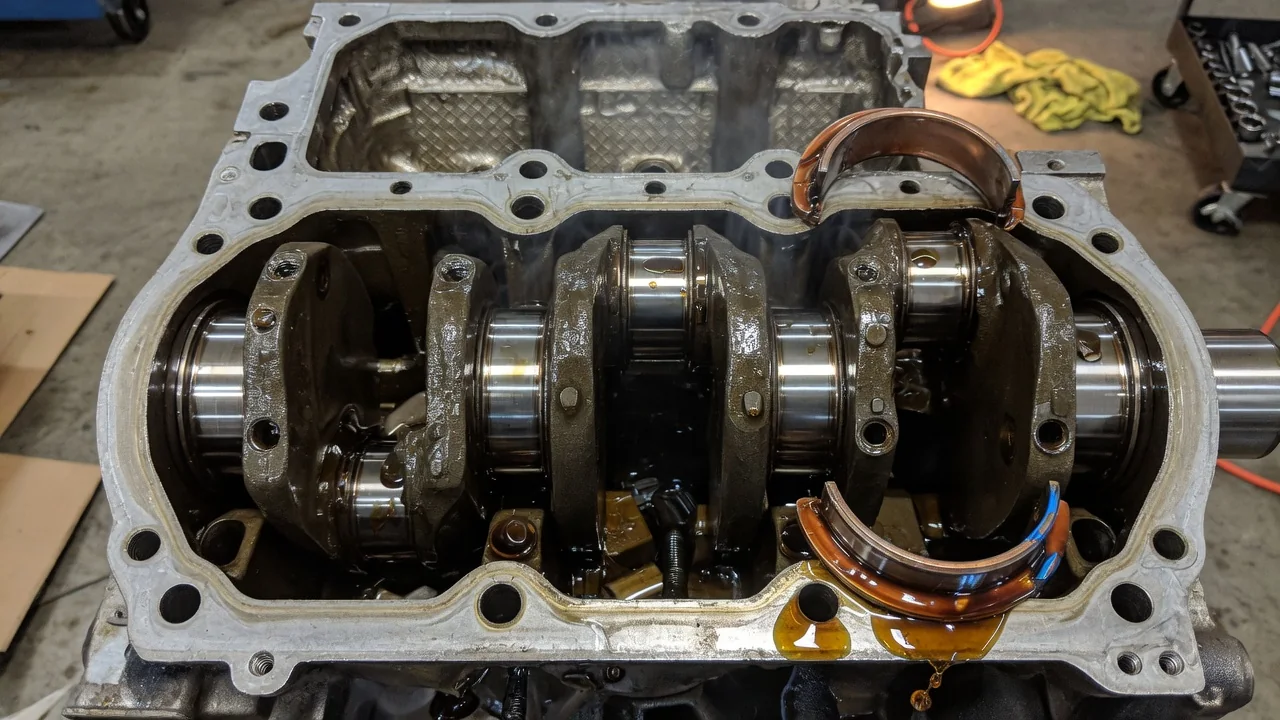
An oil film in an engine is the thin layer of lubricant between moving parts that keeps their metal surfaces from rubbing directly against each other. It is the core idea behind engine oil film lubrication: instead of metal sliding on metal, parts ride on a moving layer of oil. Whether that layer holds up depends on three things covered below: how well it separates the surfaces, how much load it must carry, and how hot it gets.
Surface separation: how the film keeps metal apart
No machined surface is perfectly smooth. Under magnification, crankshaft journals, cylinder walls, and cam lobes show tiny peaks and valleys called asperities. The job of the oil film is to be thicker than the height of those peaks so the surfaces never touch. When the film is thick enough, the only friction left is the internal friction of the oil itself as it shears. That friction is far lower than metal-to-metal contact and produces almost no wear.
In crankshaft main and connecting rod bearings, motion builds the film. The rotating journal sits slightly off-center in its bearing, which creates a narrowing, wedge-shaped gap. Rotation drags oil into that wedge, and because the oil cannot escape quickly enough, pressure builds and lifts the journal away from the bearing shell. This is called hydrodynamic lubrication. The oil pump supplies oil to the bearing, but the motion of the journal generates the pressure that carries the load.
Not every contact achieves a full film. Engineers describe three broad regimes. In full-film, or hydrodynamic, lubrication the surfaces are completely separated. In mixed lubrication the film carries most of the load, but some asperities touch. In boundary lubrication the film is too thin to separate the surfaces, so protection depends on chemical layers formed by oil additives, such as anti-wear compounds that react with metal surfaces to create a sacrificial layer. A related case, elastohydrodynamic lubrication, occurs in highly concentrated contacts like cam lobes on followers. There, contact pressure is high enough that the metal deforms slightly and the oil becomes momentarily much more viscous inside the contact, which lets an extremely thin film keep working.
Load: what the oil film has to carry
Most of the load on an oil film comes from combustion pressure pushing on the piston, which the connecting rod passes into the crankshaft bearings. Valve springs pressing followers against cam lobes add more. The inertia of the reciprocating parts adds further load that rises with engine speed. These forces are not steady. They change sharply through every combustion cycle, so the film is constantly squeezed and rebuilt.
Film thickness depends on a balance between load, sliding speed, and oil viscosity. Higher speed and higher viscosity tend to thicken the film, while higher load tends to thin it. This relationship is often shown on a Stribeck curve, which plots friction against these combined conditions and shows the transition from boundary to mixed to full-film lubrication. In practice, heavy load at low speed is a less favorable condition for the film than the same power delivered at a moderate speed. Accelerating hard at very low engine rpm is one example.
Oil also resists sudden loads through what is called a squeeze-film effect. When a load spike pushes surfaces together, the oil between them cannot be expelled instantly, so it briefly cushions the impact. Piston rings show the opposite weakness. At the top and bottom of each stroke the piston momentarily stops, so the motion that builds a hydrodynamic film disappears. The rings pass through mixed or boundary conditions at those points. This is one reason cylinder wear tends to concentrate near the top of ring travel, where combustion pressure and heat are also highest.
Temperature: how heat changes the oil film
Viscosity is the oil's resistance to flow. It drops as temperature rises, and it is one of the main factors that set film thickness. Multigrade oils are formulated so that their viscosity changes less with temperature than a single-grade oil would. In an SAE grade such as 5W-30, the number with the W describes cold-temperature performance, and the second number describes viscosity at normal operating temperature. Oil specifications also include a high-temperature, high-shear viscosity test, because bearing films work under heat and intense shear at the same time.
A cold start is a demanding moment for the film. Thick, cold oil takes longer to flow through the passages to the bearings and valvetrain. Meanwhile, some surfaces rely on the residual oil and additive layers left from the last run. Until oil pressure and flow are fully established, parts of the engine can operate in mixed or boundary conditions. That is why cold-start flow is a major focus of oil formulation.
At the other extreme, excessive heat thins the oil and speeds up oxidation, which degrades the oil over time and can leave deposits. Oil also helps cool the engine. Oil flowing through the bearings, and oil sprayed or splashed onto the undersides of the pistons, carries heat away. If oil temperatures run too high, the film becomes thinner precisely where loads and temperatures are already greatest.
Practical implications and limits
For owners, the most reliable way to support a healthy oil film is to use the viscosity grade and oil specification listed in the owner's manual. Bearing clearances, oil pump capacity, and valvetrain design are matched to that recommendation. A heavier oil is not automatically more protective. It can flow more slowly at startup and add friction, and some modern engines are designed specifically around lower-viscosity oils. Any deviation should follow the manufacturer's guidance, which sometimes lists alternative grades for extreme climates or severe service.
Oil condition matters as much as grade. Fuel dilution, coolant contamination, soot, and oxidation can lower viscosity or use up the additives that protect surfaces in boundary conditions. Follow the service intervals in the manual, including any severe-service schedule for short trips, towing, or dusty conditions. Doing so keeps the oil's ability to form a film closer to what the engine was designed for.
There are also limits to what an owner can observe. An oil pressure gauge or warning light reports supply pressure in the oil gallery, not the actual thickness of the film inside a bearing. Normal pressure does not prove that every contact is fully separated. A low-pressure warning, however, signals that the oil supply may be inadequate, and the engine should be stopped safely and checked. No oil or additive can restore a film where wear has already opened clearances beyond design limits. How any particular engine behaves also depends on its own design and condition.