How Do Gear Teeth Stay Lubricated? Oil Splash, Film Strength and Heat
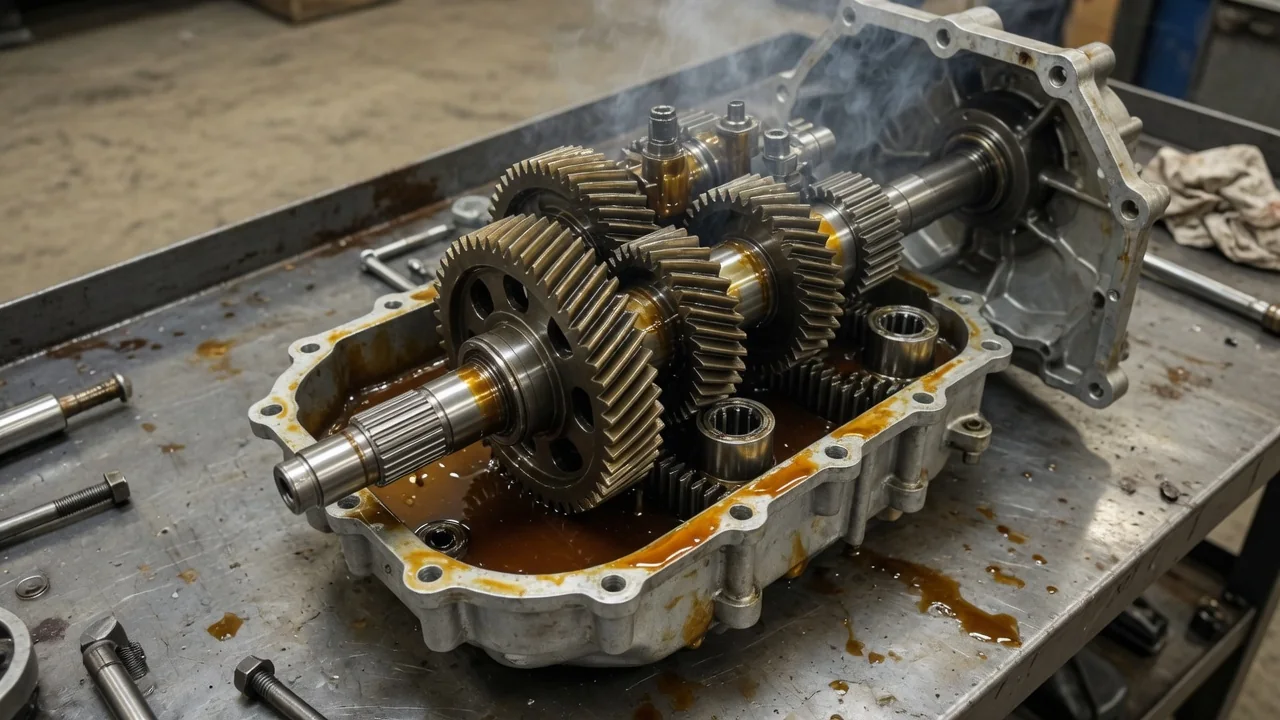
Gear teeth in a transmission, transfer case or differential press against each other under heavy load many times each second, yet in a healthy unit they rarely touch metal to metal. How gear teeth stay lubricated comes down to three linked ideas. Oil has to reach the mesh, survive the crushing pressure there, and stay within a workable temperature range. Here is how each part works.
Oil splash
Most manual transmissions, transfer cases and axle differentials rely largely on splash lubrication rather than a pressurized pump. The housing holds a pool of gear oil, and some of the rotating gears sit partly submerged in it. As they turn, their teeth carry oil up out of the pool and fling it around the inside of the case. Oil coats the mating gear at the mesh, runs down the walls, and drips onto shafts, bearings and synchronizers. In a differential, the large ring gear does much of this work. It picks up oil from the bottom of the housing and throws it toward the pinion and its bearings.
Designers use internal features to help splash do its job. In many housings, ribs, troughs, catch basins and drilled passages collect flung oil and channel it to bearings that would otherwise sit above the oil level. Some transmissions add a small pump, or hollow shafts with feed holes, to deliver oil to specific points. Conventional automatic transmissions use pump pressure throughout, but the basic goal of getting oil into the mesh is the same. These details vary widely by design, so the owner's or service manual is the reference for any particular unit.
Splash only works when the oil level is correct. If the level drops, fewer teeth dip into the pool and less oil reaches high-mounted bearings and gears. If the unit is overfilled, the gears churn through excess oil. That wastes energy, adds heat and can whip air into the fluid. The resulting foam lubricates poorly and may push oil out of vents or past seals.
Film strength
Getting oil to the teeth is only the first step. Where two teeth meet, the load is concentrated on a very narrow contact area, so local pressure is extremely high. Under these conditions, gear oil behaves differently than it does in the sump. Engineers call this elastohydrodynamic lubrication. The pressure briefly makes the oil far more viscous inside the contact, while the steel surfaces flex very slightly. Together, these effects let a film much thinner than a human hair keep the tooth surfaces separated as they roll and slide past each other.
Tooth motion is not uniform. Near the pitch line, the teeth mostly roll against each other. Toward the tips and roots, sliding increases, and sliding generates more friction and heat. Hypoid gears, common in rear-drive axles, have especially high sliding because the pinion sits offset from the ring gear's centerline. That sliding is a main reason axle oils typically need stronger protective chemistry than many other lubricants.
Sometimes heavy load, low speed or heat thins the film enough that microscopic surface peaks start to touch. At that point the oil relies on boundary protection. Extreme-pressure additives, often based on sulfur and phosphorus compounds, react with hot metal at the contact points. They form a sacrificial layer that shears away instead of letting the steel weld and tear. Base oil viscosity sets how thick the film can be, and additive chemistry covers the moments when that film is not enough. These additives can affect other materials, such as some synchronizer components or limited-slip clutch packs, so gear oils are formulated for specific applications and are not freely interchangeable.
Heat
Every gear set turns some of its input power into heat. Sliding friction at the mesh, oil churning and bearing drag all warm the lubricant. That heat leaves mainly through the metal housing into the surrounding air, which is why airflow under the vehicle and the surface area of the case matter. Some heavy-duty applications add external coolers, but many units rely on the housing alone.
Temperature changes how oil performs. As oil gets hotter, its viscosity drops, so the film at the mesh gets thinner and boundary contact becomes more likely. Sustained high temperatures also speed up oxidation, which darkens and thickens the oil, consumes additives and can leave varnish or sludge. Heat also ages rubber seals faster. Hardened seals are more likely to leak, and leaks eventually lower the oil level that splash lubrication depends on.
Cold creates the opposite problem. Thick oil flows and splashes more slowly, so less oil may reach distant bearings during the first moments of operation. In a manual transmission, shifts can also feel stiff until the fluid warms. Multigrade gear oils with a high viscosity index are designed to narrow this gap. They stay fluid enough when cold while keeping adequate thickness when hot.
Practical implications and limits
For owners, the most useful takeaway is that the specified lubricant is part of the design. Gear oil lubrication depends on matching the viscosity grade, the performance classification and any special requirements, such as limited-slip compatibility, to what the vehicle maker lists. An oil that is too thin, too thick or chemically wrong for the unit can affect shift feel, noise, wear and component life, even if the gears seem to work normally at first.
Driving conditions change how hard the oil works. Towing, carrying heavy loads, sustained high speed, hot climates and off-road use raise operating temperatures and stress the film. That is why many maintenance schedules list shorter service intervals for severe use. Checking for leaks around seals, vents and drain plugs is a simple way to protect the oil level that splash systems need. When the oil is drained, fine gray paste on a magnetic plug is often normal wear debris. Larger chips or flakes suggest a problem worth inspecting.
Lubrication also has limits. Fresh oil cannot restore pitted, chipped or worn teeth. It cannot correct improper gear setup or bearing preload, and it cannot silence a whine caused by mechanical damage. Aftermarket additives are not a substitute for the correct oil and may conflict with its chemistry. Persistent noise, grinding, a burnt smell or metal debris calls for an inspection, not just an oil change.