What Is Wheel Backspacing? Mounting Face, Clearance, and Measurement Explained
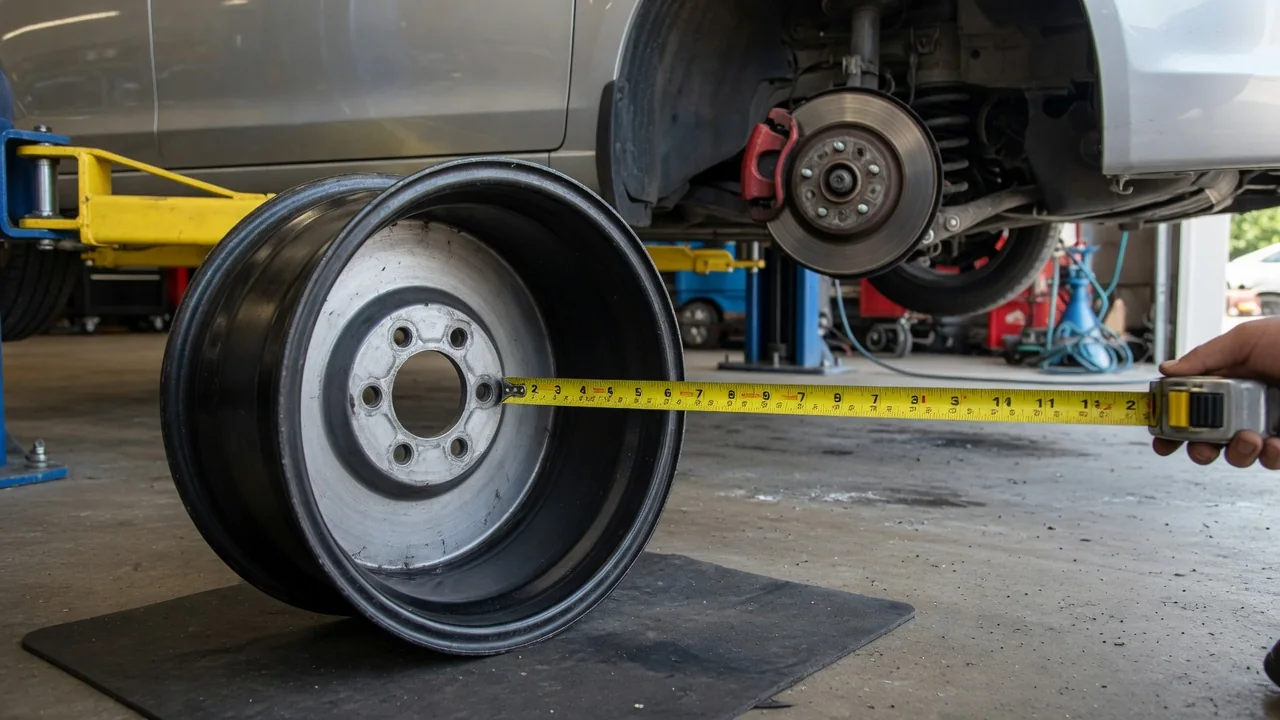
Wheel backspacing is the distance from a wheel's mounting face to its inner edge. It is one of the measurements that decides whether a wheel and tire fit inside the wheel well without touching suspension, brake, or body parts. If you have wondered what wheel backspacing means and why it is listed next to diameter and width, the answer comes down to where the wheel sits relative to the hub. This guide covers the mounting face, clearance, and how to measure backspacing yourself.
Mounting face
The mounting face, also called the mounting pad or hub face, is the flat surface on the back of the wheel's center section. It seats against the vehicle's hub or brake rotor when the lug nuts are tightened. Because this surface is clamped in a fixed position, it is the reference plane for the wheel's sideways position. Backspacing is measured from this plane straight back to the inboard lip of the rim, the edge closest to the vehicle's centerline once the wheel is installed.
Two related terms come from the same reference point. Frontspacing is the distance from the mounting face out to the outer lip. Offset is the distance from the wheel's centerline to the mounting face. Offset is positive when the mounting face sits outboard of the centerline and negative when it sits inboard. Backspacing plus frontspacing equals the wheel's overall width measured lip to lip. That overall width includes the rim flanges, so it is wider than the nominal rim width, which is measured between the bead seats where the tire sits. Two wheels with the same offset but different widths therefore have different backspacing.
Backspacing is useful because it describes directly how much wheel sits behind the hub. Offset tells you where the mounting face is relative to the middle of the wheel. To work out how far the wheel reaches inward from offset alone, you also need the wheel's width. Backspacing gives that inboard reach as a single number.
Clearance
The space behind the hub is shared with suspension arms, struts or shock absorbers, spring seats, steering linkage, sway bar links, brake lines, frame rails, and inner fender liners. More backspacing tucks the wheel further inward. That usually gives more room at the fender lip but less room toward the suspension and chassis. Less backspacing pushes the wheel outward, freeing up inboard space while bringing the tire closer to the fender opening. Which side runs out of room first depends on the vehicle's layout, so there is no universally correct backspacing value.
Clearance is not a static check. On front wheels, the tire sweeps around the steering axis as you turn, so the inboard edge can approach the frame, tie rods, or inner liner at full lock even if it clears easily when pointed straight. Suspension compression and body roll move the wheel up into the fender and change its angle, which can close gaps at the top and outer edge. Tires also matter. A mounted tire's sidewall usually bulges beyond the rim flange, so the tire often makes contact before the rim does. A backspacing figure measured at the rim lip is a starting point, not the full clearance picture.
Brake clearance is a separate question. Whether a wheel clears the caliper depends mainly on the barrel's inner diameter and on the shape of the spokes behind the mounting face. Some spoke designs curve inward toward the caliper. A wheel can have suitable backspacing for the suspension and still have spokes that touch the caliper body, so backspacing alone cannot confirm brake fit.
Measurement
To measure backspacing, remove the wheel from the vehicle. A bare wheel is easiest. If a tire is mounted, make sure your straightedge rests on the rim flange itself and not on the bulging sidewall. Place the wheel face down on a flat surface with the back side facing up. Lay a straightedge across the inboard lip so it spans the full diameter. Then measure straight down from the underside of the straightedge to the mounting face with a ruler or tape measure, keeping the ruler perpendicular to the straightedge. Take readings at more than one spot to confirm the straightedge is sitting evenly.
Measure to the surface that actually contacts the hub. Many cast and forged wheels have raised pads, recessed pockets, or a center bore lip on the back. Touching the wrong surface can throw off the reading. To derive the related figures, measure the overall width from outer flange edge to inner flange edge. Frontspacing equals overall width minus backspacing. Offset equals backspacing minus half the overall width. In the US, backspacing is commonly stated in inches while offset is usually given in millimeters, and one inch equals 25.4 millimeters. A positive result means the mounting face is outboard of the centerline.
You can estimate how much backspacing a vehicle can accept by working from the other direction. With the wheel removed, measure from the hub face inward to the nearest component the wheel or tire could reach. Then allow a margin for tire sidewall bulge, steering movement, and suspension travel. This gives an approximate upper limit for inboard reach. It should be confirmed with an actual test fit.
Practical implications and limits
Backspacing is one fitment dimension among several. A wheel must also match the vehicle's bolt pattern and center bore, suit the brake package, carry the required load rating, and work with the chosen tire size. Matching a known-good backspacing number does not guarantee fit if the diameter, width, spoke design, or tire changes. Published dimensions are also nominal. Tires of the same labeled size from different makers can differ in actual section width and sidewall shape, which moves the real contact points.
Wheel spacers and adapters reduce effective backspacing by their thickness. They can resolve an inboard interference, but they also change thread engagement and hardware requirements and must be installed with correctly specified components. Moving the wheel's mounting position also changes the leverage acting on wheel bearings, steering components, and the geometry known as scrub radius. That can affect steering feel and component wear. How much these effects matter depends on the suspension design, so the outcome is vehicle-specific rather than a general rule.
For a reliable result, start with the vehicle manufacturer's wheel specifications or the wheel maker's fitment information for your vehicle. Treat your own measurements as a cross-check. When possible, test-fit the wheel before the tire is mounted, then recheck with the tire at full steering lock in both directions and through suspension travel. A measured backspacing figure tells you where the wheel will sit. Only a test fit on the specific vehicle confirms that it will clear everything around it.