Why Do Exterior Plastic Parts Expand in Heat?
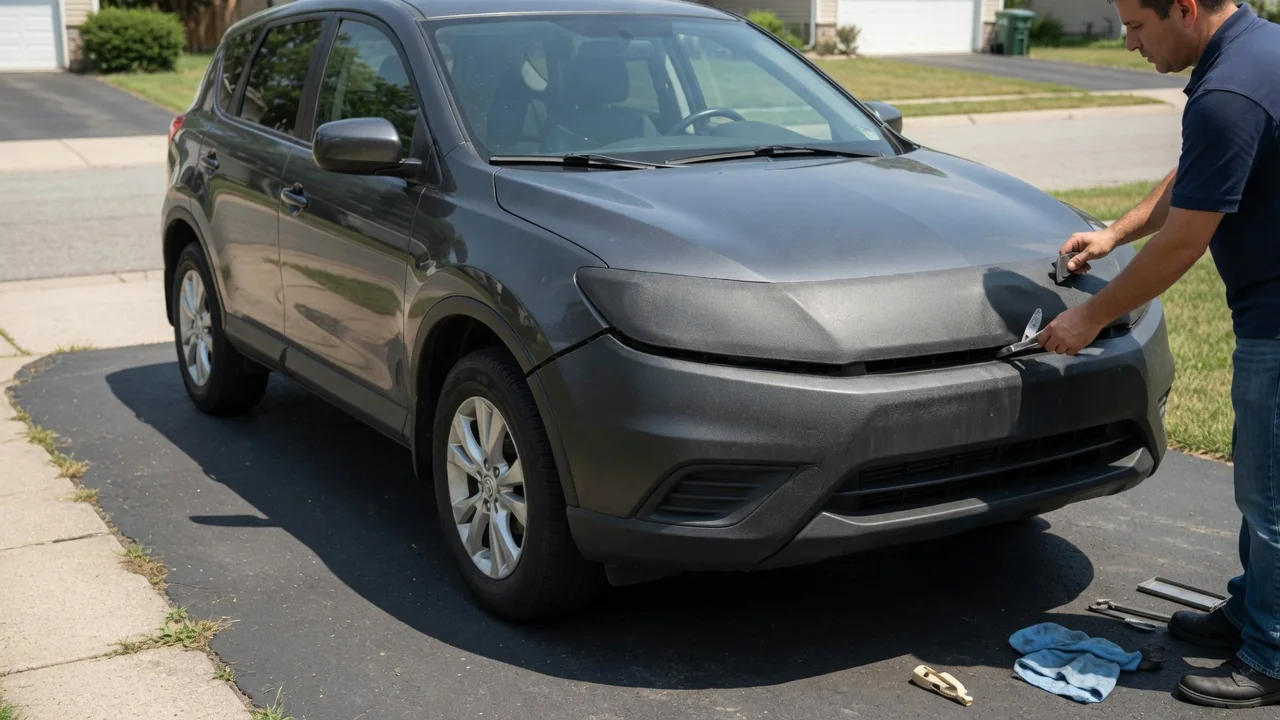
Bumper covers, mirror housings, grilles, and trim strips are usually made from polymers rather than metal, and they respond to heat differently. On a hot day, or after hours parked in direct sun, these parts grow slightly larger. They shrink again as they cool. This is normal physics, not a defect. Understanding thermal expansion in car plastic explains why panel gaps can change through the day and why exterior parts are mounted the way they are.
Material response
All materials expand when heated because their molecules move more energetically and take up more space. In polymers, the effect is especially pronounced. Plastics are built from long molecular chains held together by relatively weak forces between the chains. Metals, by contrast, have a rigid, closely packed atomic structure. As temperature rises, polymer chains vibrate and move apart more easily, so the part grows in length, width, and thickness. A material's coefficient of thermal expansion describes how much it grows per degree. For most unreinforced plastics, this value is considerably higher than for steel or aluminum, often several times higher.
Exterior parts also get hotter than the surrounding air temperature suggests. The surface absorbs sunlight, and darker colors absorb more of it. Under the same conditions, a black bumper cover or trim piece can become noticeably hotter than a light-colored one. Parts near the engine, exhaust, or brakes also pick up heat from the vehicle itself. Plastics conduct heat poorly, so one face of a part can be warmer than the other. That temperature difference can cause uneven expansion and slight bowing rather than uniform growth.
Automotive polymers do not all behave the same way. Common exterior materials include polypropylene blends, ABS, polycarbonate blends, and various filled or reinforced compounds. Mineral fillers or glass fibers generally reduce expansion and increase stiffness, which is one reason manufacturers use different formulations for different parts. Heat also softens many plastics, so they become less stiff as temperature rises. A softer part is more likely to sag or flex under its own weight or under clip pressure, which adds to the effect of the size change itself.
Panel gaps
Panel gaps are the visible spaces between adjacent body parts, such as where a bumper cover meets a fender, headlamp, or quarter panel. When a plastic part sits next to a steel or aluminum panel, the two materials grow at different rates as temperature changes. Across a large component like a bumper fascia, even a small difference in expansion rate adds up to a visible change in size. A gap that looks even on a cool morning may narrow, widen, or shift slightly after the car has sat in hot sun.
The direction of the change depends on how the part is mounted. Suppose a bumper cover is anchored firmly at its center and free to move toward its ends. In that case, most of the growth shows up at the outer joints. If the part is held tightly at several points, the expansion has nowhere to go, and the part may bulge or ripple between fasteners instead. Total expansion scales with a part's length. As a result, long horizontal trim, roof rails, and wide fascia sections tend to move more than small parts.
Designers account for this when they set gap and flushness targets. Gaps are typically sized so that adjacent parts do not touch or bind at the hot end of the expected temperature range. They are also sized so they do not open too far at the cold end. For this reason, a joint between plastic and metal parts may be intentionally a little wider than a joint between two metal panels. Small daily or seasonal variation is generally expected. A gap that is clearly uneven at every temperature points to something other than thermal expansion.
Fit
Exterior plastic parts must be allowed to move, so the way they are attached matters as much as the material itself. Many parts use a combination of fixed locating points and floating attachments. A fixed point sets the part's position. Slotted holes, sliding clips, and flexible brackets let the rest of the part expand and contract without building up stress. This approach keeps the part aligned at its critical edges while letting it grow freely in less visible directions.
Fit problems tend to appear when this designed freedom of movement is lost. A broken or missing clip, or one replaced with a rigid fastener, can turn a floating point into a fixed one. The part may then buckle when it heats up. In the opposite case, a part that is not secured at its locating point may drift out of position after repeated expansion and contraction. Other causes include overtightened screws, brackets misaligned after a repair, and adhesive-backed trim applied to a poorly prepared surface. Any of these can interfere with normal thermal movement.
Heat can also interact with stresses already inside a molded part. Injection-molded plastics may retain some internal stress from manufacturing. Prolonged high temperatures can let such parts relax and settle into a slightly different shape over time. A part forced into place during installation may also gradually take on a permanent bend if it stays under strain while warm. These effects are separate from normal, reversible expansion, and they help explain why some fit issues remain even after the part cools.
Practical implications and limits
For owners, the most useful step is to judge panel fit under consistent conditions. Check gaps after the car has been parked in shade for a while. That gives a more reliable picture than comparing a sun-heated panel with one in shade. Some signs are generally consistent with ordinary thermal behavior rather than damage: slight movement, a minor creak from trim as it cools in the evening, or a gap that changes a little between seasons.
When replacing or reinstalling exterior plastic parts, follow the vehicle's service information for fastener types, clip locations, and tightening values. Doing so preserves the designed allowance for movement. Aftermarket parts may use different formulations than the original components, which can change how they respond to heat. A part that fits well at one temperature may not fit across the full range. Added heat sources, such as modified exhaust routing or accessories mounted close to plastic trim, can also push parts beyond the conditions they were designed for.
Thermal expansion does not explain every problem. It does not account for cracks, pronounced permanent warping, faded or chalky surfaces, or parts that have separated from their mounts. Those conditions usually come from impact damage, heat exposure beyond the material's tolerance, ultraviolet degradation, or failed fasteners. Exact expansion rates, temperature ratings, and gap tolerances vary by material, manufacturer, and model. Specific figures should come from the relevant service manual rather than general rules.