Why Do Engines Use Valve Springs?
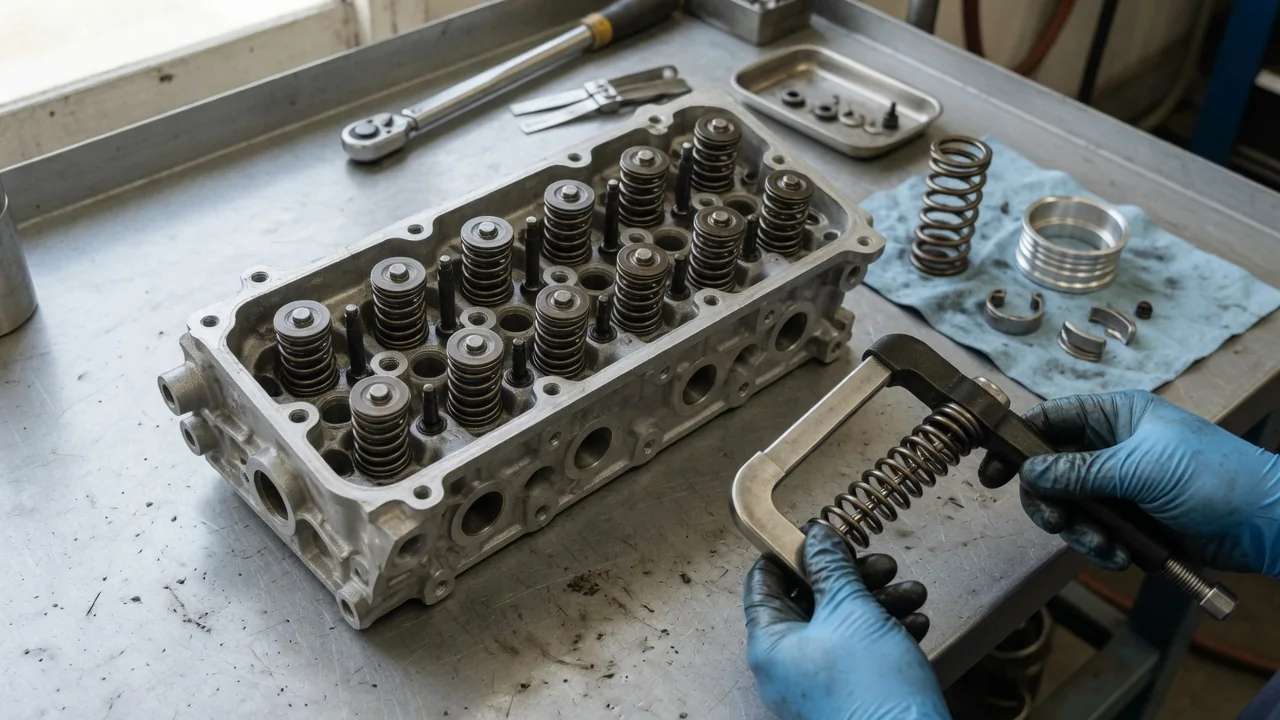
Most car engines open their intake and exhaust valves with a camshaft, but a cam lobe can only push. Something has to return each valve to its seat and hold it there, thousands of times per minute, without letting the moving parts lose contact. That job belongs to the valve spring. Understanding the engine valve spring purpose explains how an engine seals compression, how fast it can safely rev, and why tired or mismatched springs cause problems that are easy to misdiagnose.
Closing force
A typical poppet valve is a mushroom-shaped part that slides in a guide in the cylinder head. When the cam lobe rotates against a follower, tappet, or rocker arm, it pushes the valve open into the combustion chamber. Once the peak of the lobe passes, the cam profile falls away, but nothing in the cam itself pulls the valve back. The spring sits between the cylinder head and a retainer locked to the valve stem by small keepers. It stores energy as the valve opens and uses that energy to close the valve as the lobe recedes.
Closing the valve is only half of the task. When the valve is shut, the spring still applies a residual load, usually called seat pressure. That force holds the valve face firmly against its seat so the cylinder can contain compression and combustion pressure. A good seal matters for more than power. The seat is also one of the main paths for heat to leave the valve head, especially on the exhaust side, so firm and consistent contact helps the valve shed heat into the cylinder head and its cooling system.
Seat pressure also resists forces that try to unseat a closed valve. Pressure in a port acts on the back of the valve head, and when it exceeds the pressure inside the cylinder, it pushes the valve toward opening. The spring has to keep the valve closed under those conditions, which is one reason engines with forced induction or unusual exhaust conditions may need different spring characteristics than otherwise similar engines.
High-speed control
At low engine speed, the spring has an easy job. As rpm rises, the valve, retainer, keepers, part of the follower or rocker, and the spring's own moving coils must be accelerated and slowed far more quickly. The cam lobe is shaped so the valve accelerates open, then decelerates near peak lift and reverses direction. During the portion of the profile where the valvetrain must slow down and change direction, only the spring keeps the follower pressed against the lobe. If the inertia of the moving parts demands more force than the spring can supply, the follower separates from the cam.
That separation is called valve float. The valve no longer follows its designed lift curve, it may stay open longer than intended, and when contact returns it can strike the seat or the cam hard and bounce. Effects range from lost power and misfires at high rpm to bent valves or valve-to-piston contact in interference engines. Designers choose spring force, valvetrain mass, and cam profile together so float does not occur within the engine's intended operating range, and rev limiters help keep the engine inside that range.
The spring itself adds another high-speed challenge. A coil spring has natural frequencies, and when the rhythm of cam events excites one of them, waves travel through the coils, a behavior known as spring surge. During surge, the force delivered at the retainer can momentarily drop and coils can clash. Common countermeasures include nested dual springs, internal dampers, variable-pitch coils, and tapered beehive shapes that reduce moving mass near the retainer. Some racing engines use pneumatic or mechanical valve closing instead, but conventional coil springs remain the usual choice because they are compact, inexpensive, and dependable.
Wear
A valve spring is loaded and unloaded every time its valve opens, which adds up to an enormous number of cycles over an engine's life. Spring steel is selected and processed to tolerate this fatigue, but springs can gradually lose force, a change often described as relaxation or sagging. Heat contributes, because springs sit close to hot cylinder heads and exhaust valves. A relaxed spring provides less seat pressure and less high-rpm control, even if it looks normal.
Spring force also shapes how other valvetrain parts wear. Each spring presses the follower against the cam, so the contact between lobe and follower, along with rocker pivots, pushrod ends, and valve tips, carries loads that rise with spring force. Those contacts depend on adequate oil supply and suitable oil. Excessive force for a given design can accelerate cam and follower wear, while too little force allows float and bounce that hammer valve faces, seats, keepers, and retainers. The right force is a balance, not a maximum.
Springs can also fail outright. Fatigue cracks, corrosion, or manufacturing flaws can lead to a broken coil. Depending on the design, a broken spring may cause a persistent misfire, unusual valvetrain noise, or, in severe cases, allow the valve to drop into the cylinder. Worn or damaged keepers and retainers are closely related concerns, since they transfer spring force to the valve stem.
Practical implications and limits
For most owners, valve springs are not a scheduled maintenance item, and in many engines they serve for a long time under normal use. How long depends on the specific design, operating conditions, and history of the engine. One risk deserves attention: a rev limiter can cut fuel or spark, but it cannot stop the wheels from spinning the engine past its limit after a mistaken downshift in a manual transmission. That kind of mechanical overspeed can exceed what the springs were designed to control.
Weak springs often show up as power that fades or misfires that appear only near the top of the rev range, yet those symptoms overlap with ignition, fuel delivery, and sensor faults. Confirming a spring problem generally means measuring installed height and spring force at specified heights with proper tools, then comparing results with the service manual figures for that exact engine. General explanations cannot replace those engine-specific specifications.
Valvetrain changes should be treated as a system. A camshaft with more lift or a more aggressive profile can require springs with different force, travel, and coil-bind clearance, and stiffer springs may call for matching retainers, pushrods, or break-in procedures recommended by the component maker. Stiffer is not automatically better: unneeded force adds friction and wear without benefit in an engine that never approaches its float point. Matching parts to the intended use and following the engine maker's guidance is how valve springs deliver the sealing and control they exist to provide.