Why Do Some Engines Have Four Valves per Cylinder?
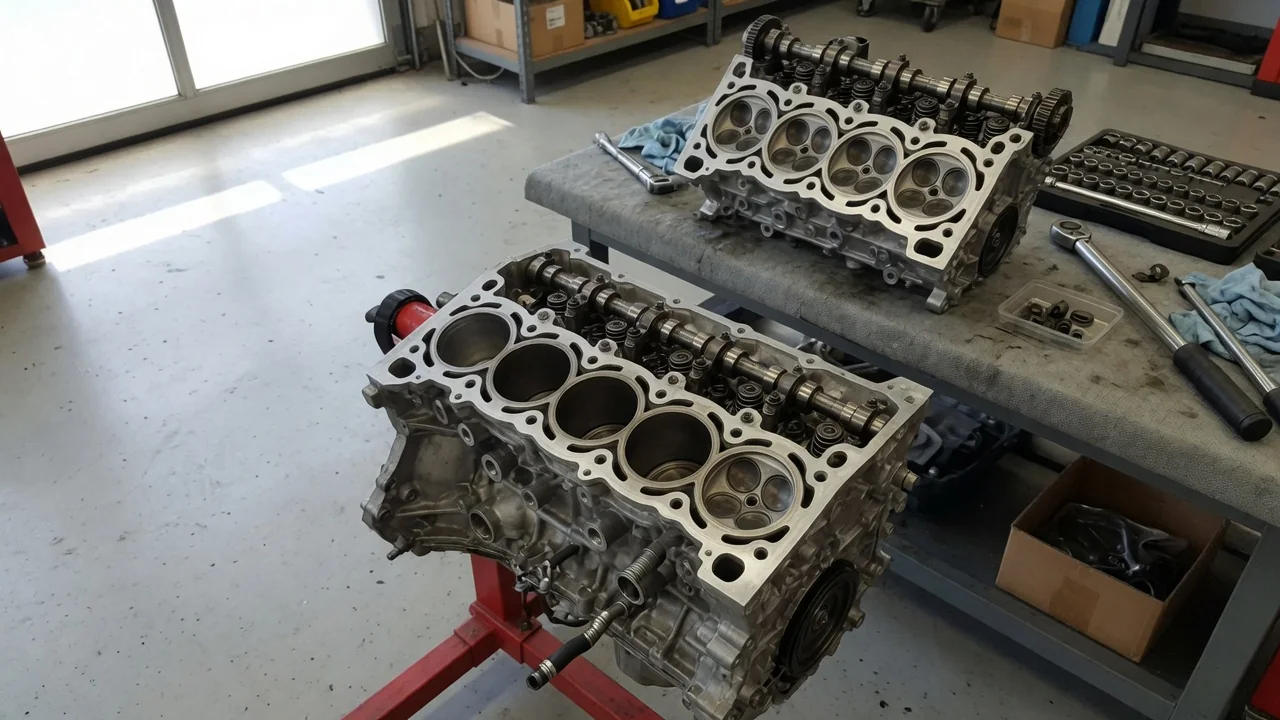
Many modern engine specifications list 16 valves for a four-cylinder engine, which means four valves per cylinder: two for intake and two for exhaust. This layout is an engineering choice, not just a marketing label. A four valve cylinder design changes how much air can move through the cylinder head, where the spark plug can sit, and how the mixture burns. It also adds parts and cost. Here is why some engines have four valves per cylinder and what the tradeoffs are.
Flow area
A piston engine works like an air pump. How much power it can make depends heavily on how much air and fuel it can draw into each cylinder and how completely it can push the exhaust out. The valves are the main restriction in that path. The cylinder bore limits how much room the combustion chamber roof has for valves. With only two valves, each one has to be as large as possible, and the gap needed between the valves and the cylinder wall limits how large they can be.
Splitting the intake side into two smaller valves uses the available space more effectively. What matters most is not just the area of the valve head but the curtain area: the circumference of the valve multiplied by how far it lifts off its seat. That ring-shaped gap is what the air actually flows through. Two smaller valves have more combined circumference than one large valve that fits in the same space, so at the same lift they open a larger total passage. In effect, a four-valve head can flow more air without needing extreme valve lift.
Smaller valves are also lighter. A lighter valve needs less spring force to follow the camshaft lobe accurately as engine speed rises, and it is less prone to valve float, a condition where the valve stops following the cam profile at high rpm. This is one reason multi-valve heads are associated with engines that keep breathing well at higher engine speeds. On the exhaust side, two valves give spent gases more room to leave the cylinder, and a smaller valve head has a shorter path for heat to travel to its seat and guide, where most of that heat is carried away.
Combustion
Placing four valves around the chamber leaves a natural spot for the spark plug in the center. In many two-valve designs the plug has to sit off to one side. A centrally located plug lets the flame spread outward over a shorter, more even distance to the cylinder walls. Faster, more uniform burning gives the unburned mixture at the edges of the chamber less time to ignite on its own, which is the mechanism behind engine knock. Better knock resistance can give engineers room to use a higher compression ratio or more ignition advance, which can improve efficiency and power when other design factors allow it.
Four-valve heads typically use a pent-roof combustion chamber, shaped like a shallow peaked roof with the intake valves on one slope and the exhaust valves on the other. This shape is compact, which reduces the surface area through which heat escapes into the head. The intake ports can also be shaped to make the incoming charge tumble, rolling end over end inside the cylinder. As the piston rises, that motion breaks down into turbulence that mixes air and fuel and helps the flame spread quickly.
Having two intake ports also gives designers another tool. Some engines shape the two ports differently or restrict flow through one of them at light load to strengthen charge motion when airflow is low, then let both flow freely at higher load. In direct-injection engines, the valve layout also affects where the fuel injector can be placed. How these features are used varies by engine, so the details depend on the specific design rather than on valve count alone.
Complexity
Doubling the valve count doubles many related parts: valves, springs, retainers, keepers, stem seals and the followers, rocker arms or lifters that transfer motion from the camshaft. Most four-valve engines use dual overhead camshafts, with one camshaft for the intake valves and one for the exhaust valves on each cylinder bank, although some designs operate all four valves from a single camshaft using forked rockers. Additional camshafts mean a longer timing chain or belt along with extra sprockets, guides and tensioners.
All of this adds manufacturing cost, machining time and weight, and it can make the cylinder head taller or wider. More moving contact points can add friction, although lighter components and low-friction followers help offset that. On engines with mechanical valve clearance adjustment, there are twice as many clearances to check, and reaching them often means removing the camshaft covers and sometimes the camshafts themselves. Engines with hydraulic lash adjusters avoid routine adjustment but depend on clean oil at proper pressure.
Designers have tried other counts. Three-valve layouts, usually two intake and one exhaust, exist, and so do five-valve heads. Beyond four, the gains tend to shrink because each valve becomes very small, space for the spark plug and cooling passages gets tight, and complexity keeps rising. That is why four valves per cylinder became such a common balance point. Two-valve engines remain in use where low cost, compact packaging or simpler service matter more than high-rpm airflow.
Practical implications and limits
Valve count alone does not tell you how an engine will perform. Displacement, port shape, camshaft profiles, variable valve timing, turbocharging, exhaust design and engine calibration all shape real-world power, torque and fuel economy. A carefully developed two-valve engine can be competitive with a less refined four-valve design, especially at low engine speeds. If you want to understand a particular engine, look at its published specifications and service information rather than judging it by the number of valves on its cover.
For ownership, the main practical effects show up in maintenance and repair. A longer cam drive with more tensioners and guides makes regular oil changes and the correct oil specification important, particularly on engines with hydraulic lifters or variable cam timing. If your engine uses a timing belt, follow the replacement interval in the owner's manual; whether a belt failure can damage the valves depends on the specific engine design. Valve clearance inspection intervals, where required, also vary by engine and should come from the manufacturer's schedule.
Major cylinder head work generally involves more labor on a multi-valve engine because there are more parts to remove, inspect, reseat and reassemble. That does not make four-valve engines inherently less durable, but it does mean repair estimates can differ from those for simpler designs. Understanding why the extra valves are there helps put those costs in context: they are the price of better breathing and more efficient combustion in a compact package.