Why Do Engines Have Intake and Exhaust Valves?
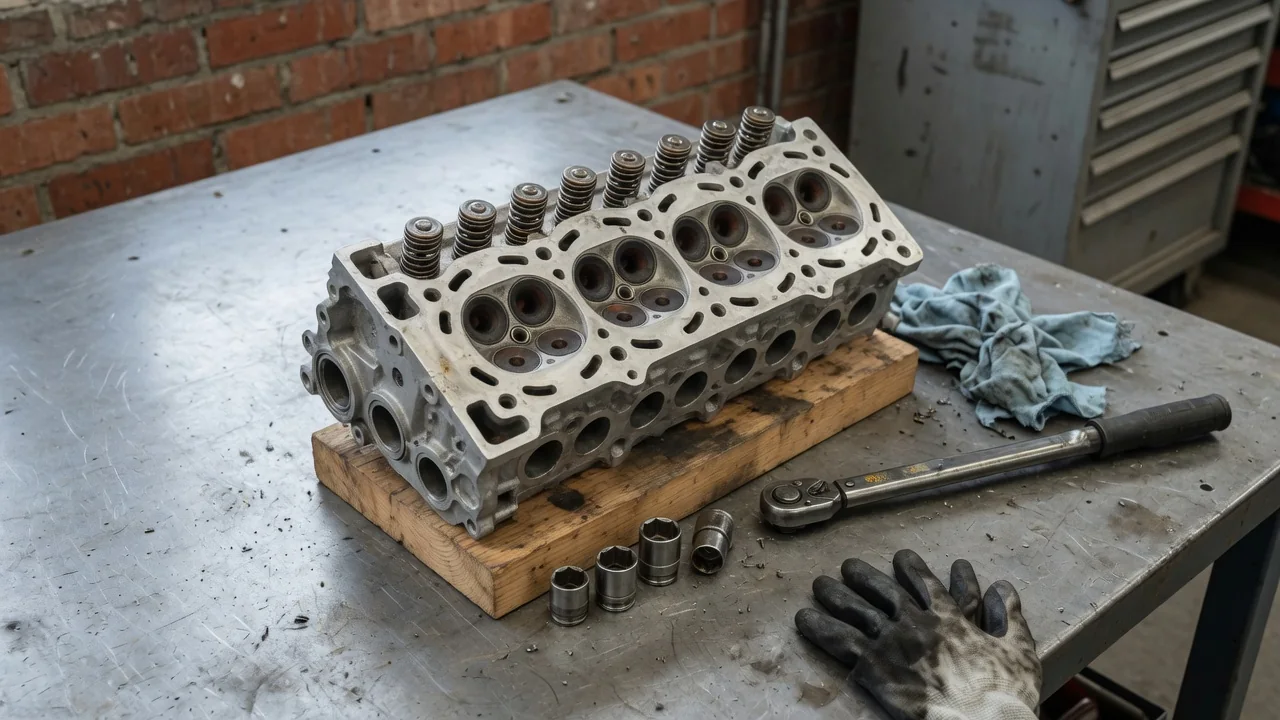
An internal combustion engine works like an air pump that burns fuel along the way. To make power, each cylinder must take in a fresh charge, seal it for compression and combustion, and then push the spent gases out before the cycle repeats. Intake and exhaust valves are the doors that make this possible. Their roles explain why engines use separate valves for each job, why those valves open at specific moments, and why their condition matters.
Air entry: how intake valves let the cylinder breathe
In a four-stroke engine, the intake stroke begins as the piston moves down from top dead center. That downward motion lowers pressure in the cylinder, and the open intake valve lets air flow in from the intake manifold. In port-injected and carbureted engines, that incoming charge already contains fuel. In direct-injected gasoline engines and diesels, the intake valve admits air only, and fuel is sprayed straight into the cylinder. Turbocharged and supercharged engines push air in under pressure, but the intake valve still controls when the passage is open.
A valve is needed instead of a permanently open hole because the cylinder must be sealed during compression and combustion. Most car engines use poppet valves, which are mushroom-shaped parts that open by moving down into the cylinder and close against a precisely machined seat in the cylinder head. Combustion pressure pushes the valve head against its seat, which helps it seal tightly at the moment sealing matters most. A valve spring returns each valve to its closed position after the camshaft lobe has passed.
Intake valves are often larger in diameter than exhaust valves in the same cylinder head. The general reason is that incoming air is moved by a relatively small pressure difference, while exhaust gas leaves under substantial pressure. Giving the intake side more flow area helps the cylinder fill. Many modern engines use two intake valves per cylinder for the same purpose, although valve count and sizing vary from one engine design to another.
Gas exit: how exhaust valves clear the cylinder
After combustion drives the piston down on the power stroke, the cylinder is full of hot, spent gases. If they stayed there, little room would remain for a fresh charge, and the next combustion event would be weak. The exhaust valve opens near the end of the power stroke, and the rising piston on the exhaust stroke pushes the remaining gases out into the exhaust manifold or turbocharger and onward through the exhaust system.
Exhaust valves work in a harsher environment than intake valves. They are exposed to the hottest gases leaving the cylinder, and they do not get the cooling effect of incoming air. Heat leaves an exhaust valve mainly through contact with its seat and through the stem and guide into the cylinder head. For that reason, exhaust valves are commonly made from heat-resistant alloys, and some engines use hollow, sodium-filled stems to carry heat away from the valve head. The specific materials depend on the engine.
A single shared opening would have to switch between cool incoming air and hot outgoing gas every cycle. That would heat the incoming charge, reducing its density, and would force one passage to serve two very different flow jobs. Separate intake and exhaust paths let engineers shape each port for its own task, keep hot exhaust away from the intake side, and control each valve independently.
Timing: why valves must open and close at the right moment
Valves are driven by one or more camshafts, which are linked to the crankshaft by a timing belt, chain, or gears. In a four-stroke engine, the camshaft turns at half crankshaft speed, so each valve opens once for every two crankshaft revolutions. The shape of each cam lobe determines when the valve opens, how far it lifts, and how long it stays open. Depending on the design, the cam acts on the valve directly through a follower or indirectly through rocker arms or pushrods.
Valve events are not neatly aligned with piston position. Intake valves typically close after bottom dead center, using the momentum of the moving air to pack a little more charge into the cylinder. Exhaust valves typically open before bottom dead center on the power stroke, giving high-pressure gas a head start out of the cylinder. Around top dead center between the exhaust and intake strokes, both valves are briefly open at the same time. This valve overlap lets outgoing exhaust help draw in the fresh charge. The exact amounts of early opening, late closing, and overlap are specific to each engine design.
Because ideal timing changes with engine speed and load, many modern engines use variable valve timing, which shifts camshaft phase relative to the crankshaft. Some systems also vary valve lift or duration. These systems differ widely between manufacturers and engines, so the service information for a particular engine is the authority on how its valvetrain behaves.
Practical implications and limits
Keeping valves synchronized with the pistons is mechanically critical. If a timing belt or chain skips teeth or breaks, valve events fall out of step with piston movement. In an interference engine, an open valve and a piston near top dead center can occupy the same space, so such a failure can bend valves or damage pistons. In a non-interference engine, the result may simply be that the engine stops running. Whether a specific engine is an interference design, and when its timing components should be inspected or replaced, should come from the owner's manual or service documentation rather than general rules.
Valve problems often appear as drivability symptoms. A valve that does not seal fully, because of a burned edge, deposits on the seat, or incorrect clearance, lets compression escape and can contribute to misfires, rough idle, or reduced power. Some engines require periodic valve clearance adjustment, while engines with hydraulic lifters adjust automatically. A ticking or tapping noise from the top of the engine can point to clearance or lubrication issues. Direct-injected gasoline engines can build up carbon on the backs of intake valves because fuel no longer washes over them. Compression and leak-down tests are common ways to narrow down whether a sealing problem involves the valves.
This explanation covers conventional four-stroke piston engines. Many two-stroke engines rely on ports in the cylinder wall for at least part of their gas exchange, and rotary engines use ports instead of poppet valves. Symptoms such as misfires or engine noise also have many possible causes beyond the valvetrain. Treat this as background knowledge, and rely on the specific engine's service information for specifications, procedures, and diagnosis.