What Happens Inside an Engine Cylinder?
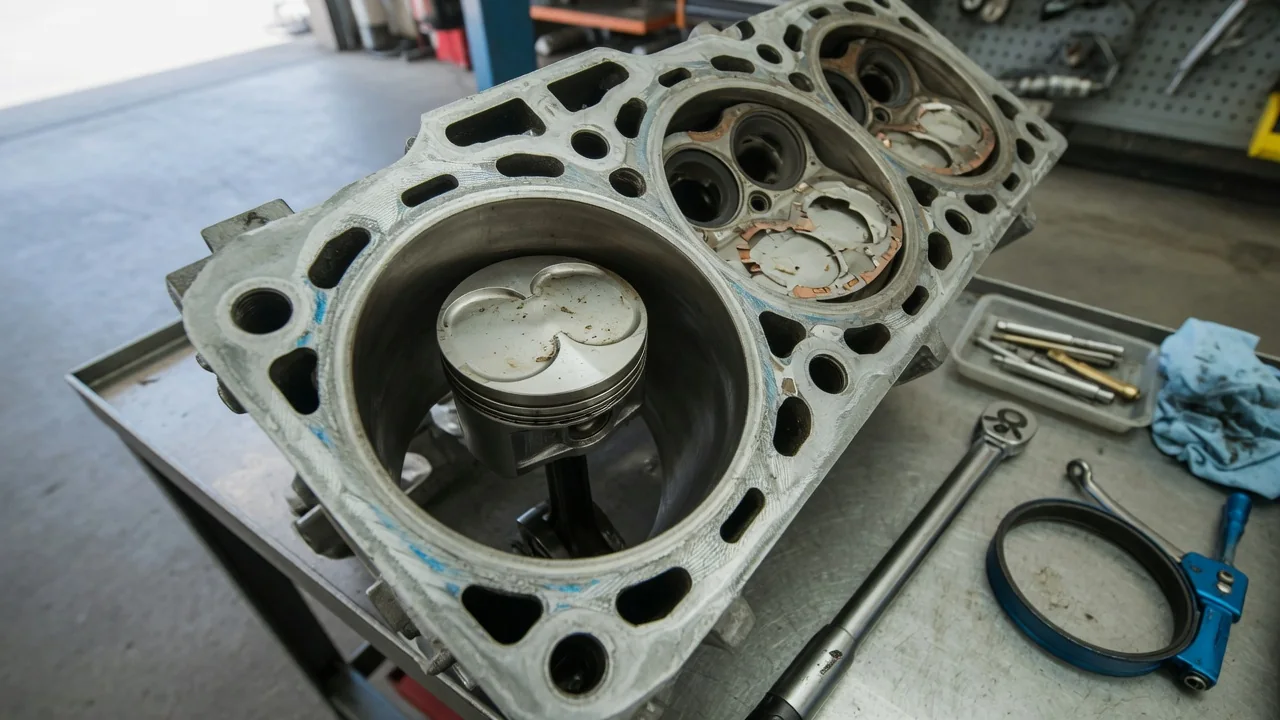
Anyone curious about what happens inside an engine cylinder is really asking how fuel becomes motion. Inside each sealed bore, a piston travels up and down while air and fuel are drawn in, squeezed, burned and pushed out. That repeating cycle, completed many times every second, is what turns a tank of gasoline into the force that moves a car down the road.
Four strokes
Most car engines run on a four-stroke cycle, meaning the piston makes four trips along the cylinder for every burst of power. On the intake stroke, the piston moves down and the intake valve opens, so fresh air fills the growing space. In many gasoline engines fuel is mixed with that air in the intake port, while direct-injection designs spray it straight into the cylinder. The compression stroke follows, with both valves closed and the piston rising to squeeze the charge into a small volume near the top.
Compressing the mixture raises its pressure and temperature, which makes the burn that follows far more forceful. Near the top of the stroke, a spark plug ignites the charge in a gasoline engine, and the expanding hot gas drives the piston down on the combustion, or power, stroke. A diesel works differently, using the heat of very high compression to ignite fuel as it is injected. Finally, the exhaust valve opens and the rising piston pushes the spent gases out, clearing the cylinder for the next intake.
Moving parts
The piston is the central moving part, a close-fitting metal plug that slides inside the cylinder bore. Rings seated in grooves around it press against the cylinder wall, sealing combustion pressure above and controlling the thin film of oil that lubricates the wall below. A connecting rod links the piston to the crankshaft, and that joint is what lets straight-line travel become rotation. Above the piston, the cylinder head closes the top of the chamber and houses the valves and, in gasoline engines, the spark plug.
Intake and exhaust valves open and close at precisely timed moments, driven by a camshaft that is linked to the crankshaft through a belt, chain or gears. Springs snap each valve shut so the chamber seals during compression and combustion. The number of valves per cylinder, the position of the camshaft and whether valve timing can be adjusted while running all vary by engine design. An owner will not see these parts in normal use, but they sit beneath the valve cover on top of the engine.
Power transfer
Only one of the four strokes actually produces power, so the engine depends on stored momentum to carry it through the other three. When burning gas pushes the piston down, the connecting rod turns the offset journal of the crankshaft, much as a leg pushes a bicycle pedal. A heavy flywheel on the end of the crankshaft keeps things spinning between power strokes. Because the cylinders fire in a staggered order, their pushes overlap, which is why an engine with more cylinders generally feels smoother.
From the crankshaft, rotation passes through the clutch or torque converter into the transmission, then on to the driveshafts and wheels. The same crankshaft also runs the camshaft, oil pump and belt-driven accessories such as the alternator, so part of each power stroke goes to keeping the engine itself working. A good deal of combustion energy never reaches the wheels at all, leaving as heat through the cooling system and exhaust. That is why the radiator and tailpipe get so hot even during gentle driving.
Everyday Use and Observations
Drivers experience the cylinder cycle indirectly. Pressing the accelerator admits more air, the engine control unit adds matching fuel, and each power stroke becomes stronger, which is felt as acceleration. The tachometer shows how fast the crankshaft is turning, and since each cylinder fires once every two revolutions, a higher reading means far more combustion events per second. The steady hum at idle is the sound of those events blending together, and the pulses can sometimes be felt at the tailpipe as rhythmic puffs.
When one cylinder stops doing its share, the change is usually noticeable. A rough or shaking idle, hesitation under load, a flashing or steady check engine light, unusual exhaust smoke or a drop in fuel economy can all point to a problem with combustion. These signs do not identify the cause by themselves, because a weak spark, a fuel delivery fault, an air leak or lost compression can produce similar symptoms. How obvious they feel also varies with engine size, cylinder count and how well the engine mounts isolate vibration.
Limits and Next Steps
This basic picture has limits. Turbocharged engines force extra air into the cylinder, hybrids shut the engine off and restart it frequently, and some engines deactivate cylinders under light load or alter valve timing to change how the strokes behave. Rotary engines and two-stroke designs do not follow the four-stroke pattern at all. Compression ratios, fuel requirements and ignition strategies differ widely, so the owner's manual and the manufacturer's service information remain the right references for any particular vehicle.
If a warning light appears, a stored fault code is a starting point for diagnosis rather than proof that a specific part has failed. A misfire code, for example, tells a technician which cylinder to investigate, not why it misbehaved, and some codes are manufacturer-specific and need vehicle-specific confirmation. Tests such as compression or leak-down checks reveal how well a cylinder seals, and they are best left to a qualified shop. Keeping up with oil changes and scheduled maintenance is the most practical way to protect what goes on inside each cylinder.