What Is Valve Float? Spring Control, Engine Speed and Damage Risk
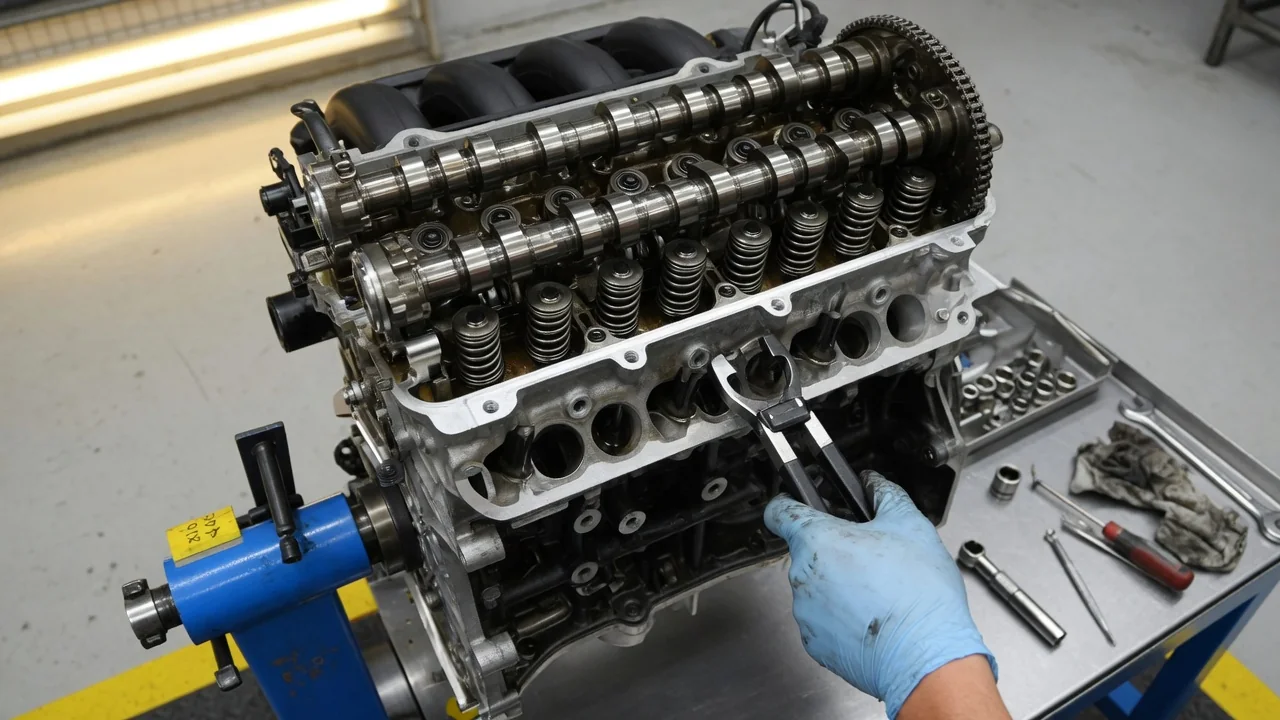
Valve float is a condition in which an engine's valves stop following the shape of the camshaft lobes, usually at high engine speed. A floating valve does not close on time and stay seated. It lags behind the cam, hovers off its seat, or bounces after closing. For an ordinary engine, valve float marks the point where the valve springs can no longer control the parts they are responsible for.
Spring control: what keeps a valve on the cam
In a conventional poppet-valve engine, the camshaft opens the valve but the spring closes it. As the cam lobe rises, it pushes on a follower, which may be a bucket tappet, a roller finger follower, or a lifter, pushrod and rocker arm, depending on the design. That opens the valve against spring pressure. On the closing side, the lobe profile drops away, and only the spring returns the valve to its seat and keeps every component pressed against the lobe. As long as the spring force is greater than the force needed to slow and reverse the moving parts, everything stays in contact and the valve follows the lift curve the engineers designed.
Float begins when that balance is lost. The valve, retainer, keepers, part of the spring itself, and any lifter, pushrod or rocker all have mass. Near maximum lift, the cam profile asks these parts to decelerate and change direction. If their inertia carries them farther than the lobe, they separate from it. On the closing ramp, a valve that is not fully controlled can strike its seat too hard and rebound open, a closely related problem usually called valve bounce. Springs add another complication. A coil spring has its own natural frequency, and at certain speeds the coils can oscillate, an effect called spring surge, which momentarily reduces the force on the retainer. Designers counter this with dual springs, damper coils, beehive or conical springs, variable-pitch coils, and lighter retainers and valves.
Engines with hydraulic lifters can show a further variation. When the lifter briefly loses contact with the cam, it can extend to take up the apparent gap, a behavior often called pump-up. Once extended, the lifter may hold the valve slightly open until it bleeds back down, which reduces compression and power.
Engine speed and why valve float happens near redline
Valve float is tied to engine speed because inertial loads grow much faster than rpm. For a given cam profile, the acceleration of the valvetrain rises roughly with the square of engine speed. Doubling rpm therefore roughly quadruples the force needed to control the moving parts, while the spring delivers the same force at a given lift no matter how fast the engine turns. Every spring-closed valvetrain has a speed above which the springs can no longer keep up. Manufacturers choose spring rates, cam profiles and component weights so that this point sits above the engine's intended operating range, with some margin.
Modern engines use an electronic rev limiter that cuts fuel or spark to keep the engine out of that region under power. The limiter has an important blind spot. If a driver selects too low a gear in a manual transmission, the wheels drive the engine through the drivetrain, and engine speed can exceed the limit regardless of what the engine computer does. This is often called a mechanical over-rev, and it is a common way for valve float to occur in otherwise healthy engines.
The float threshold is also not fixed for the life of an engine. Springs lose some force with age and heat, heavier aftermarket valves add mass, and more aggressive cam profiles raise accelerations. Any of these can lower the speed at which control is lost. Simply fitting much stiffer springs is not a free fix either, since higher spring force increases friction, raises loads on the cam and followers, and can speed up wear.
Damage risk from floating and bouncing valves
Mild, brief float mainly costs performance. When the valves no longer open and close on schedule, cylinder filling and sealing suffer. The engine may feel like it runs out of breath near the top of its range, run rough, or misfire. In this stage the effect is a loss of control rather than immediate breakage, but it is a warning that the valvetrain is operating beyond its intended limits.
Severe or repeated float can cause serious damage. In an interference engine, where the valves and pistons occupy some of the same space at different times, a valve that stays open too long can be struck by the rising piston. The result can be bent valves, damaged pistons and broken valve guides. Valve bounce hammers the valve faces and seats, which can damage sealing surfaces, stretch or crack valve stems, and in extreme cases release keepers so that a valve drops into the cylinder. Pushrod engines can also suffer bent pushrods or rockers that are knocked out of position. Even when nothing breaks outright, repeated float accelerates wear on cam lobes, followers and springs. Weakened springs then make float more likely at lower speeds, so the problem can feed itself. Non-interference engines avoid piston-to-valve contact by design, but they are still exposed to seat, valve and spring damage.
Practical implications and limits
For a stock engine that is maintained and driven within its rev limit, valve float is generally not an everyday concern, because the manufacturer's design accounts for it. The risk rises in specific situations. These include missed downshifts, tuning that raises the rev limit, camshaft changes made without matching springs, very high-mileage engines with tired springs, and engines that have suffered severe overheating, which can relax spring tension.
The symptoms are not unique to float. A loss of power near redline, misfire codes or stumbling at high rpm can also come from ignition, fueling or sensor problems. Confirming weak springs usually requires disassembly and measuring installed height and spring pressure against the figures in the service manual for that engine. After a known over-rev, a compression or leak-down test can help reveal bent valves or poor sealing. Safe engine speeds and spring specifications differ widely between engines, so general rules cannot replace the manufacturer's data for a particular vehicle.
Anyone upgrading a camshaft or raising engine speed should treat the springs as part of the same package. That means following the cam manufacturer's spring recommendations and checking clearances such as coil bind and retainer-to-guide clearance during assembly. A small number of specialized engines avoid spring-related float with other closing methods, such as desmodromic mechanisms that close the valve mechanically or pneumatic valve springs used in some racing engines, but these are uncommon in everyday road cars.