What Is a Fireball Extinguisher? How Fire Extinguisher Balls Work and Where They Fit in a Car Fire
The Short Answer
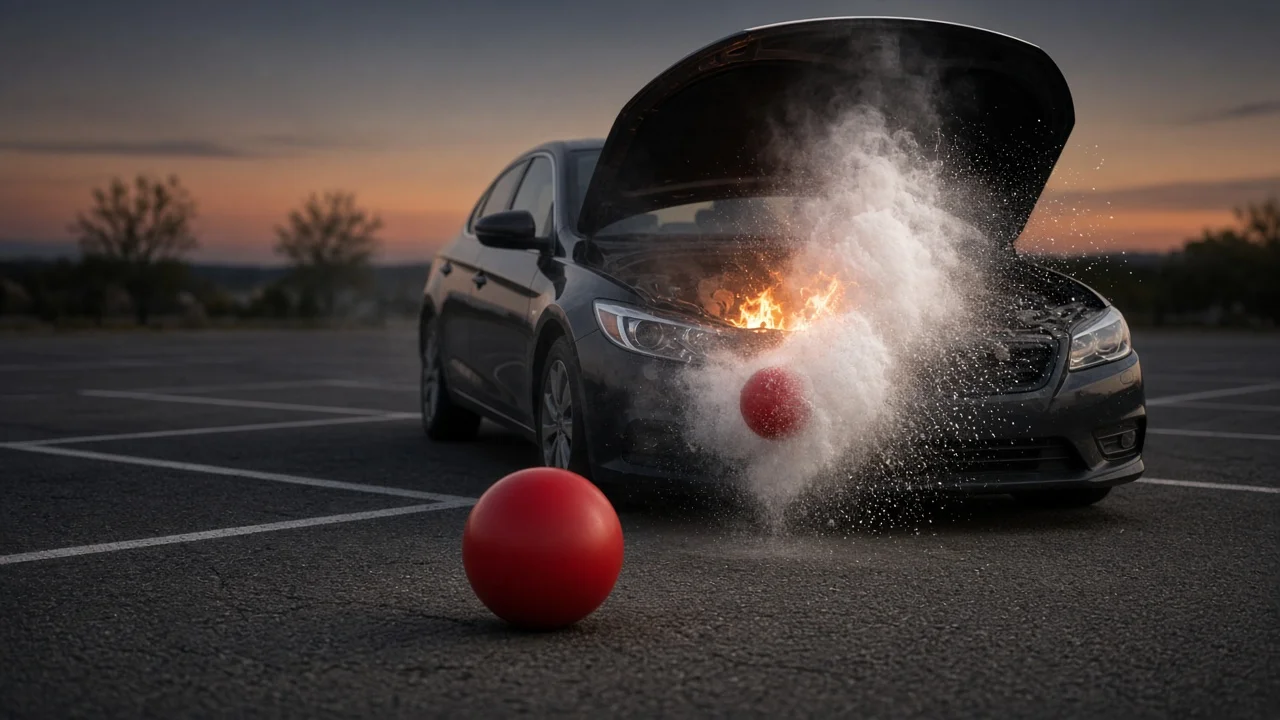
A fireball extinguisher, usually sold as a fire extinguisher ball, is a sphere filled with fire-suppressing dry chemical powder. It sits inside a thin outer shell that has a heat-sensitive trigger. When flame reaches the ball, the trigger activates, the shell bursts, and the powder spreads over the immediate area. You can throw it into a fire or mount it near a likely ignition point so it works without anyone present.
This matters for vehicles because a fire ball is a passive, single-use device. It does not replace a conventional handheld extinguisher, and it is not suitable for every type of car fire. The term "fireball" is used both as a general description and in product names, so construction, powder type, coverage and certification vary by manufacturer. Check each claim against the specific product's documentation.
How a Fire Extinguisher Ball Works
The working principle has three parts: a heat-triggered release, a short burst, and dry chemical suppression.
Activation: A fuse or heat-sensitive element on the shell reacts to direct flame. Nothing needs to be pulled, aimed or squeezed. Release: Once triggered, the shell breaks apart with a loud report and scatters the powder around the ball. It does not produce a directed stream. Suppression: Dry chemical agents interrupt the chemical reaction of combustion and coat the burning material. Many products use a multipurpose, ammonium-phosphate-based powder of the kind found in common ABC extinguishers, but formulations differ by brand.
In practice, the ball only works where the flame actually reaches it, or where it lands when thrown. It has no means of reaching a fire behind panels, under a hood or beneath the vehicle unless it is already sitting in that space or is thrown directly into it.
How It Differs From a Conventional Handheld Extinguisher
Feature | Fire extinguisher ball | Handheld portable extinguisher; Operation | Activates automatically from flame contact or when thrown into fire | Operator pulls the pin, aims at the base of the fire and squeezes the handle; Control | No aiming or stopping once triggered | Discharge can be directed and applied in bursts; Reach | Limited to where the ball sits or lands | Stream can be aimed at a fire from a distance; Unattended protection | Yes, if mounted where flame will reach it | No, a person must operate it; Reuse | Single use | Can often be serviced and recharged, depending on the unit; Certification in the US | Varies by product; verify any listing claimed | Units are commonly listed and rated for specific fire classes
The table reflects general differences in how each device works. It does not compare test results. No verified performance data, coverage areas or listing details for specific fire ball products were available for this article.
Strengths
No training needed to activate it, which may help users who would hesitate with a handheld unit. Can protect an unattended space, such as a garage, trailer, workshop or storage compartment, if mounted where a fire is likely to start. Compact and simple, with no pressure gauge or hose. Lets a user act from a distance by throwing it rather than standing next to the flames.
Limitations in Vehicle Fires
Hidden fires: Engine-bay fires often burn under a closed hood, and opening the hood can feed the fire fresh air. A thrown ball cannot reach those areas without exposing the user to that risk. One shot: If the fire reignites or spreads beyond the burst area, the ball is spent. No control: Aim, timing and duration cannot be adjusted the way they can with a handheld extinguisher. Fuel fires: Leaking fuel can spread flames quickly over a wider area than a single burst may cover. High-voltage batteries: Hybrid and electric vehicle traction batteries can enter thermal runaway, a self-sustaining reaction inside the cells that small dry chemical devices are not designed to stop. These fires call for the fire department. Residue: Dry chemical powder leaves a fine deposit that can be corrosive to electrical connections and electronics. Professional cleanup is advisable afterward. Noise and unintended release: The burst is loud, and a mounted ball triggers whenever flame reaches it, whether or not anyone is nearby. Certification uncertainty: Listings and ratings differ by product. Buyers in the US should confirm what independent listing, if any, a specific ball carries before relying on it.
Where It Fits in a Vehicle Fire Response
Any extinguisher is secondary to getting people clear. Standard US guidance for a vehicle fire is to pull over safely, turn off the engine, get everyone out, move well away from the vehicle and upwind, and call 911. Do not return to the vehicle for belongings, and do not open the hood. Use a fire ball or handheld extinguisher only on a small, clearly visible fire, only from a safe distance, and only with a clear path to retreat. If the fire involves the fuel system, the high-voltage battery or the passenger compartment, or if it grows, leave it to firefighters.
Who It Suits
A fire extinguisher ball makes the most sense as an extra layer of protection for spaces that are often unattended, such as a garage, RV storage bay, trailer or workshop near vehicles. For carrying in the car itself, a properly rated handheld extinguisher, secured so it cannot roll around, is the more versatile primary tool because it can be aimed and controlled. Drivers of hybrids and electric vehicles should know that neither device is a remedy for a battery fire.
Gaps in the Available Evidence
No confirmed product specifications, independent test results, prices or certification records were available for this article. It therefore does not state activation times, coverage areas, weights, shelf life or ratings for any fire ball. Check those details in the product documentation and any listing it claims, and follow your vehicle manufacturer's emergency guidance, especially for electrified vehicles.